🌏 KOSPI +0.68% — the close that hid a 4.3% fall
Seoul gapped down on New York's chip rout, touched 6,408, and closed near its high. Today: reading a daily candle — and Vietnam's FTSE countdown.


Numbers compiled Tuesday, 25 August 2026, at 5:10 pm in Seoul (UTC+9). Seoul, Tokyo and Hong Kong closes are final; the Hong Kong row notes how we sourced it. Vietnam's close is fresh and labeled where provisional. Currency and bond rows are late-afternoon snapshots.
The KOSPI was down 4.3% at mid-morning and closed up 0.68% — and if that sentence sounds impossible, today's issue is for you. Overnight, New York sold its chip stocks hard — Nvidia fell a seventh straight session, its longest slump since 2022, on reports of AI-chip price increases exceeding 15%, and a memory-chip ETF lost 5.9% — and Asia's chip-heavy boards opened straight into that hole. What happened next is the part worth learning to read.
📊 The Dashboard — Tuesday, 25 August 2026
| Gauge | Level | Move | What this means |
|---|---|---|---|
| KOSPI (South Korea) | 6,742.74 | 🟢 ▲ +0.68% | Closed, settled — Google Finance, Investing.com's settled row and Yonhap agree. It opened 2.4% lower and touched 6,408.82 before the afternoon bought the whole fall back. Foreigners sold a net 3.82 trillion won; individuals bought 1.00 trillion and institutions 1.17 trillion — the sellers set the morning's price, the buyers set the close. |
| KOSDAQ (South Korea, rotation row) | 827.15 | 🟢 ▲ +1.70% | Closed, settled — Investing.com's row: day's range 781.89 to 827.15, and the close IS the top of the range. "Fell almost 4% intraday" and "closed at its high" were, today, the same day. |
| Nikkei 225 (Japan) | 65,856.43 | 🟢 ▲ +0.50% | Closed, settled — Google Finance and Trading Economics agree. Same shape as Seoul: early chip-led losses, then technology and AI names rebounded — Furukawa Electric +10.3%, Ibiden +6.3%, SoftBank Group +2.3% — the day before Nvidia reports. |
| Hang Seng (Hong Kong) | ≈25,500 | ⚪ ≈ flat | Closed. Google Finance's post-close print (−0.07%) and Trading Economics (−0.01%) sit within a few points, so we print the level as approximate. Hong Kong mostly sat out the round trip — technology names fell (Xpeng −5.8%, Meituan −2.1%) while IPO-sector strength limited the damage: a board with less chip weight had less to reprice. |
| USD/KRW | ≈1,386 | ⚪ ≈ flat | Late-afternoon snapshot — a fourth session in the mid-1,380s. Seoul's 3:30 close was 1,386.1; sources disagree on the tiny daily direction, which is itself the reading: on a day foreigners sold nearly four trillion won of stock, the won barely moved. The money that left the market did not leave the country. The Bank of Korea reads this same row on Thursday. |
| USD/JPY | ≈159.5 | ⚪ ▲ yen softer | Late-afternoon snapshot — up about 0.2%, crawling toward the 160 area analysts flag as the key line. Round numbers matter in FX for one honest reason: everyone is watching the same one. |
| JGB 10-year yield (Japan) | ≈2.90% | ⚪ ▲ +2 bp | Late-afternoon snapshot — 2.895%, with markets still pricing roughly 80% odds of a September Bank of Japan hike. Unmoved by the equity round trip: the bond market's question this week is the BOJ, not Nvidia. |
🌏 The SEA watch — this week's number: Vietnam's VN-Index
The rotation completes its loop in Ho Chi Minh City, and Vietnam is running the region's most interesting experiment in flows. The VN-Index closed near 1,788 today, little changed, after Monday's +1.17% — among Asia's best sessions — took it within reach of 1,800. The push came from property: Vingroup rose 4.63% and Vinhomes 2.37% after FTSE Russell slotted 27 Vietnamese stocks into its Global All Cap index, the concrete first step of the country's upgrade from frontier to secondary emerging market, effective 21 September. The gauge to learn is index-inclusion flow: money that arrives on a calendar, not on a view. Funds that passively track FTSE's indices must buy those 27 names, in proportion, on schedule — SSI Research estimates roughly $1.45 billion of passive money through the transition, with the first ~$145 million tranche in September, and about $475 million pointed at Vingroup alone. A rally into a known, dated buyer is partly the market front-running that calendar — which is why the index can rise before a single inclusion dollar lands.
Now the 1997 lens, because it is never just the stock index. The dong tells the other half: it takes about 26,100 dong to buy a dollar today — a level meaningfully weaker than the 25,354 that made headlines as a record low in late 2024, under a system where the central bank sets a daily reference rate with a ±5% trading band. Stocks at highs while the currency sits at lows is exactly the pair this column exists to teach: read them together, and ask what kind of money is arriving (equity money, on an index calendar) and what is steadily paying more for dollars anyway (trade and debt money, every day). We are not calling anything — an FX regime absorbing pressure gradually is the system working as designed. But 1997 began with readers looking at one gauge while the other drifted; you now watch both.
⭐ Spotlight: the daily candle — four numbers that tell one story
Every trading day produces four prices, not one: where it opened, the highest and lowest it traded, and where it closed. Chartists draw the four as a "candle" — a box from open to close, with thin wicks reaching the extremes — and once you can read one, every price chart on earth becomes legible, because they are all built from these. Today's KOSPI candle: open 6,535.93, low 6,408.82, high 6,747.16, close 6,742.74. The open is where the overnight forecast lands — Monday's New York selling was priced into Seoul before a single local share traded, yesterday's "priced in" lesson working the overnight shift. The rest of the candle is the region's own verdict: sellers owned the morning, buyers owned the afternoon, and the close — a hair under the high — is who had the last word. One honest caution: chartists have fortune-telling names for shapes like today's ("a hammer"). We don't read candles to predict; we read them to know what actually happened — a summary number says "Seoul rose 0.68%," the candle says "Seoul fell hard, and the fall was bought."
📈 Chart of the Day — one candle, four numbers
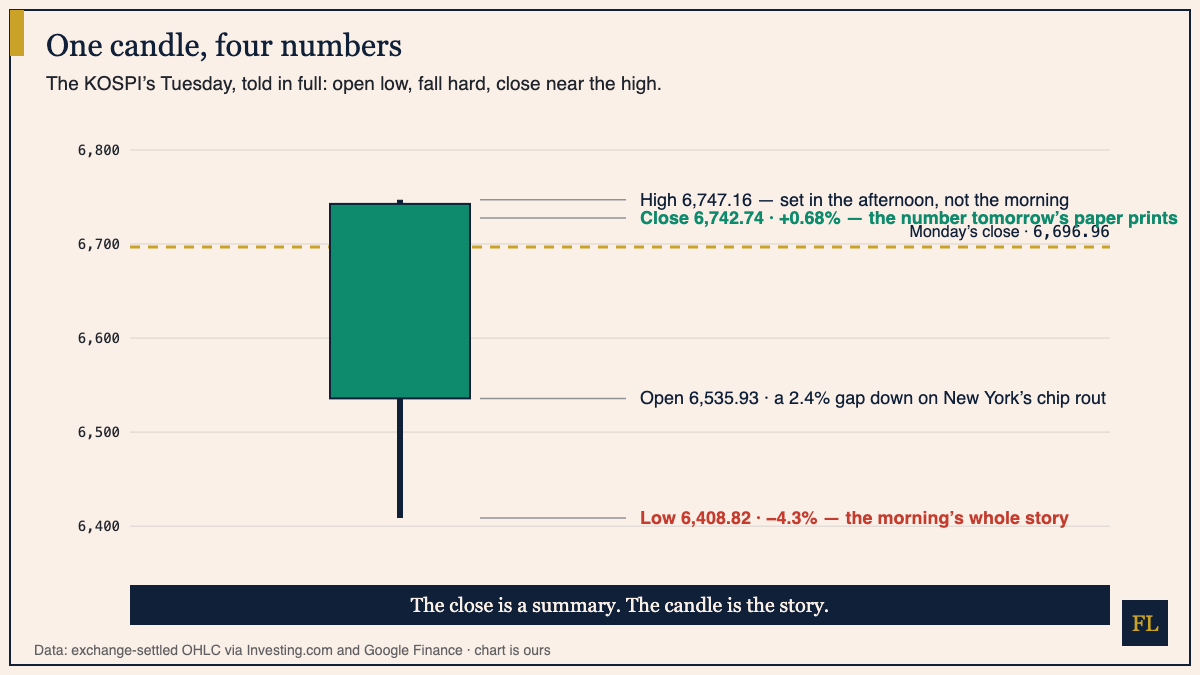
How to read this: the box runs from the open to the close — green because the close is higher. The line below it is the wick: how far sellers pushed before the price came back. A long lower wick under a body that closes near the day's high is the shape of a fall that got bought. Compare the gold dashed line (Monday's close): everything below it was today's scare; the close above it is what remained of the scare by 3:30. Tomorrow, when a headline says markets "shrugged off" the chip worry, you can be more precise: the worry was real for about three hours, and then it was outbid.
📅 Tomorrow
Wednesday is the week's hinge. The Bank of Thailand decides with its policy rate at 1.0% — last Thursday's issue taught the rate-gap gauge; tomorrow you watch it move or hold. Then Nvidia reports after the US close — 6 am Thursday in Seoul — and today's whole morning was a live demonstration of how much of Asia's board rides on that one report. Thursday stacks the Bank of Korea decision (base rate 2.75%) on top of the Nvidia reaction, with the Fed's Jackson Hole symposium opening the same day. Whatever those mornings print, you now know to ask for more than the closing number.
We explain; we never advise. Nothing here is investment advice.
Financial Literature is for educational and informational purposes only. Nothing here is investment, financial, legal, or tax advice, or a recommendation to buy or sell any security. Content is impersonal and not tailored to any individual. Data may contain errors — verify before relying on it. Sources: Google Finance (KOSPI, Nikkei, Hang Seng, USD/JPY, USD/VND); Investing.com (KOSPI settled, KOSDAQ, VN-Index); Trading Economics (Nikkei, JGB yield); The Korea Herald/Yonhap (Seoul close, flows, won); Korea JoongAng Daily (Seoul open, Bank of Korea preview); FinancialJuice (US chip selloff); BigGo/SSI Research (FTSE inclusion flows); The Investor (FTSE upgrade date, dong 2024 record); Bank of Thailand (meeting calendar); Nvidia IR via StockTitan (earnings date); Regards of Wall Street (Jackson Hole schedule).
— The Editorial Team