🌏 Japan bought 3.6% more crude and paid 58.7% more for it
Japan's August trade gap hit ¥1.11 trillion. Read the crude line twice: once as barrels, once as yen, and the price shows up in the space between.

Japan sold nearly a fifth more abroad in August than a year earlier, and still bought ¥1.11 trillion more than it sold.
Numbers compiled Wednesday, 16 September 2026, at 6:45 pm in Seoul (UTC+9), a 5-min read. The Tokyo, Seoul and Hong Kong closes are final. The currency, bond and oil rows are snapshots from markets still trading.
Yesterday's answer (Monday's question, the last one we asked): B. Seoul's official close is the price set at the end of the 3:30 pm regular session, and both the index level and the next day's price limits are worked out from it. A 7 pm trade in the new after-market is a real price at a later time. It does not reopen a close that has already been published.
📊 The Dashboard, Wednesday, 16 September 2026
| Gauge | Level | Move | What this means |
|---|---|---|---|
| Nikkei 225 (Japan) | 63,923.00 | 🟢 ▲ +0.69% | Closed, final: Google Finance, Yahoo Finance. It spent part of the day below Tuesday's close and finished on its high. |
| KOSPI (South Korea) | 6,717.97 | 🟢 ▲ +1.37% | Closed, final: Google Finance, AP. The first gain in five sessions, with SK hynix up 4.08% and Samsung Electronics up 2.01%. |
| Hang Seng (Hong Kong) | 24,713.78 | 🟢 ▲ +0.19% | Closed, final: Google Finance, Yahoo Finance. The smallest gain of the three on a day Shanghai added 0.7%. |
| USD/JPY | ≈155.1 | 🟢 ▼ yen a touch firmer | Snapshot, still trading: Google Finance. Every dollar-priced barrel below is paid for at roughly this rate. |
| USD/KRW | ≈1,367 | 🔴 ▲ won weaker, about 0.3% | Snapshot, still trading: Google Finance. Seoul now trades the won late into the night, so this is a level, not a close. |
| USD/CNY | ≈6.71 | ⚪ flat | Snapshot, still trading: Google Finance. Beijing sets a daily reference rate, which keeps the yuan's daily range narrow. |
| JGB 10-year yield (Japan) | ≈3.00% | 🟢 ▼ lower | Snapshot: 2.995% at compile, back under 3% after trading above it. It first touched 3% on 1 September, a level last seen in 1996. Green because a lower yield means a higher bond price. |
| Brent crude | ≈$107.7 | 🟢 ▼ −0.9% | Snapshot, still trading: AP. Green because Asia buys crude, not sells it. |
What happened, in plain words
Japan's customs service published August trade statistics on Wednesday morning. Exports came to ¥10.05 trillion, 19.3% above August last year. Imports came to ¥11.15 trillion, 28.0% above. Subtract the second from the first and the month ends ¥1.11 trillion in deficit, the fourth monthly deficit in a row and the widest since January, against ¥294 billion in August 2025.
Nothing on either side of Japan's trade shrank. Both sides grew, at different speeds, and the space between them is what a trade balance is. A balance is a subtraction of two large numbers, so a gap of 8.7 percentage points between their growth rates turns into a deficit almost four times last year's. A percentage change on a balance and a percentage change on a flow are not the same kind of number, and the first one moves much faster.
⭐ Spotlight: the crude line in Japan's import bill
Today's rotating row is a single line of that table. In August, Japan took delivery of 11.59 million kilolitres of crude oil, 3.6% more than a year earlier. It paid ¥1.19 trillion for that oil, 58.7% more. The two numbers describe the same cargo: one counts it, the other prices it.
Crude alone was 10.7% of everything Japan imported last month, and by the ministry's own arithmetic it supplied 5.1 of the 28.0 percentage points by which the import bill rose. All mineral fuels together supplied 7.8. The price half of that sum is public and free to check: the EIA on the Data Catalog carries the daily crude and gas series anyone can pull. Four days ago we read the other half of this ledger, Japan's import bill in two currencies.
📈 Chart of the Day: two numbers for one cargo
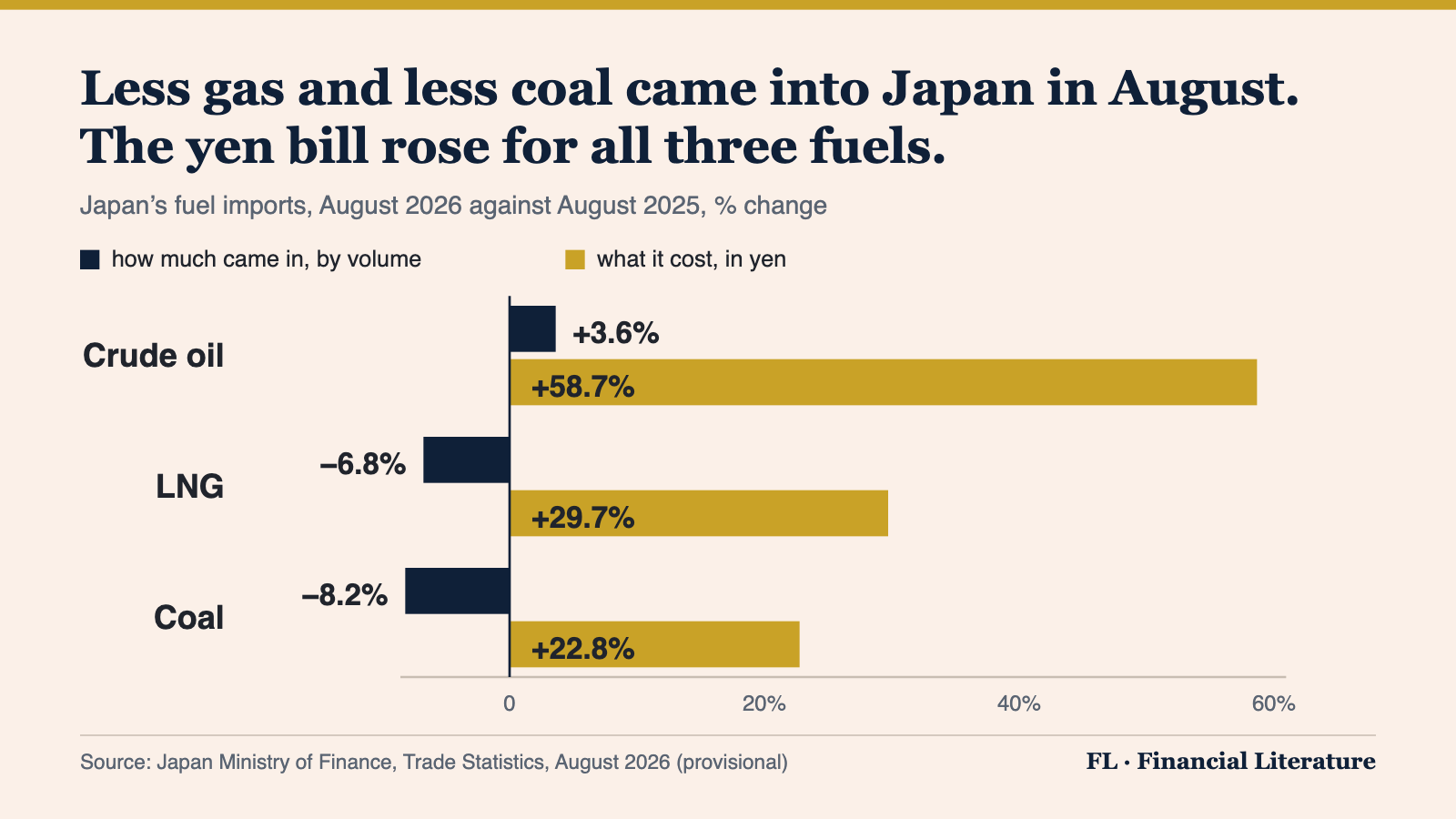
How to read this. Every money figure in a trade table is a quantity multiplied by a price, and that price is quoted in a currency which moves too. So a value line and a volume line answer different questions, and the table gives you both on purpose. When the two bars for one fuel point in opposite directions, as they do for gas and for coal, the movement sits in the price, not in how much the country wanted. A bill that climbs while volumes fall is a country paying more for less.
🌏 SEA watch: the region's gas, sold by the tonne and paid for in yen
The same table reaches Southeast Asia. Japan took 1.015 million tonnes of liquefied natural gas from the ASEAN countries in August, 13.1% less by weight than a year earlier, and paid ¥126.0 billion for it, 30.7% more. Coal from the region traced the same shape: the tonnage barely moved, down 0.5%, while the bill rose 33.1%. Gas alone was 7.0% of everything Japan bought from ASEAN last month.
Read from the selling side those are receipts, and read from the buying side they are costs, and several economies in the region sit on both sides at once. The US Energy Information Administration ranks Malaysia the fifth-largest exporter of liquefied natural gas in the world in 2023, with Japan its largest customer, and records it importing almost 1.2 million barrels a day of petroleum products in the same year. So the useful question is never whether a country is labelled an energy exporter or an energy importer. It is which of its two lines moves further when a price moves, because that difference lands in its current account, one of the early-warning gauges this section reads.
📅 Tomorrow
The Federal Reserve's two-day meeting ends on Wednesday afternoon in Washington, 3 am Thursday in Seoul, with fresh projections from each official, and markets widely expect its first rate rise in three years. Asia trades the result first. Then the Bank of Japan's board sits on Thursday and Friday and announces on Friday. The yen and JGB rows are the ones to watch against both.
One question. Today's chart showed Japan's coal imports down 8.2% by volume and up 22.8% in yen. Which reading is right? A: Japan took in more coal in August than a year earlier. B: Japan took in less coal and paid more for each unit of it. C: The two numbers contradict each other, so one of them must be wrong.
Forwarded this by a friend? Subscribe here. Found it useful? Forward it to one person who'd want it.
Financial Literature is for educational and informational purposes only. Nothing here is investment, financial, legal, or tax advice, or a recommendation to buy or sell any security. Content is impersonal and not tailored to any individual. Data may contain errors, verify before relying on it. We explain; we never advise. Sources: Japan Ministry of Finance, Trading Economics, Google Finance, Yahoo Finance, Investing.com, AP, US Energy Information Administration, Bank of Japan, US Federal Reserve.
— The Editorial Team