🌏 Hong Kong's base rate rose to 4.25% by formula. HSBC's rate did not
The Fed moved at 3 am Seoul time and Hong Kong's official rate followed by formula within hours. The rates people borrow at are another matter.

Hong Kong's Base Rate rose a quarter point to 4.25% on Thursday, and no meeting in Hong Kong decided it.
Numbers compiled Thursday, 17 September 2026, at 5:25 pm in Seoul (UTC+9), a 5-min read. The Tokyo, Seoul and Hong Kong closes are final. The currency and bond rows are snapshots from markets still trading.
Yesterday's answer: B. A money figure in a trade table is a quantity multiplied by a price, so less coal and a bigger coal bill can only be squared by a higher price per tonne. The two lines measure different things, and neither contradicts the other.
📊 The Dashboard, Thursday, 17 September 2026
| Gauge | Level | Move | What this means |
|---|---|---|---|
| Nikkei 225 (Japan) | 64,136.25 | 🟢 ▲ +0.33% | Closed, final: Google Finance, Yahoo Finance. It touched 64,643.58 in the morning and kept under a third of that gain. |
| KOSPI (South Korea) | 6,715.41 | 🔴 ▼ −0.04% | Closed, final: Google Finance, etoday. It opened 0.91% higher and gave all of it back. |
| Hang Seng (Hong Kong) | 24,604.29 | 🔴 ▼ −0.44% | Closed, final: Google Finance, Yahoo Finance. It opened 0.94% lower, touched 24,357.69 and won back more than half of that fall. |
| USD/JPY | ≈155.8 | 🟢 ▼ yen firmer | Snapshot, still trading: Google Finance. The yen gained on the day the Fed raised rates, one day before the Bank of Japan decides. |
| USD/KRW | 1,382.2 | 🔴 ▲ won weaker, 13.6 won | Seoul's 3:30 pm close: etoday. The weakest close for the won since 26 August, and its sixth fall in a row. |
| USD/CNY | ≈6.707 | ⚪ flat | Snapshot, still trading: Google Finance. Beijing's daily reference rate keeps the range narrow. |
| USD/HKD | ≈7.845 | ⚪ flat | Snapshot, still trading: Google Finance. Added today: close to the 7.85 edge of the band Hong Kong guarantees. |
| JGB 10-year yield (Japan) | ≈2.99% | ⚪ little changed | Snapshot, still trading: Investing.com. Just under 3% going into the Bank of Japan's decision. |
What happened, in plain words
The US Federal Reserve raised its target range by a quarter point to 3.75–4.00% by a 12–0 vote, at 2 pm in Washington on Wednesday, 3 am in Seoul. It was the Fed's first rise since July 2023. Hours later the Hong Kong Monetary Authority set its Base Rate at 4.25% "with immediate effect according to a pre-set formula". HSBC, Bank of China (Hong Kong) and Standard Chartered kept their prime rates unchanged, and the HKMA's chief executive, Eddie Yue, said banks would weigh their own funding costs and the supply of Hong Kong dollars when they set deposit and loan rates. None of the three stock markets on the dashboard moved as much as half a percent by the close.
⭐ Spotlight: Hong Kong's Base Rate, 4.25%
Today's rotating row is the rate from which the HKMA prices its Discount Window, where banks can borrow Hong Kong dollars by pledging securities. Nobody votes on it. The formula takes the higher of two numbers: half a point above the bottom of the Fed's range, or an average of Hong Kong's overnight and one-month interbank rates. On Thursday the first came to 4.25% and the second to 2.50%, so the rate is 4.25%.
Why track a rate set by arithmetic? Because Hong Kong has held its dollar between HK$7.75 and HK$7.85 to the US dollar since 17 October 1983. The HKMA buys Hong Kong dollars from banks at 7.85, which shrinks the money banks hold and pushes local rates up until the currency moves away from that edge. The Base Rate is the Fed's decision, carried into Hong Kong dollars the same day. The daily rates behind it, both interbank fixings included, are free to pull: HKMA on the Data Catalog.
📈 Chart of the Day: one decision, four rates
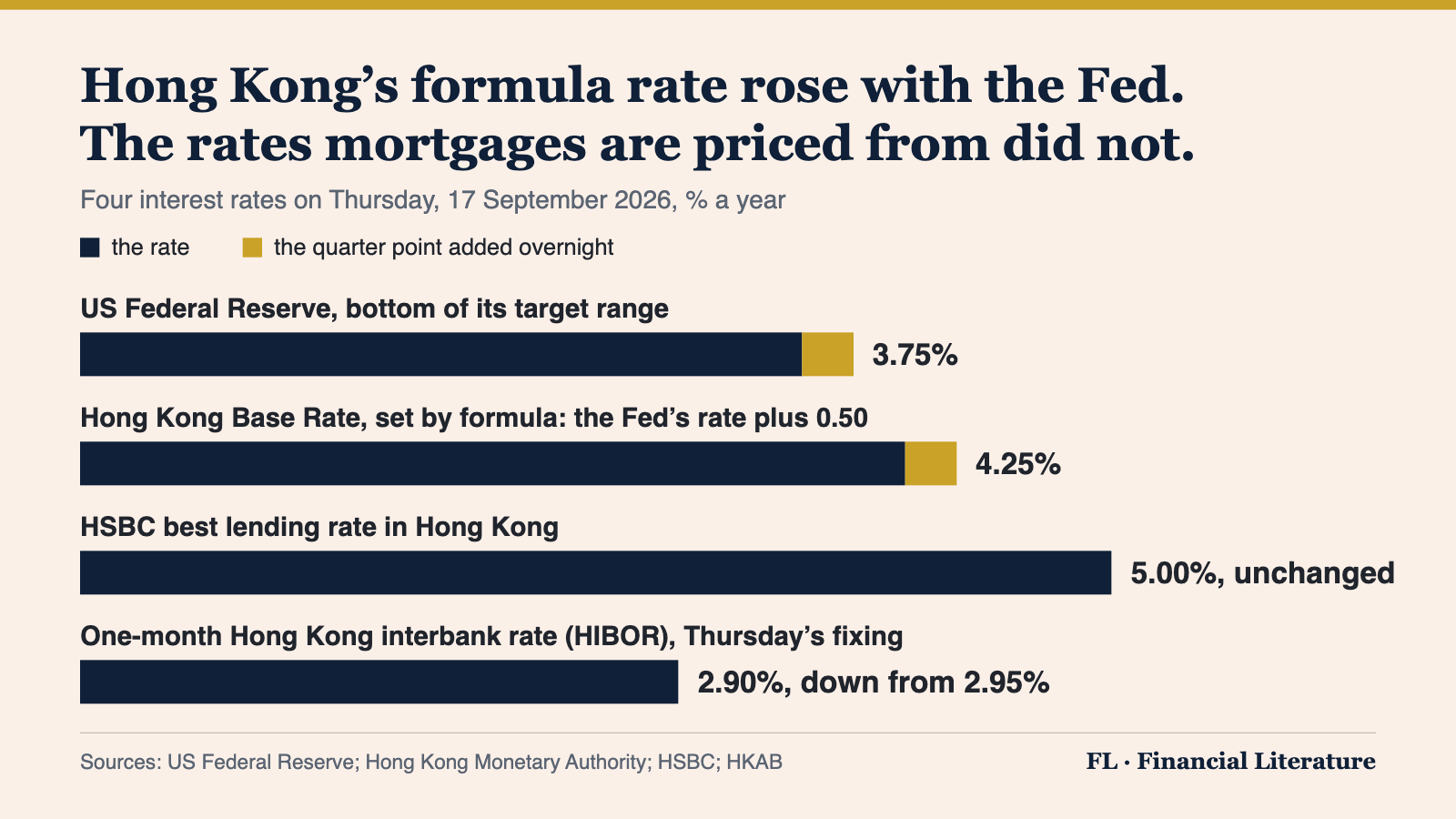
How to read this. An official rate and a borrowing rate answer different questions. The Base Rate is what the HKMA charges banks at its own window, and Hong Kong writes it by formula. Mortgages there are mostly calculated from HIBOR or a bank's prime rate, and HSBC's has sat at 5.00% since 31 October 2025. The one-month fixing slipped to 2.90%. So when a policy rate moves, find the rate a loan is written against before deciding what changed for the borrower.
🌏 SEA watch: Thailand's reserves, read twice
Thailand's policy rate did not move overnight. The Bank of Thailand's committee held it at 1.00% on 26 August, its third hold in a row, and it now sits 2.75 points below the bottom of the Fed's new range. With no peg to hold, no formula links the two.
The gauge in today's rotation is the one at the centre of 1997: reserves, and the line printed under them. In the week to 4 September the central bank held $284.0 billion of gross reserves, and its forward book added $24.6 billion, for net reserves of $308.6 billion. In 1997 that line pointed the other way. The Bank of Thailand reported in August 1997 that it had taken on obligations to deliver $23.4 billion in the forward market, against reserves that had fallen to $30.9 billion by June, and Thailand abandoned the baht's near-peg to the dollar on 2 July. A reserves figure is two numbers, what is held and what is already promised.
📅 Tomorrow
The Bank of Japan's board ends its two-day meeting on Friday and announces its decision that day. August's national consumer prices come out on Friday too. Last week we read the Bank's 1.0% against the range it is judged by. The yen and JGB rows show the reaction first.
One question. Today's chart showed Hong Kong's Base Rate up a quarter point to 4.25% and HSBC's best lending rate unchanged at 5.00%. Which reading is right? A: HSBC's borrowers pay a quarter point more from Thursday. B: The Base Rate follows a published formula tied to the Fed, while a bank sets its own lending rate, so the two can move on different days. C: One of the two figures must be out of date.
Forwarded this by a friend? Subscribe here. Found it useful? Forward it to one person who'd want it.
Financial Literature is for educational and informational purposes only. Nothing here is investment, financial, legal, or tax advice, or a recommendation to buy or sell any security. Content is impersonal and not tailored to any individual. Data may contain errors, verify before relying on it. We explain; we never advise. Sources: US Federal Reserve, Hong Kong Monetary Authority, HSBC, HKAB, RTHK, The Standard, Bank of Thailand, Federal Reserve Bank of San Francisco, Trading Economics, Google Finance, Yahoo Finance, Investing.com, etoday, Bank of Japan, Statistics Bureau of Japan.
— The Editorial Team