Why do Hong Kong's interest rates follow the Fed?
The Fed moved on Wednesday and Hong Kong's official rate followed within hours, by formula. The rates people borrow at answer to the peg on a slower clock.

The short answer: Hong Kong has held its dollar between HK$7.75 and HK$7.85 to the US dollar since 1983, and under a fixed exchange rate money tends to leave whenever it earns less in Hong Kong than it would in US dollars. So Hong Kong's official rate follows the Fed by formula on the same day, while the rates banks lend at are pulled towards US rates as that money moves, on a slower and less predictable clock.
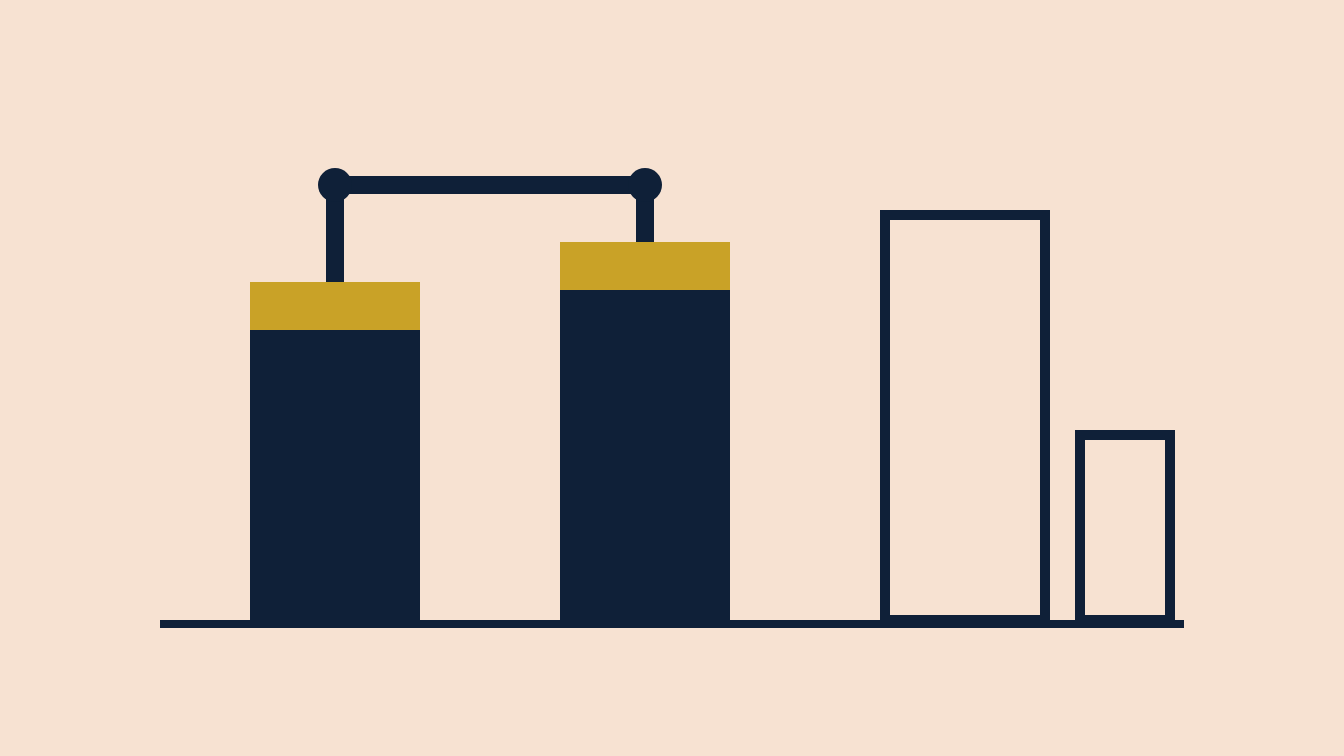
This week showed both halves. The Fed raised its range by a quarter point to 3.75–4.00% on Wednesday in Washington, and Hong Kong's Base Rate rose to 4.25% within hours, while HSBC's best lending rate and the one-month interbank rate did not rise. Nobody in Hong Kong voted on any of it.
What the peg is
The Hong Kong Monetary Authority calls it the Linked Exchange Rate System, "implemented in Hong Kong since 17 October 1983", and it keeps the Hong Kong dollar "within a band of HK$7.75-7.85 to one US dollar" through a currency board, meaning every Hong Kong dollar in the monetary base is matched by US dollars in reserve. At the edges the HKMA stands ready to trade with banks: it sells Hong Kong dollars at 7.75 and buys them at 7.85. Between the edges, the market sets the price.
Two ways the Fed reaches Hong Kong
By formula, the same day. The Base Rate is what the HKMA charges banks that borrow at its Discount Window. The rule, restated in Thursday's announcement, is "either 50 basis points above the lower end of the prevailing target range for the US federal funds rate or the average of the five-day moving averages of the overnight and one-month" interbank rates, "whichever is the higher". On Thursday the first came to 4.25% and the second to 2.50%. That is arithmetic, which is why the Base Rate moves within hours of every Fed decision.
By plumbing, over weeks or months. The rates households meet, HIBOR (the Hong Kong interbank offered rate) and each bank's prime rate, have no formula. They depend on how many Hong Kong dollars banks keep at the HKMA, a sum called the Aggregate Balance. When Hong Kong rates sit well below US rates, investors borrow cheap Hong Kong dollars and swap them into US dollars to earn more, and the Hong Kong dollar drifts towards 7.85. At 7.85 the HKMA buys Hong Kong dollars from banks, and the Aggregate Balance, in the HKMA's words, "will then contract to drive Hong Kong dollar interest rates up". Fewer Hong Kong dollars make them dearer to borrow, and the gap with US rates narrows.
The mechanism, in 2025's numbers
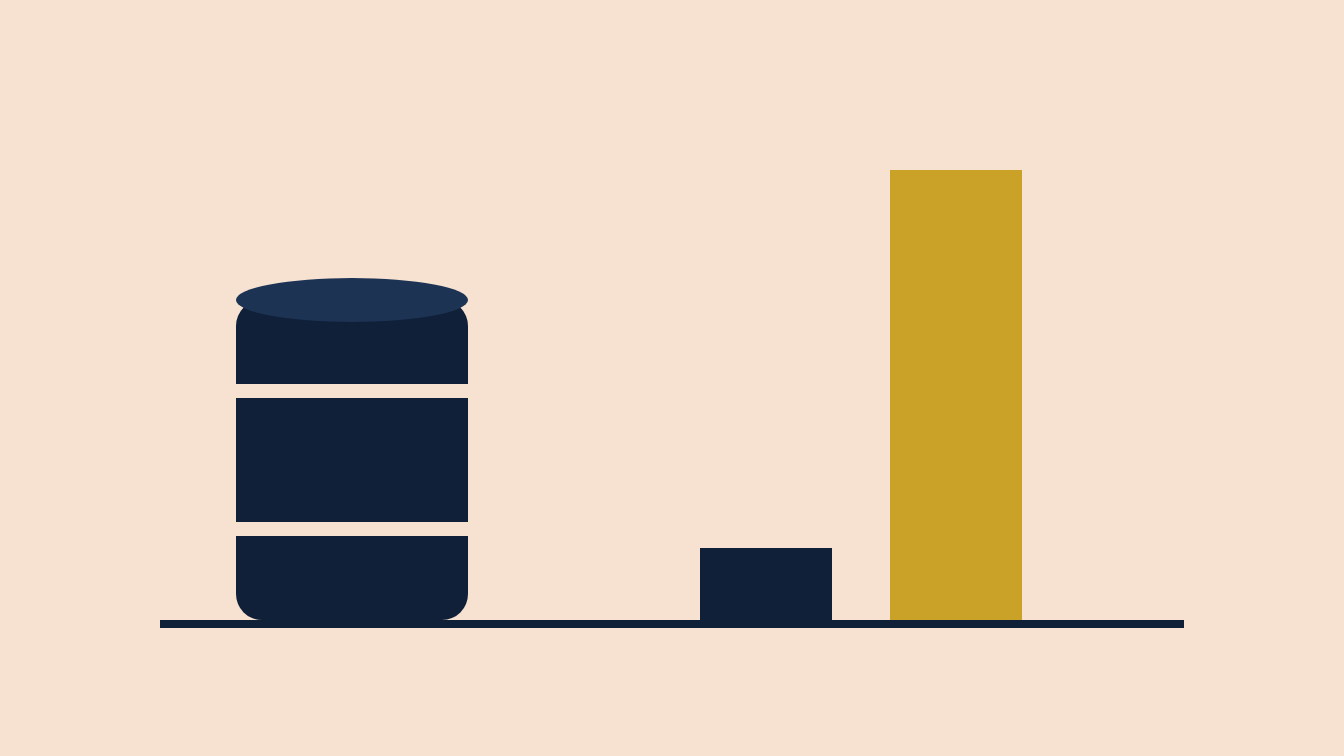
The last full turn of this wheel is on the record. The HKMA's September 2025 stability report says the weak-side undertaking "was triggered twelve times between late June and mid-August" 2025. The HKMA bought a total of HK$119.9 billion, and the Aggregate Balance came down from HK$174.1 billion on 8 May to HK$54.1 billion at the end of August. As it shrank, "HIBORs picked up". No committee met. The rise in Hong Kong's rates was a by-product of defending 7.85.
Since then the balance has barely moved. The HKMA's currency board report to 22 April 2026 found it "stable at HK$54 billion", and the daily figures still put it at HK$54.0 billion on 18 September, with the one-month rate at 2.87%, nearly a point below the bottom of the Fed's new range. The same report explains how such a gap lasts: HIBORs "generally track their USD counterparts" but "are also influenced by the local supply and demand of HKD funding". The daily figures are free to pull: HKMA on the Data Catalog.
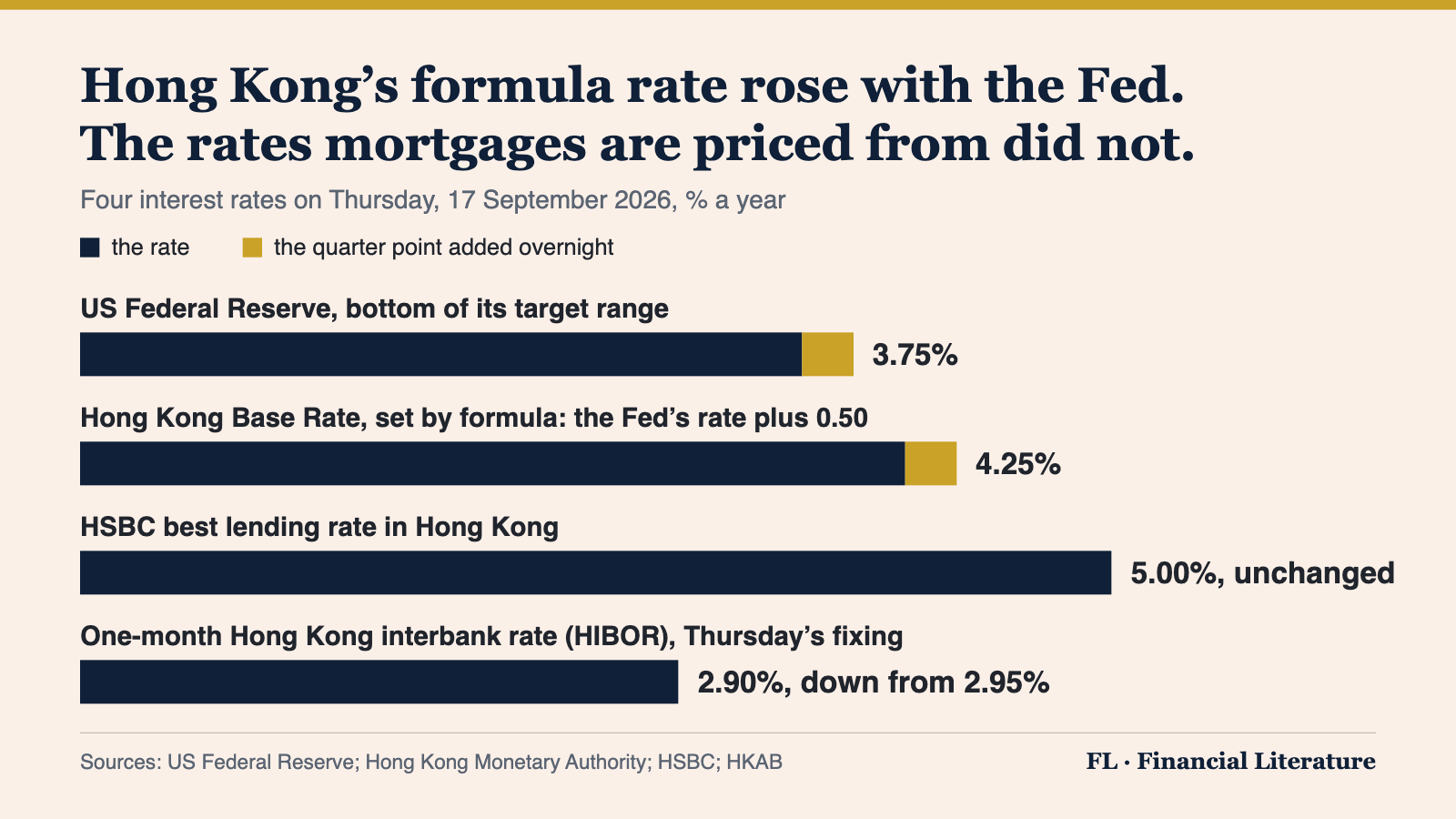
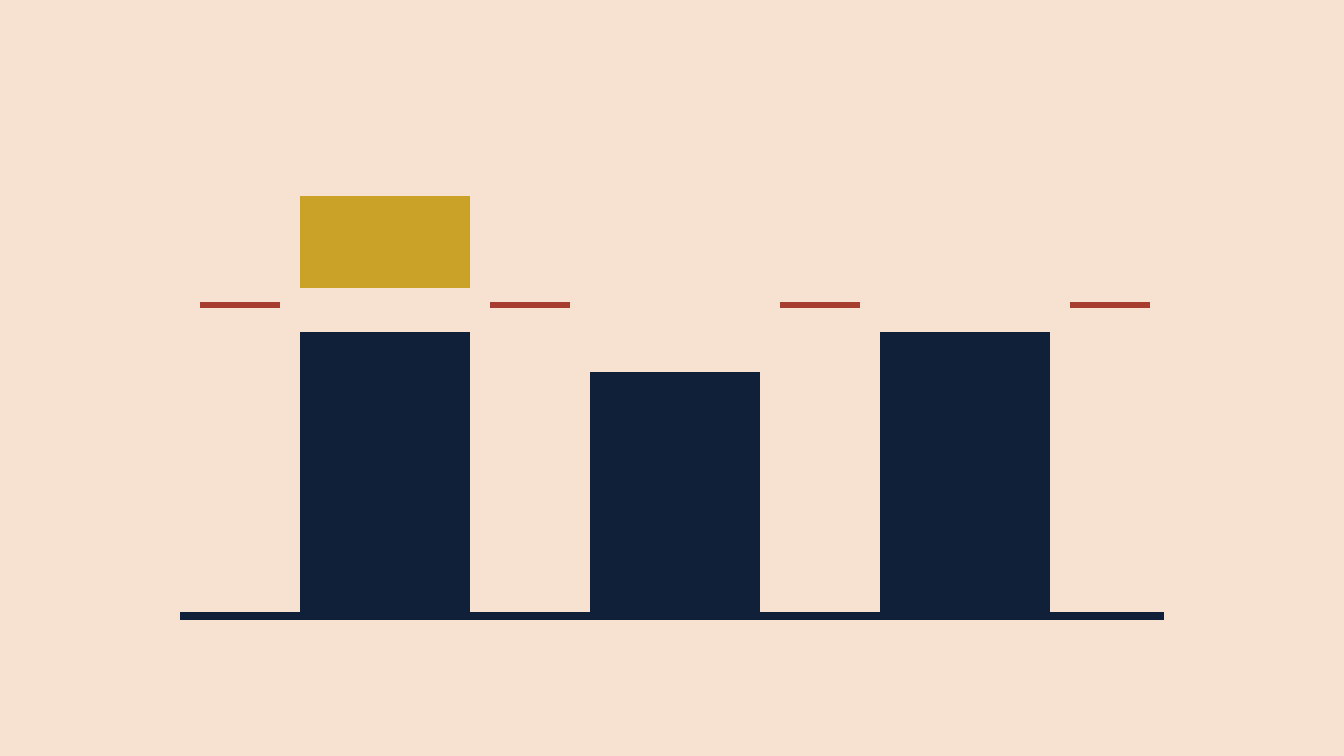
How to read this: the gold slivers are the quarter point the Fed added on Wednesday. They sit on the Fed's own rate and on the Base Rate that copies it, and on neither bar a borrower pays. When you read a Hong Kong rate after a Fed decision, ask first who set it. A formula rate tells you the peg's rule was applied; the interbank rate tells you how scarce Hong Kong dollars are; the prime rate tells you what one bank decided. Mortgages in Hong Kong are "mostly calculated with reference to" HIBOR or prime, so only the last two reach a household.
What this is not
A Hong Kong dollar near 7.85 is not a currency in trouble. The weak edge is where the system is built to act, and the HKMA's 2026 report describes the market as trading "in a smooth and orderly manner". A higher Base Rate does not mean borrowing got dearer: HSBC's best lending rate has been 5.00% since 31 October 2025. And the peg does not make Hong Kong's rates equal to America's. It makes them answer to America's, through a quantity the HKMA publishes daily, which is why HIBOR can sit below US rates for months at a time.
The habit
When a rate moves on the same day as the Fed, find out who set it: a committee, a formula or a market. We read the formula on Thursday, and a committee on Friday, when two of Japan's nine board members voted no. The archive keeps the daily series.
Financial Literature is for educational and informational purposes only. Nothing here is investment, financial, legal, or tax advice, or a recommendation to buy or sell any security. Content is impersonal and not tailored to any individual. Data may contain errors, so verify before relying on it. We explain; we never advise. Sources: Hong Kong Monetary Authority, US Federal Reserve, HSBC, Bank of Japan.
Forwarded this by a friend? Subscribe here. Found it useful? Forward it to one person who'd want it.
— The Editorial Team