🌏 Japan raised rates to 1.25% the day its core inflation slowed to 1.7%
Two of nine board members voted no, citing prices under 2%. The statistics bureau's own footnote shows how much the energy measures took off.


The Bank of Japan raised its policy rate to 1.25% on Friday, hours after the statistics bureau said Japan's core inflation had slowed to 1.7%.
Numbers compiled Friday, 18 September 2026, at 6:26 pm in Seoul (UTC+9), a 5-min read. The Tokyo, Seoul and Hong Kong closes are final. The yen, yuan and bond rows are snapshots from markets still trading.
Yesterday's answer: B. Hong Kong's Base Rate is set by a published formula the moment the Fed moves, while a bank sets its prime rate from its own funding costs, so the two can move on different days. A borrower's rate follows the one the loan is written against.
📊 The Dashboard, Friday, 18 September 2026
| Gauge | Level | Move | What this means |
|---|---|---|---|
| Nikkei 225 (Japan) | 65,018.95 | 🟢 ▲ +1.38% | Closed, final: Google Finance, Yahoo Finance. A good day on the day rates rose, but narrow: the broader TOPIX slipped 0.07%. |
| KOSPI (South Korea) | 6,894.23 | 🟢 ▲ +2.66% | Closed, final: Google Finance, Newspim. SK hynix rose 6.42% and Samsung Electronics 3.37%, and foreign investors were net buyers for the first time in eight sessions. |
| Hang Seng (Hong Kong) | 24,750.78 | 🟢 ▲ +0.60% | Closed, final: Google Finance, Yahoo Finance. An ordinary up day, a day after the Base Rate rose. |
| USD/JPY | ≈157.6 | 🔴 ▲ yen weaker, about 1% | Snapshot, still trading: Google Finance. The yen fell to a two-week low on the day its own rates rose. More on why below. |
| USD/KRW | 1,383.3 | 🔴 ▲ won weaker, 1.1 won | Seoul's 3:30 pm close: etoday. The won's seventh fall in a row, its longest run since the ten sessions to 14 January. |
| USD/CNY | ≈6.70 | ⚪ little changed | Snapshot, still trading: Google Finance. Beijing's daily reference rate keeps the range narrow. |
| JGB 10-year yield (Japan) | ≈2.98% | ⚪ little changed | Snapshot, still trading: Investing.com. Still just under 3%, on a day the rise was widely expected. |
What happened, in plain words
At 8:30 am in Tokyo, the Statistics Bureau put August's consumer prices excluding fresh food 1.7% above a year earlier, down from 1.8% in July. Later that day the Bank of Japan raised its target for the overnight call rate to around 1.25% from around 1.0%, by seven votes to two, effective 24 September. That is the highest since April 1995. The Bank said underlying inflation "has been approaching 2 percent" and named a risk that it goes above the target. The two dissenters, Toichiro Asada and Ayano Sato, pointed the other way: Asada cited the core rate "being below 2 percent recently". The yen fell rather than rose: traders read two votes against as a sign that further rises would come slowly. A currency answers the rates it expects, not only the rate announced.
⭐ Spotlight: Japan's core inflation, 1.7%
Today's rotating row is the gauge the Bank of Japan writes its statements in: consumer prices excluding fresh food, which Japan calls "core". Fresh food swings with the weather (cabbage was 45% dearer than a year earlier in August), so leaving it out shows the trend more clearly. Energy stays in, and that is the detail to remember. In the United States "core" leaves out food and energy both, so the same word covers a different basket; Japan's nearest match to the American gauge excludes fresh food and energy, and it held at 1.9%. Because energy stays in Japan's core, anything the government does to petrol or power bills lands in it directly. The Bank's statement puts the core rate "in the range of 1.5-2.0 percent" recently, and the Bank publishes its own measures of underlying inflation for the same reason.
📈 Chart of the Day: what the energy measures took off
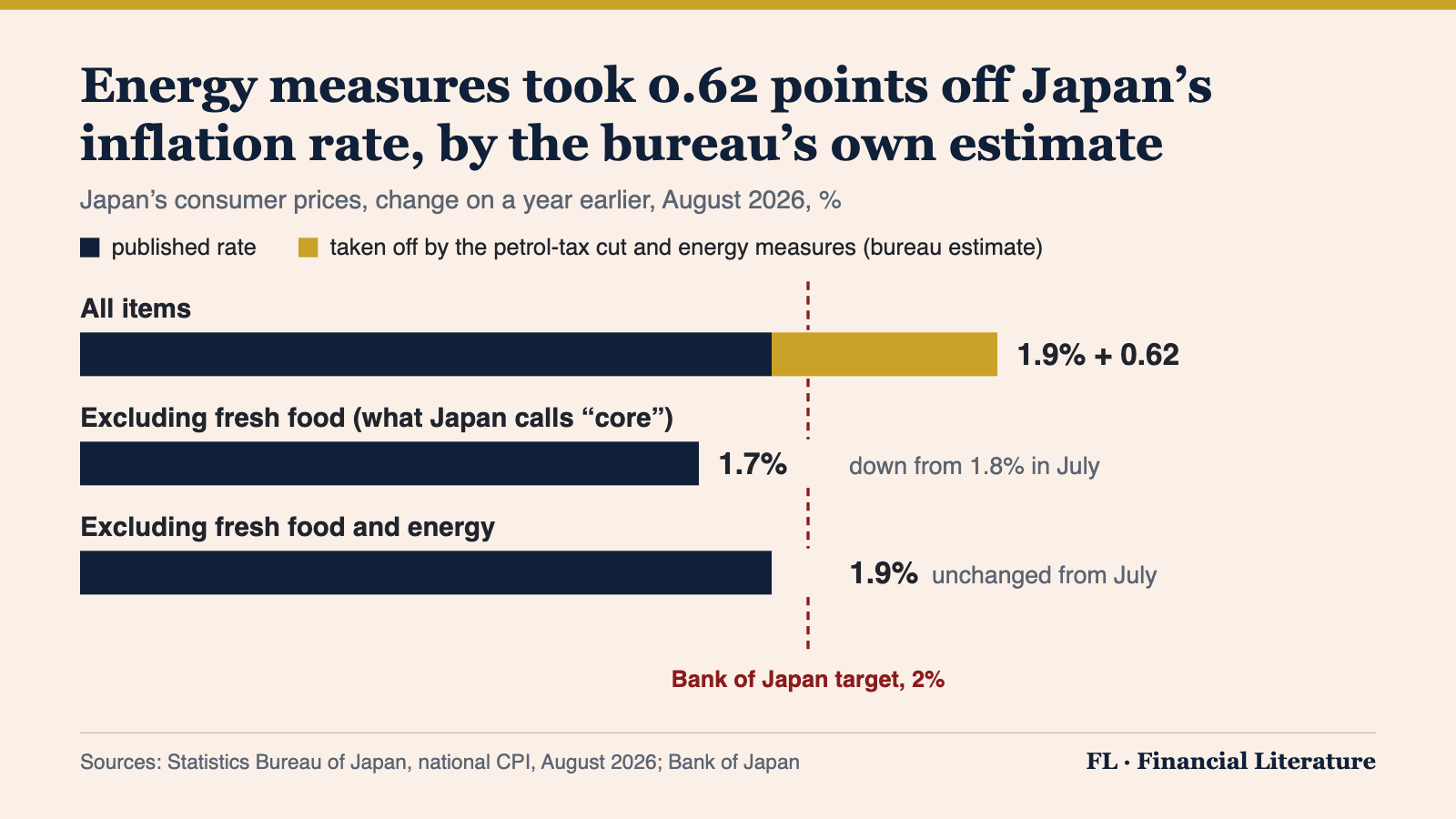
How to read this. A price index records what people paid, including whatever a government took off the bill. When a tax is cut or a bill subsidised, the index falls without anything underneath changing. So before reading a headline rate, look for the statistics office's note on policy effects. Japan's bureau prints its own estimate at the foot of the Japanese release: the end of the provisional petrol tax and the energy measures took 1.03 points off in August, last year's measures dropping out of the comparison added 0.41 back, and the net is 0.62 points. That is how a central bank can raise rates with every published gauge under 2%. The Bank's statement names "the government's measures to reduce the household burden of higher energy prices" before it calls underlying inflation close to 2%. Last week we read the Bank's 1.0% against the range it is judged by; from Thursday that rate is 1.25%.
🌏 SEA watch: a dollar line that is promised, not held
Today's gauge does not appear in any reserves table. On 15 September the Bank of Japan, acting for Japan's finance minister, and Bank Negara Malaysia signed a third Bilateral Swap Arrangement of up to $6 billion, effective Friday. It lets either side swap its own currency for dollars, and lets Malaysia swap ringgit for yen. The line before it was up to $3 billion, renewed in September 2023, so the size has doubled.
Against Malaysia's reserves of $132.1 billion at the end of July, $6 billion is about 4.5%. The number that matters more is the tense: these dollars are promised, and they only become Malaysia's to spend on the day a swap is drawn. That is a lesson of 1997 built into the region's plumbing. The Chiang Mai Initiative, launched by the ASEAN countries with China, Japan and South Korea in May 2000, is at its core a network of bilateral lines like this one, there for short-term shortages of dollars. Malaysia's reserves and ringgit rates are free to pull: BNM OpenAPI on the Data Catalog.
📅 Tomorrow
The next issue lands Monday, with Tokyo shut: the exchange is closed Monday 21 to Wednesday 23 September for Respect for the Aged Day, a bridging holiday and the autumn equinox, so the Nikkei row holds today's close until Thursday. The new 1.25% takes effect that Thursday. Until then, the yen row carries Japan's reaction.
One question. Today's chart showed Japan's all-items inflation at 1.9%, with the bureau's 0.62-point estimate for the energy measures stacked on top. Which reading is right? A: Japan's inflation was really 2.5% in August, and the 1.9% figure is wrong. B: The 1.9% is what people paid; the 0.62 is the bureau's estimate of what policy took off, so the two answer different questions. C: Energy prices fell on their own in August, so the gold segment overstates inflation.
Forwarded this by a friend? Subscribe here. Found it useful? Forward it to one person who'd want it.
Financial Literature is for educational and informational purposes only. Nothing here is investment, financial, legal, or tax advice, or a recommendation to buy or sell any security. Content is impersonal and not tailored to any individual. Data may contain errors, verify before relying on it. We explain; we never advise. Sources: Bank of Japan, Statistics Bureau of Japan, Japan's Ministry of Finance, Bank Negara Malaysia, Asian Development Bank, Japan Exchange Group, Trading Economics, Free Malaysia Today, Google Finance, Yahoo Finance, Investing.com, Newspim, Seoul Shinmun, etoday.
— The Editorial Team