🌏 KOSPI +0.88% — the index rose; most of its stocks fell
Seoul closed up 0.88% with 681 decliners to 193 advancers; Kosdaq fell 4.63%; Indonesia printed a record current-account deficit. Weight is not breadth.


Numbers compiled Friday, 21 August 2026, at 5:15 pm in Seoul (UTC+9). Seoul, Tokyo and Hong Kong closes are final; the Hong Kong row notes a small spread between sources. Jakarta closed at 4:00 pm local (6:00 pm Seoul) and its row is a late-session snapshot. Bond and currency rows are late-Friday snapshots.
The KOSPI rose 0.88% to 6,912.95 — Investing.com's settled row agrees — and on the same exchange, on the same day, 681 stocks fell and 193 rose. Both facts are true. Today's issue is about how an index can go up while most of the market goes down — and why the Kosdaq, which has no Samsung to lean on, lost 4.63%.
📊 The Dashboard — Friday, 21 August 2026
| Gauge | Level | Move | What this means |
|---|---|---|---|
| KOSPI (South Korea) | 6,912.95 | 🟢 ▲ +0.88% | Closed, settled — two sources agree. Two stocks did it: Samsung Electronics rose 3.87% and SK hynix 2.31%, on reports of a Samsung shareholder-return plan of up to 110 trillion won. Since Tuesday's 6,869.83 close, Seoul is 43 points higher — with a −5.80% day and a +5.89% day in between. |
| KOSDAQ (South Korea, rotation row) | 801.94 | 🔴 ▼ −4.63% | Closed, settled. The exchange paused program sell orders for five minutes at 10:05 am — the Kosdaq's 32nd sidecar this year — as biotech names that jumped on Thursday's Moderna news reversed (Alteogen −7.81%, ABL Bio −9.21%) and chip-equipment makers gave back their rebound (PSK −7.99%). Foreigners and institutions sold; retail bought 339.5 billion won net. |
| Nikkei 225 (Japan) | 66,016.36 | 🔴 ▼ −0.30% | Closed, settled — Google Finance and Trading Economics agree. Technology names led the losses (Taiyo Yuden −3.4%, SoftBank Group −2.5%) as bond yields rebounded; the index lost 3.93% on the week, ending a two-week winning run. |
| Hang Seng (Hong Kong) | ≈25,998 | 🟢 ▲ ≈+1.2% | Closed. Google Finance shows 25,997.73 (+1.16%); Trading Economics and Investing.com sit within 0.2% either side, so we print the level as approximate. Hong Kong's inflation eased to 1.7% in July from 2.0%. |
| USD/KRW | ≈1,386 | 🟢 ▼ won firmer | Onshore close 1,386.5, 6.1 won stronger; Google Finance's late quote sits near 1,384. Third straight day under 1,400. When the won firms on a day most stocks fall, the money is not leaving — it is rotating. |
| USD/JPY | ≈158.9 | ⚪ ≈ flat | Late-Friday snapshot — unchanged on the day even after an inflation print that strengthens the case for a Bank of Japan move. US yields rose too; FX prices the difference, and today both sides moved together. |
| JGB 10-year yield (Japan) | ≈2.89% | 🔴 ▲ +3 bp | Late-Friday snapshot — rose to about 2.88%, ending a two-day decline, tracking US Treasuries. Japan's core inflation quickened to 1.8% in July from 1.6% — matching forecasts; headline 1.9% — a seventh month under 2%, but moving toward it. |
🌏 The SEA watch — this week's number: Jakarta's JCI
The rotation returns to Jakarta, where two things happened this week. Bank Indonesia held its rate at 5.75% on Wednesday — the first decision under acting Governor Destry Damayanti, matching 34 of 35 forecasts, and she framed it as a rupiah-stability call. The market treated it as a non-event: the IDX Composite traded near 6,536, up about 0.5%, at a three-month high late Friday (a snapshot, not a close), and the rupiah firmed to about 17,698 per dollar.
The second thing is the gauge to learn. This morning Bank Indonesia published the second-quarter balance of payments, and the current account — the country's net earnings from trade, services and income with the rest of the world — showed a deficit of $12.5 billion, or 3.3% of GDP, from $3.6 billion (1.0%) in the first quarter; Trading Economics calls it a record. The bank's own explanation: "the oil and gas trade deficit widened due to higher oil imports amid elevated global oil prices," and income payments abroad rose. This is the 1997 gauge in its purest form — a current-account deficit means a country spends more abroad than it earns, and the gap must be financed by money coming in. In 1997 Thailand's gap was about 8% of GDP and the money financing it was short-term. Here is why Jakarta shrugged: the same release shows a $12.0 billion financial-account surplus — direct investment up, portfolio inflows "in line with higher yields" — and reserves of $145.6 billion, 5.6 months of imports. The gap was covered, this quarter, and a 5.75% rate is part of what covered it. We are not calling anything. We are teaching you to read two lines together: the deficit says how much must be financed; the financial account says whether it was, and by what kind of money. Portfolio money can leave faster than factories can. That pair is Jakarta's gauge for the rest of the year.
⭐ Spotlight: 193 to 681 — what "breadth" means
Advancers versus decliners — how many stocks rose versus how many fell — is called market breadth, and today it told the opposite story from the index. The KOSPI is weighted by market value, so Samsung Electronics and SK hynix, the two largest companies in Korea, count for far more than the hundreds of smaller names below them. When those two rise 3.87% and 2.31%, they can lift the whole index even while 681 stocks fall and only 193 rise, and even while Hanwha Aerospace (−7.03%) and Kakao (−7.49%) fall hard. People track breadth because a rise carried by a few heavyweights behaves differently from a rise shared by most of the market; the Kosdaq, which has no such heavyweights, showed what the average stock actually did today. The reading skill: when the index and the breadth disagree, ask which stocks are doing the lifting — the answer is usually the day's real story.
📈 Chart of the Day — one market, two scoreboards
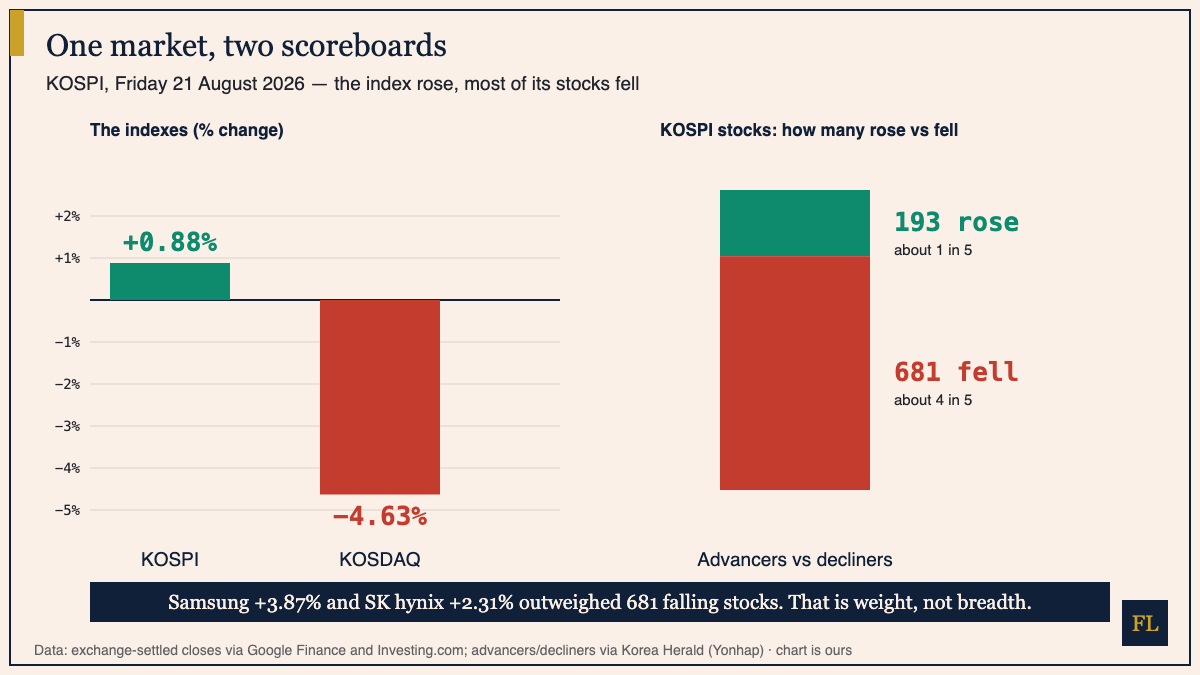
How to read this: the left panel is what the headlines print; the right panel is what happened to the typical stock. A value-weighted index answers "how did the money do?", while the advance-decline count answers "how did the companies do?" — and on a day like today they diverge because the money is concentrated in two chipmakers. Whenever you see a green index, glance at the count: if four in five stocks fell, the green belongs to a few names, and the Kosdaq bar shows what a market without those names looks like.
📅 Next week
Monday is quiet on the calendar. The Bank of Thailand decides on Wednesday 26 August — the baht appeared in this column on Thursday at a 1.0% policy rate; read whether the rate gap with the US changes. Jackson Hole opens on Thursday the 27th, and Samsung's board is reported to be meeting late this month on its shareholder-return plan — the number that carried today's index. If it lands, check the breadth count that day too.
We explain; we never advise. Nothing here is investment advice.
Financial Literature is for educational and informational purposes only. Nothing here is investment, financial, legal, or tax advice, or a recommendation to buy or sell any security. Content is impersonal and not tailored to any individual. Data may contain errors — verify before relying on it. Sources: Google Finance (KOSPI, Nikkei, Hang Seng, USD/KRW, USD/JPY, USD/IDR); Investing.com (KOSPI settled, KOSDAQ, Hang Seng); Trading Economics (Nikkei, Hong Kong, JGB yield, Japan core CPI, Jakarta Composite, Indonesia current account); The Korea Herald/Yonhap (Seoul close, breadth, won); Seoul Economic Daily (Kosdaq sidecar); Xinhua (Japan CPI); Bank Indonesia (Q2 2026 balance of payments); BigGo Finance (BI rate decision); Seoul Economic Daily (Samsung); Bank of Thailand (meeting calendar).
— The Editorial Team