🌏 KOSPI −3.12% — why 110 trillion won disappointed
Samsung fell 8.7% on its largest-ever shareholder-return plan — big, but smaller than the price. The Kosdaq rose; Singapore inflation near a 2-year high.

Numbers compiled Monday, 24 August 2026, at 5:20 pm in Seoul (UTC+9). Seoul, Tokyo and Hong Kong closes are final; the Hong Kong row notes a small spread between sources. Singapore was still trading at compile time and its row is a late-session snapshot. Currency and bond rows are late-afternoon snapshots.
On Friday evening Samsung Electronics announced the largest shareholder-return plan in its history — up to 110 trillion won. On Monday, the first day the market could answer, its shares fell 8.70% and took 3.12% of the KOSPI with them. Today's issue is about how record-sized good news buys a red day — and what “priced in” actually means.
📊 The Dashboard — Monday, 24 August 2026
| Gauge | Level | Move | What this means |
|---|---|---|---|
| KOSPI (South Korea) | 6,696.96 | 🔴 ▼ −3.12% | Closed, settled — Google Finance and Investing.com's settled row agree. Foreigners and institutions sold large-cap tech; Samsung Electronics fell 8.70% to 257,000 won — the same weight that lifted the index on Friday, working in reverse. |
| KOSDAQ (South Korea, rotation row) | 813.33 | 🟢 ▲ +1.42% | Closed — Investing.com settled row. Friday's story, mirrored: the board with no heavyweights rose 1.42% while the main board fell 3.12%. The average Korean stock had a far better day than the index suggests. |
| Nikkei 225 (Japan) | 65,528.09 | 🔴 ▼ −0.74% | Closed, settled — Google Finance and Trading Economics agree on the percent. Chip and AI names led the fall — Kioxia −6.2%, Advantest −3.9%, SoftBank Group −5.3% — as the sector holds its breath for Nvidia's results on Wednesday. |
| Hang Seng (Hong Kong) | ≈25,473 | 🔴 ▼ ≈−2.1% | Closed. Trading Economics shows −2.1%; Google Finance's last afternoon print sat within 0.2%, so we print the level as approximate. Alibaba announced a ≈HK$80 billion share placement at a 3.6% discount to fund AI spending — new shares dilute existing ones, and Tencent (−2.6%) and Xiaomi (−3.6%) fell with it. |
| USD/KRW | ≈1,384 | ⚪ ≈ flat | Late-afternoon snapshot — little changed near 1,384. The won held the mid-1,380s through a −3% equity day: money rotated inside the market rather than leaving it. The won's summer rebound is itself a live question for Thursday's Bank of Korea meeting. |
| USD/JPY | ≈159.1 | ⚪ ≈ flat | Late-afternoon snapshot — up about 0.1% on the day. Quiet FX on a red equity day, again: today's selling was about expectations, not about safety. |
| JGB 10-year yield (Japan) | ≈2.88% | ⚪ ▲ +1 bp | Late-afternoon snapshot — near a multi-decade high, with markets pricing roughly 82% odds of a September Bank of Japan hike. Last Tuesday's spotlight number, still doing what it was doing. |
🌏 The SEA watch — this week's number: Singapore's STI
The rotation returns to Singapore, where the STI traded near 5,685, roughly flat, late in the session — a snapshot, not a close — about 90 points below the record it set earlier this month, and up about a third over a year. Quiet index, loud release: this morning the Monetary Authority of Singapore and the trade ministry published July inflation, and it is the region's cleanest lesson in reading a price index. Headline inflation rose to 2.2%, the highest since August 2024, from 1.9% in June; core rose to 2.0% from 1.6%. The push came almost entirely from energy: electricity and gas tariffs were raised to record highs for the third quarter, utilities and fuels ran 6.1% above a year ago, and transport 7.9% — the bill for the US-Iran war arriving through the power socket of a city that imports nearly all its energy. The government has rolled out close to S$2 billion of support since the war began; MAS still sees core averaging 1.5–2.5% this year, with pressure staying elevated until mid-2027 — and, in the same breath, upgraded 2026 growth to 4.5–5.5%.
The 1997 lens, applied honestly, reads Singapore as the counter-example — and that is worth learning too. Singapore's central bank does not set an interest rate the way Seoul, Tokyo or Bangkok do; it steers the exchange rate itself, letting the Singapore dollar's strength do the inflation-fighting, because in a city-state that imports what it consumes, the currency IS the price level. So the gauge pair to read here is not FX reserves against short-term debt — it is imported-energy inflation against the currency's path. A country announcing 4.5–5.5% growth while handing out S$2 billion in cost-of-living support is not a stress reading; it is what absorbing an oil shock from a position of strength looks like. Keep the frame for Wednesday, when the Bank of Thailand — a country with far less cushion — decides on rates.
⭐ Spotlight: “priced in” — why record money bought a red day
A share price is not a scoreboard of what a company is; it is a running forecast of what the company will do. That is why markets react not to news, but to news minus expectations — when traders say something was “priced in,” they mean the forecast already contained it. Samsung's plan was genuinely huge: 90–110 trillion won for 2026, with about 30 trillion won of cash dividends in the third quarter — roughly 5,000 won a share, thirteen times last quarter's payout. But the price had spent two weeks rising on bigger forecasts — one brokerage had sketched returns reaching 200 trillion won — and the plan deferred the part the market wanted most, the buyback details, to later board meetings. Friday, the index rose on the hope; Monday, the same number, now real, was worth −8.70%. Nothing got worse over the weekend except the comparison point. The reading skill: when a stock falls on good news, don't ask “what's wrong with the news?” — ask “what forecast was the price already carrying?” SK hynix is today's control group: it paired its results with a 40 trillion won buyback-and-cancellation — the concrete version of what Samsung postponed — jumped early, and still closed 3.41% lower. On a day the whole forecast resets, even the right answer gets marked down.
📈 Chart of the Day — the scoreboards flipped
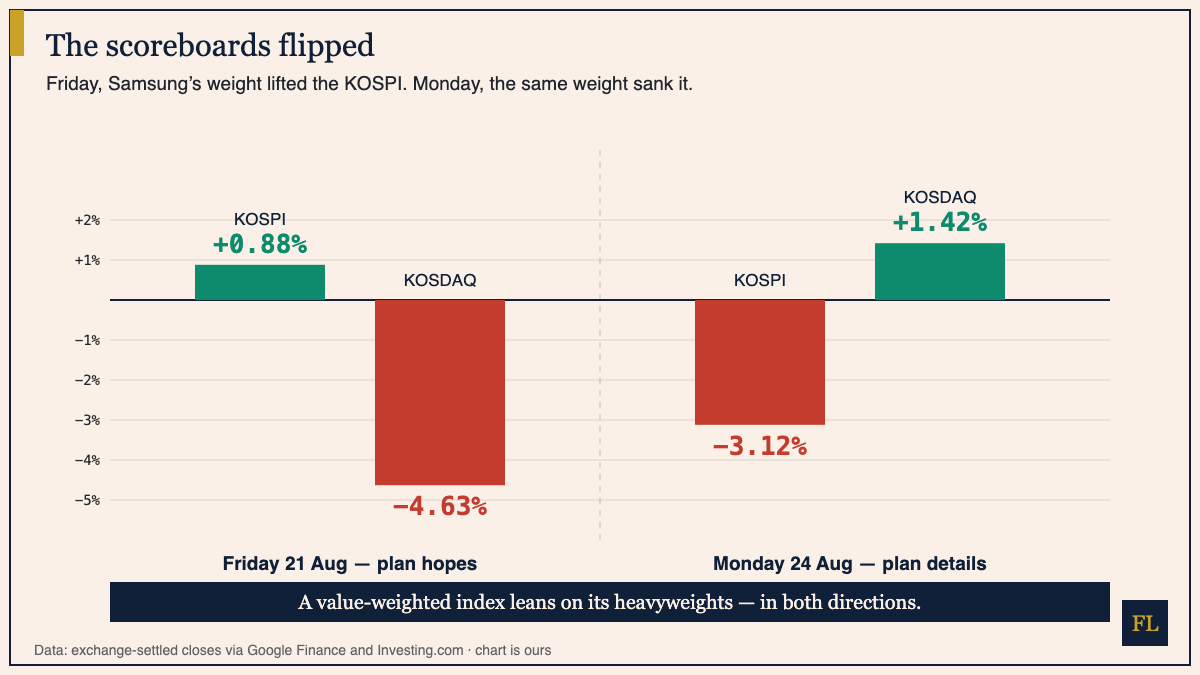
How to read this: Friday's issue taught that a value-weighted index leans on its heavyweights — two stocks lifted the KOSPI while four in five of its members fell. Today is the same chart with the sign flipped: Samsung's weight dragged the index down 3.12% while the Kosdaq, which has no Samsung, rose. Read the two days as one lesson: index weight is a lever, and it doesn't care which direction it is pushed. When the KOSPI and the Kosdaq disagree this sharply, the gap between them is roughly “what the giants did” — and today the giants were repricing a forecast, not the economy.
📅 This week
Tuesday's calendar is quiet — the week stacks up from Wednesday. The Bank of Thailand decides Wednesday 26 August. Nvidia reports Wednesday after the US close — 6 am Thursday in Seoul, and today's chip selling across Seoul and Tokyo is the market bracing for it. Thursday the Bank of Korea decides with the base rate at 2.75% — the firmer won argues both ways, which is what makes it worth reading — and the Fed's Jackson Hole symposium opens, with Chair Kevin Warsh's keynote Friday morning US time. And if a Samsung buyback headline lands any day this week, you now know exactly which two scoreboards to check.
We explain; we never advise. Nothing here is investment advice.
Financial Literature is for educational and informational purposes only. Nothing here is investment, financial, legal, or tax advice, or a recommendation to buy or sell any security. Content is impersonal and not tailored to any individual. Data may contain errors — verify before relying on it. Sources: Google Finance (KOSPI, Nikkei, Samsung Electronics, SK hynix, USD/KRW, USD/JPY); Investing.com (KOSPI settled, KOSDAQ, Samsung); Trading Economics (Nikkei, Hong Kong, JGB yield, STI, Singapore CPI); The Korea Herald/Yonhap (Seoul close); Korea JoongAng Daily (Samsung plan, Bank of Korea preview); Free Malaysia Today/AFP (Singapore inflation); Bank of Thailand (meeting calendar); Nvidia IR via StockTitan (earnings date); Regards of Wall Street (Jackson Hole schedule).
— The Editorial Team