🌏 KOSPI +3.56% — a bull market, by the book
Four green days put Seoul 20% above its July low — the textbook bull-market line. What that label does and doesn't mean. Plus Singapore takes the SEA watch.

Numbers compiled Thursday, 13 August 2026, at 4:50 pm in Seoul (UTC+9). Tokyo's and Seoul's closes are final; Hong Kong and Singapore were still trading at press time, and their rows say so.
Seoul's KOSPI closed up 3.56% at 6,813.34 — a fourth straight gain that leaves the index just over 20% above its late-July close, the line where market convention starts saying "bull market." Yesterday we said this morning's open would be the verdict on the US inflation number; the verdict arrived in one jump, with the KOSPI opening 2.96% higher after July US consumer prices rose a tame 0.1% on the month, 3.4% on the year — exactly what forecasters expected, which eased fears of a September rate rise.
📊 The Dashboard — Thursday, 13 August 2026
| Gauge | Level | Move | What this means |
|---|---|---|---|
| Nikkei 225 (Japan) | 68,309 | 🟢 ▲ +1.16% | Closed, final. Tokyo's own answer to the tame US inflation print — technology and bank shares led the advance. |
| KOSPI (South Korea) | 6,813.34 | 🟢 ▲ +3.56% | Closed, final. A fourth straight gain, again carried by the chipmakers — and it crossed a famous line, explained below. |
| Hang Seng (Hong Kong) | ≈25,367 | 🔴 ▼ ~0.3% | Still trading at press time — treat as provisional. Hong Kong sat out the region's rally for a third day; Tencent fell after its quarterly results. |
| USD/JPY | 159.4 | ⚪ ≈ flat | The yen barely moved. An in-line inflation number changes nothing about the gap between US and Japanese rates, so the currency had nothing to reprice. |
| USD/KRW | 1,419.4 | 🟢 ▼ −3.7 won | The onshore 3:30 pm close. A lower number means a firmer won — and unlike Tuesday, stocks and currency finally pointed the same way. (It has drifted back near 1,424 offshore since.) |
🌏 The SEA watch — this week's number: Singapore's STI
The rotation moves from Ho Chi Minh City (last issue) to Singapore. At press time the Straits Times Index stood at 5,711, down about 0.2% with the session still open — Singapore closes after we go to press — and the currency matched the mood: USD/SGD about 1.281, essentially flat. Run the usual check: both gauges calm, no disagreement to investigate. That is a quiet page.
The longer view is what earns Singapore its seat. The STI set its all-time high of 5,774.21 earlier this month and stands roughly 34% above where it was a year ago — the strongest twelve-month reading in our whole SEA rotation, while Jakarta, by the same source, spent the year losing ground. In a crisis-watch rotation, the hub matters as a reference point: Singapore is where the region's money does its banking, so if stress ever builds, the tell is usually divergence — the hub staying firm while a neighbor's currency and stock market slip together. Today there is no divergence to read, and learning to check for it on a calm day is the whole point of the habit.
⭐ Spotlight: the 20% line — KOSPI now +20.3% from its July low
By market convention, an index that rises 20% or more from a recent low has entered a "bull market," just as a 20% fall from a peak is called a "bear market." Seoul crossed that line today: from the 29 July close of 5,663.24 to today's 6,813.34 is a gain of 20.3% in eleven trading days — Bloomberg, counting from the intraday low, makes it 22% in ten. People track the line because it moves headlines and mood, not because anything physical changes at 20.0%. Read it the way we read every label: it is a precise description of the past — the index rose a fifth from its low — and a promise about nothing.
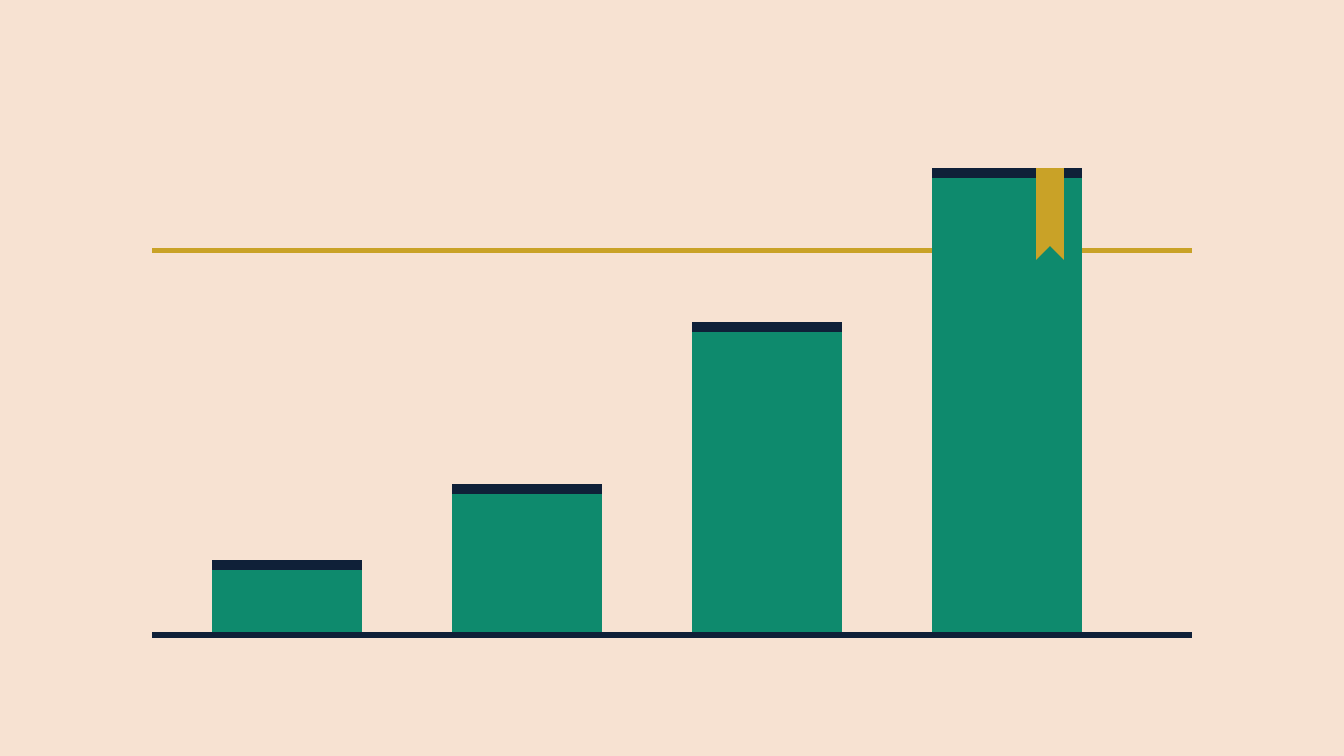
📈 Chart of the Day — four green days, two sizes of green
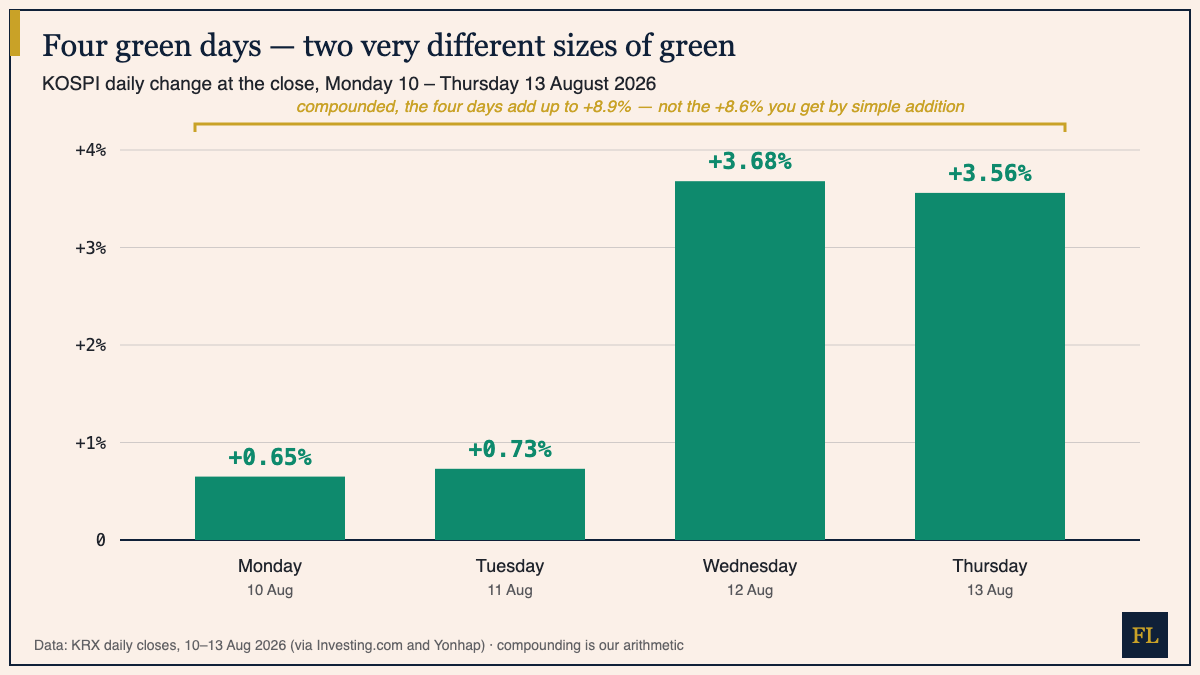
How to read this: a "four-day winning streak" sounds like four similar days, but the bars show two quiet steps and then two leaps — streak counts hide day sizes, so always look at the bars, not the streak. Second habit: the four days compound to +8.9%, a touch more than the +8.6% you get by adding them up, because each day's percentage applies to an already-larger number. One caution belongs next to all this green: on the Seoul exchange today, falling stocks outnumbered rising ones 532 to 332. An index is weighted by company size, so two giants — Samsung Electronics, up almost 5% to 268,000 won, and SK hynix, up 5.92% — can lift the whole board while most stocks fall. Foreigners and institutions bought a net 2.8 trillion won of shares; individuals sold. A rally most stocks missed is a narrow rally, and narrow is a description worth remembering, not a verdict.
📅 Tonight, then tomorrow
Tonight at 9:30 pm Seoul time the US publishes July producer prices (PPI) — the wholesale cousin of Wednesday's consumer report, measuring prices further up the pipeline before they reach shoppers. After a tame CPI, traders will check whether the pipeline agrees. Tomorrow morning, watch two things in our table: whether Asia's first hour treats PPI as calmly as it treated CPI, and whether the rally stays a two-stock story — the breadth count, not the index, will tell you.
We explain; we never advise. Nothing here is investment advice.
Financial Literature is for educational and informational purposes only. Nothing here is investment, financial, legal, or tax advice, or a recommendation to buy or sell any security. Content is impersonal and not tailored to any individual. Data may contain errors — verify before relying on it. Sources: Investing.com (KRX daily closes); Korea Herald/Yonhap (session detail, won, breadth); TradingKey (Nikkei, chipmakers); Trading Economics (Hang Seng, STI, FX snapshots); CNBC (US CPI); Seoul Economic Daily (bull-market entry); BLS (PPI schedule).
— The Editorial Team