🌏 KOSPI −5.80% — the won disagreed
Seoul fell 5.80% and triggered a sidecar — yet the won closed below 1,400 for the first time since October. When two gauges disagree, read the currency.


Numbers compiled Wednesday, 19 August 2026, at 7:20 pm in Seoul (UTC+9). Tokyo, Seoul, Hong Kong and Singapore closes are final and settled. Bond and currency rows are late-Wednesday snapshots and say so.
South Korea's stock market and South Korea's currency told opposite stories today, and telling them apart is the whole lesson. The KOSPI fell 5.80% to 6,471.17 — Investing.com's settled row agrees — while the won pushed through 1,400 per dollar and closed at 1,398.27, its first finish below that line since 2 October last year. A market fleeing a country sells both. Today's market sold one and bought the other.
📊 The Dashboard — Wednesday, 19 August 2026
| Gauge | Level | Move | What this means |
|---|---|---|---|
| KOSPI (South Korea) | 6,471.17 | 🔴 ▼ −5.80% | Closed, settled — two sources agree. Foreigners sold a net 3.49 trillion won of shares and institutions 1.32 trillion; individuals bought 4.64 trillion against the tide. The fall was steep enough to trigger a sidecar — an automatic five-minute pause on program sell orders — at 9:06 am. Samsung Electronics fell 7.8%, SK hynix 9.7%; the small-cap KOSDAQ fell only 1.17% — this was a large-cap chip repricing, not an everything-selloff. |
| Nikkei 225 (Japan) | 65,326.42 | 🔴 ▼ −3.16% | Closed, settled — down 2,134.30 points, tracking Wall Street's chip selloff: Furukawa Electric fell 13.7%, Kioxia 12.6%. Yesterday the shock was Japan's own bond market; today it was imported. |
| Hang Seng (Hong Kong) | 25,495.07 | 🟢 ▲ +0.09% | Closed, settled — up 23.92 points, flat for a second straight day. The calmest row on the loudest day: a market with little AI-chip weight had little AI-chip pain. |
| USD/KRW | 1,398.27 | 🟢 ▼ 15.31 won | Onshore close, settled. Today's dissenter — the dollar index slipped below 100 on weak US data, and Korean exporters kept converting dollar earnings into won. The Spotlight explains why this row matters more than the red one above it. |
| USD/JPY | ≈159.1 | ⚪ ≈ flat | Late-Wednesday snapshot — the yen a touch firmer from Tuesday's 159.56, moved by the same soft dollar, not by Tokyo's bad equity day. |
| JGB 10-year yield (Japan) | ≈2.90% | ⚪ ▼ eased | Late-Wednesday snapshot — back from this week's peak near 2.95%, the highest since 1996. Yesterday's engine idled today; the selling pressure came from abroad instead. |
🌏 The SEA watch — this week's number: Singapore's STI
The rotation reaches Singapore, which gave the quietest answer to Asia's loudest day: the Straits Times Index slipped 0.22% to 5,694.24 — about 1.4% below the record it set earlier this month, still up roughly 35% this year. How to read that calm: the STI is heavy with banks, property trusts and dividend payers and holds almost no chipmakers, so on a semiconductor-led selloff it is the closest thing Asia has to a control group. When Singapore barely moves, the storm has a specific address.
The scheduled SEA event landed too: Bank Indonesia held its rate at 5.75% for a second straight meeting — interim governor Destry Damayanti's first decision in the chair — with July inflation at 2.88%, comfortably inside the 1.5–3.5% target band. The rupiah barely reacted, but it remains emerging Asia's weakest currency this year, down about 7% against the dollar. Read the choice, not the number: a central bank holding rates while inflation sits mid-target is defending its exchange rate. That priority is itself a gauge — the same one the region's central banks were forced to read in 1997.
⭐ Spotlight: 1,398.27 — the won closes below 1,400
USD/KRW is the number of won one dollar buys, so a falling number means a strengthening won. It fell today for reasons that had nothing to do with Seoul's stock market: weak US data pushed the dollar index below 100, and exporters flush with chip earnings kept selling dollars for won — even as foreign funds dumped 3.49 trillion won of Korean shares. Track this gauge because it separates a bad day from a dangerous one: in 1997, crashing stocks and a crashing currency confirmed each other; today the currency refused to confirm the stock market. Different people trade the two — equity sellers were repricing chip profits against higher US yields, while the currency market was pricing the dollar itself.
📈 Chart of the Day — four stock markets and one currency
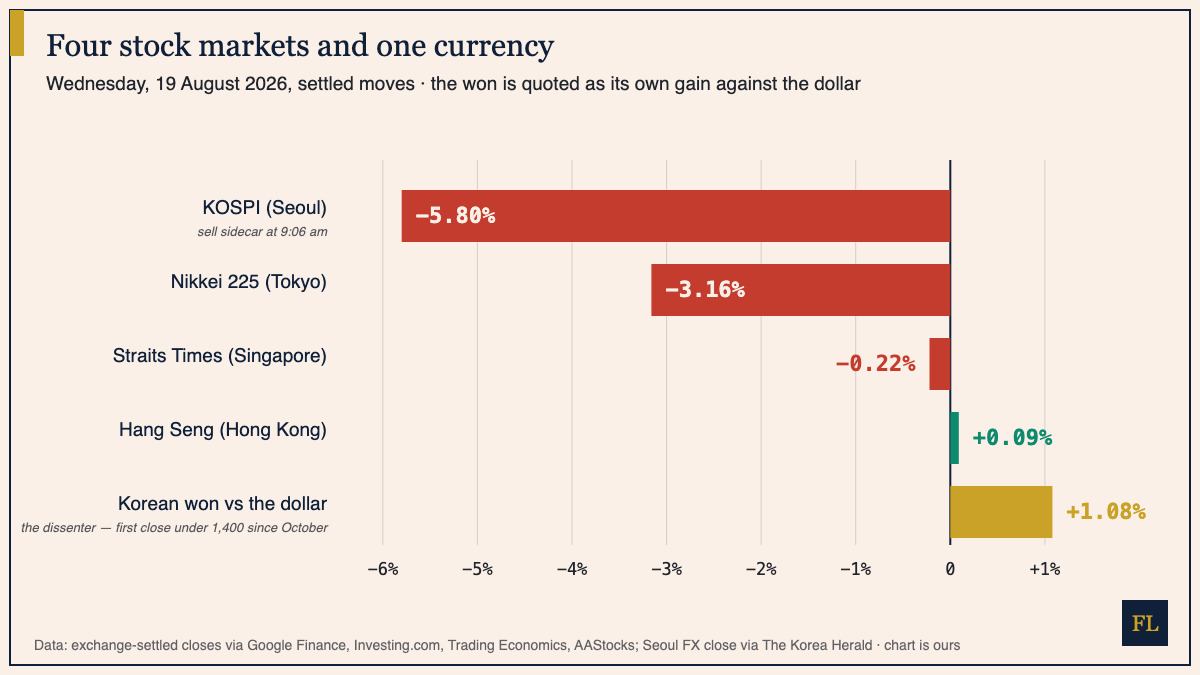
How to read this: the bottom bar is deliberately the odd one out — four stock markets and one currency, and the currency belongs to the country whose stocks fell hardest. A true crisis makes the gauges agree: stocks down, currency down, everything confirming everything (that was 1997's signature). Today's board shows the opposite pattern — the deepest equity fall in the region happened in the same country whose currency had its strongest close in more than ten months. The skill: when equities and the currency disagree, ask who is trading each. Foreign funds were repricing one trade — chips against higher US Treasury yields — while the currency market was selling a soft dollar. Disagreement between gauges usually means a repricing, not an exit.
📅 Tomorrow
The Fed publishes minutes of its July meeting at 2 pm Wednesday in Washington — overnight for Asia — from a meeting where three officials voted to raise rates. After today, check USD/KRW before the KOSPI: the currency will grade the minutes first. Friday brings FTSE Russell's list of Vietnamese stocks for the September index review, and next week Jackson Hole opens 27 August, with Fed chair Kevin Warsh's first keynote on Friday the 28th.
We explain; we never advise. Nothing here is investment advice.
Financial Literature is for educational and informational purposes only. Nothing here is investment, financial, legal, or tax advice, or a recommendation to buy or sell any security. Content is impersonal and not tailored to any individual. Data may contain errors — verify before relying on it. Sources: Google Finance (KOSPI, Nikkei, Hang Seng, USD/JPY); Investing.com (KOSPI settled); The Asia Business Daily (sidecar, flows); The Korea Herald (won); Trading Economics (Nikkei, JGB yield, STI); AAStocks (Hang Seng close); Kontan (Bank Indonesia); Newsquawk (FOMC minutes); Regards of Wall Street (Jackson Hole).
— The Editorial Team