🌏 KOSPI +5.89% — the round trip that didn't get home
Seoul rose 5.89% after the US Treasury doubled its long-bond buybacks — and still closed below Tuesday. Why a fall and a rise of equal size don't cancel.

Numbers compiled Thursday, 20 August 2026, at 4:30 pm in Seoul (UTC+9). Seoul and Tokyo closes are final and settled. Hong Kong (closes 4 pm local) and Bangkok (4:30 pm local) were still trading at compile time and their rows say so. Bond and currency rows are late-Thursday snapshots.
Seoul got most of Wednesday back today and still finished below Tuesday — the KOSPI rose 5.89% to 6,852.58, Investing.com's settled row agrees, and that arithmetic is today's whole lesson. The trigger came from Washington overnight: the US Treasury said it would at least double its buybacks of 10-to-30-year bonds, from $2 billion to $4 billion per operation, from 9 September, and the 30-year Treasury yield that had set a 19-year high on Tuesday fell about 9 basis points to around 5.19%. Lower long yields abroad were the permission slip; a record share buyback at home was the fuel.
📊 The Dashboard — Thursday, 20 August 2026
| Gauge | Level | Move | What this means |
|---|---|---|---|
| KOSPI (South Korea) | 6,852.58 | 🟢 ▲ +5.89% | Closed, settled — two sources agree. Chips did the lifting: Samsung Electronics rose 9.49% and SK hynix about 12.7%. Note the number that is not here: Tuesday's close of 6,869.83. Today's rise did not reach it. |
| Nikkei 225 (Japan) | 66,216.79 | 🟢 ▲ +1.36% | Closed, settled — Google Finance and Trading Economics agree on 66,217. Metals led in Tokyo, not chips. |
| Hang Seng (Hong Kong) | ≈25,760 | 🟢 ▲ ≈+1.05% | Still trading — a 3:20 pm Hong Kong snapshot, up about 265 points, with Google Finance and AAStocks within a few points of each other; the settled close comes tomorrow. Healthcare and technology names led, and China left its loan prime rates unchanged at 3.00% and 3.50%. |
| USD/KRW | ≈1,395 | ⚪ ≈ little changed | Late-Thursday snapshot — the won held under 1,400 per dollar for a second day. Yesterday it refused to confirm the selloff; today it had nothing to confirm. |
| USD/JPY | ≈158.4 | ⚪ ≈ flat | Late-Thursday snapshot — the yen a touch firmer than earlier in the week, moved by softer US yields rather than by anything Tokyo did. |
| JGB 10-year yield (Japan) | ≈2.85% | 🟢 ▼ eased | Late-Thursday snapshot — down from this week's 2.95%, the highest since 1996, following US yields lower. |
🌏 The SEA watch — this week's number: Thailand's SET
The rotation moves from Singapore to Bangkok, and Bangkok's session was still open when we compiled: the SET index was up 0.32% at 1,614.84 on delayed data, against Wednesday's close of 1,609.76 — a still-trading number, so a snapshot, not a close. The baht sat at about 32.85 per dollar, its strongest in roughly a month after touching 33.85 in late July.
The gauge to learn this week is the policy-rate gap. The Bank of Thailand's rate is 1.0% and Commerzbank expects it to stay there when the committee meets on Wednesday 26 August — against a US policy rate of 3.50–3.75%. A gap that wide means holding baht pays far less than holding dollars, so the currency depends on trade surpluses and tourist receipts rather than on yield to attract money; Commerzbank names foreign portfolio outflows and higher commodity prices as the two things that could weigh on it. That is the 1997 lesson in one row: the baht broke first that summer because the money holding it could leave quickly. We are not calling anything — a 1.0% rate with inflation near 2.8% is a central bank choosing growth over the exchange rate, and a baht strengthening anyway says trade flows are doing the work for now. Read the gap; watch which side changes.
⭐ Spotlight: 3.3% — what a buyback and cancellation actually does
SK hynix said it will buy back 40 trillion won of its own shares between 20 August and 19 November and cancel all of them — 24.07 million shares, 3.3% of those outstanding, the largest treasury-share cancellation by a listed Korean company. Two mechanics matter. The buying puts a large, steady bidder in the market for three months — that is why the stock jumped. The cancelling is permanent: every remaining share owns a slightly larger slice of the same profit, divided by 3.3% fewer shares. The reason investors read it as a signal rather than just a purchase: the company said it believes its share price is below its intrinsic value, after a 48.6% fall from June's peak, and Samsung is reported to be preparing a return programme of more than 100 trillion won, with a board meeting expected late this month. Notice that the word "buyback" did two different jobs today: a government buying its own bonds to calm yields, and a company buying its own shares to return cash. Same word, different gauges.
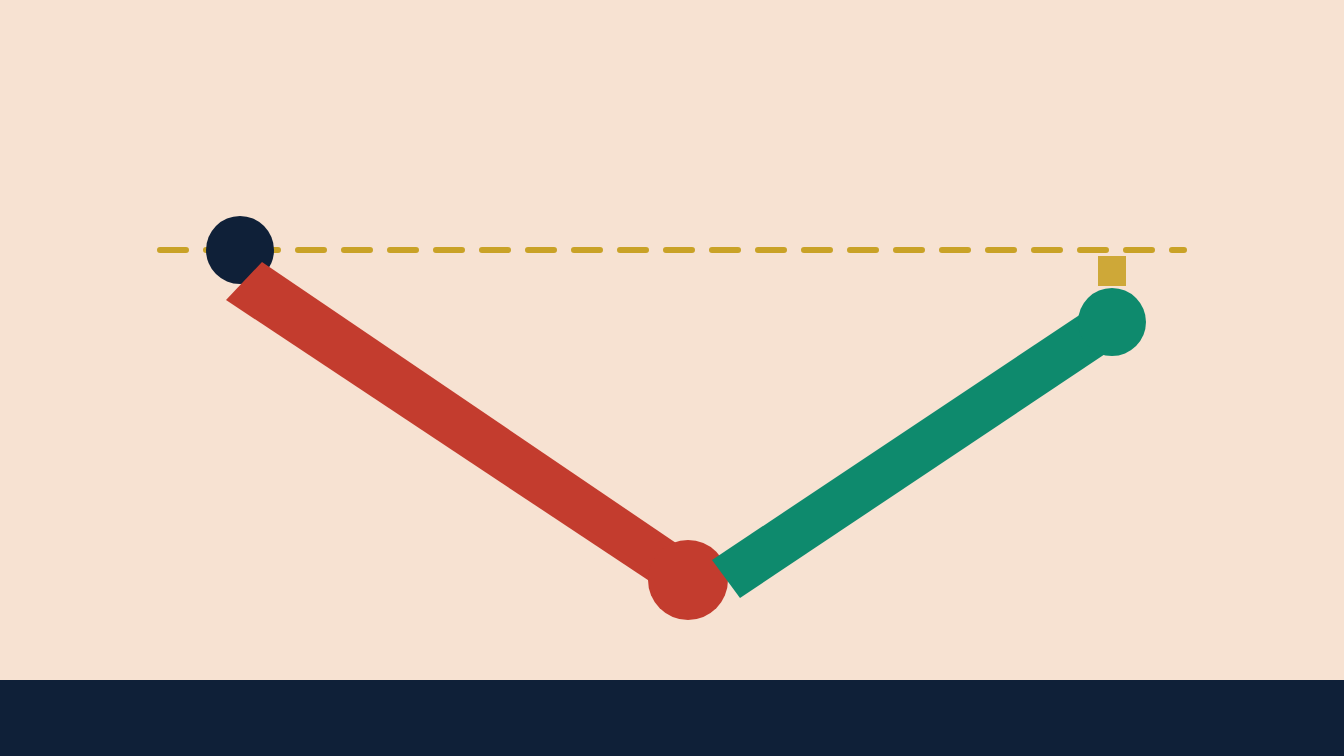
📈 Chart of the Day — the round trip that did not get home
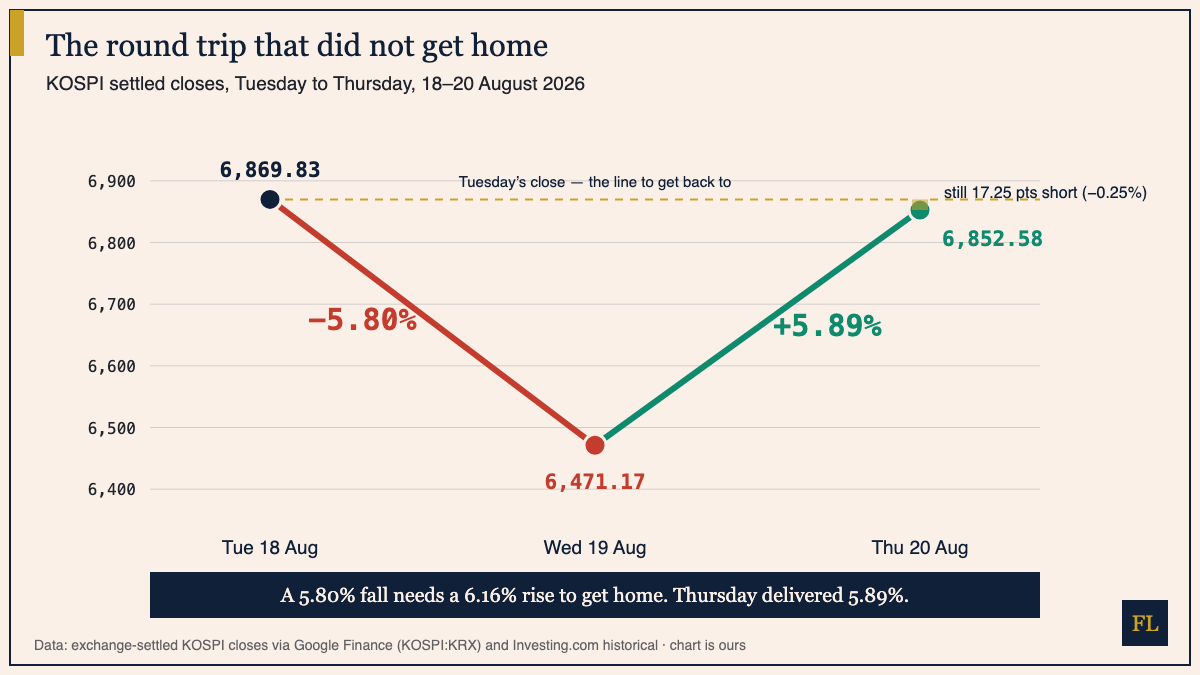
How to read this: percentages are not symmetric, because the second one is measured from a smaller base. A 5.80% fall from 6,869.83 lands at 6,471.17; to climb back, the index needs 6,869.83 ÷ 6,471.17 − 1, which is 6.16%, not 5.80%. Thursday's 5.89% looked like a full recovery in the headlines and left the KOSPI 17.25 points — 0.25% — short. The skill: whenever you see a fall and a rise of roughly equal size, check the levels, not the percentages. The deeper the fall, the wider the gap — a 20% fall needs a 25% rise, a 50% fall needs a double — which is why SK hynix's 48.6% slide from June is not undone by one 12.7% day.
📅 Tomorrow
Japan's July national inflation figures land at 8:30 am Tokyo time on Friday; June's headline rate was 1.7%. Read them against the JGB row above: a firmer print keeps the September rate-rise talk alive and the 10-year yield near its 30-year high; a softer one gives Tokyo's bond market more of the refund it started today. Next week, the Bank of Thailand decides on Wednesday 26 August and Jackson Hole opens Thursday the 27th.
We explain; we never advise. Nothing here is investment advice.
Financial Literature is for educational and informational purposes only. Nothing here is investment, financial, legal, or tax advice, or a recommendation to buy or sell any security. Content is impersonal and not tailored to any individual. Data may contain errors — verify before relying on it. Sources: Google Finance (KOSPI, Nikkei, Hang Seng, USD/KRW, USD/JPY, Samsung, SK hynix); Investing.com (KOSPI settled, Hang Seng, SET, Japan CPI calendar); Trading Economics (Nikkei, Hong Kong, JGB yield, US 30-year yield, baht), Fed funds rate, AAStocks (Hang Seng); Economic Insider (Treasury buybacks); The Korea Herald and Korea JoongAng Daily (SK hynix); Seoul Economic Daily (Samsung); FXStreet/Commerzbank (Thailand); Bank of Thailand (meeting calendar).
— The Editorial Team