🌏 Nikkei +0.74% — bad news, good day
Tokyo climbed toward 70,000 on a weak GDP print while Seoul and Jakarta stayed closed. Why bad news can make a good day — and Tuesday's tells to watch.


Numbers compiled Monday, 17 August 2026, at 9:30 pm in Seoul (UTC+9). Tokyo's and Hong Kong's closes are final and settled. Seoul and Jakarta did not trade today — public holidays — so their rows carry Friday's last settled close and say so. Currency rows are late-Monday snapshots; FX trades around the clock.
Tokyo closed within sight of 70,000 on the same morning Japan's economy missed its growth forecast — the Nikkei 225 rose 0.74% to 69,220.25, and the miss is today's whole lesson. The backdrop kept softening too: Friday night's US July retail sales fell 0.6% against a forecast rise of 0.1%, and futures markets now price about a 30% chance of a September Fed rate rise, down from 52% a week earlier.
📊 The Dashboard — Monday, 17 August 2026
| Gauge | Level | Move | What this means |
|---|---|---|---|
| Nikkei 225 (Japan) | 69,220.25 | 🟢 ▲ +0.74% | Closed, settled — three independent sources agree. The AI-memory chip complex did the lifting: Kioxia surged 15.07% while financials and consumer names mostly fell — a narrow day, aimed at 70,000. |
| KOSPI (South Korea) | 6,977.94 | ⚪ no session | Seoul was closed for the Liberation Day substitute holiday. Friday's settled close stands — the five-day winning streak is paused, not broken. The calendar has Seoul back at its desk on Tuesday. |
| Hang Seng (Hong Kong) | 25,453.23 | 🟢 ▲ +1.34% | Closed, settled — up 336.38 points, ending the four-day slide. Buyers stepped in even as Beijing signaled targeted support rather than a broad stimulus package — a market rising on less than it hoped for. |
| USD/JPY | 159.24 | ⚪ ≈ flat | A weak growth print did not move the yen. The gap between US and Japanese rates is still the gap — nothing repriced. |
| USD/KRW | ≈1,411 | 🟢 ▼ ≈5 won | Offshore snapshot — the onshore market was shut with everything else. The won firmed from Friday's ≈1,416 while Seoul slept; a lower number means a firmer won. Tuesday's open says whether onshore agrees. |
🌏 The SEA watch — this week's number: Jakarta's JCI
The rotation starts its second lap where the first began: Jakarta. There is no Monday number to print — Indonesia's market was closed for Independence Day, so Friday's settled close stands: the IDX Composite at 6,401.89, up 1.59%. The currency did trade: USD/IDR sat near 17,819 late Monday, a touch firmer than Friday — a quiet gauge on a loud week.
Loud, because Indonesia's central bank changes hands this week. Bank Indonesia's policy meeting opens Tuesday — the first since Governor Perry Warjiyo stepped down last month — chaired by acting Governor Destry Damayanti, after the bank raised rates by a full percentage point across May and June. This is exactly the situation our checklist exists for. When a central bank changes leadership mid-cycle, read three gauges in order: does the currency hold (it is holding, just below 17,800 in Monday's onshore trade); do the reserves hold (July's were broadly stable); does the rate path stay credible (that answer arrives with this week's decision). President Prabowo's Independence Day address projected growth reaching 6% next year — ambition is not a warning sign, but it is why the three gauges above earn a weekly look.
⭐ Spotlight: 1.1% — one quarter, two prints
Japan's economy grew 0.3% in the second quarter — an annualized rate of 1.1%, where forecasters expected roughly 2% annualized. Both numbers describe the same three months: the annualized version asks "what if the economy kept this pace for a year?" and compounds the quarterly figure four times over. The US reports GDP annualized, Japan leads with it, Europe mostly does not — so when growth headlines from different regions look wildly different, check which convention you are reading before you compare. Track it because the convention, not the economy, is often the difference.
📈 Chart of the Day — the quarter Tokyo shrugged off
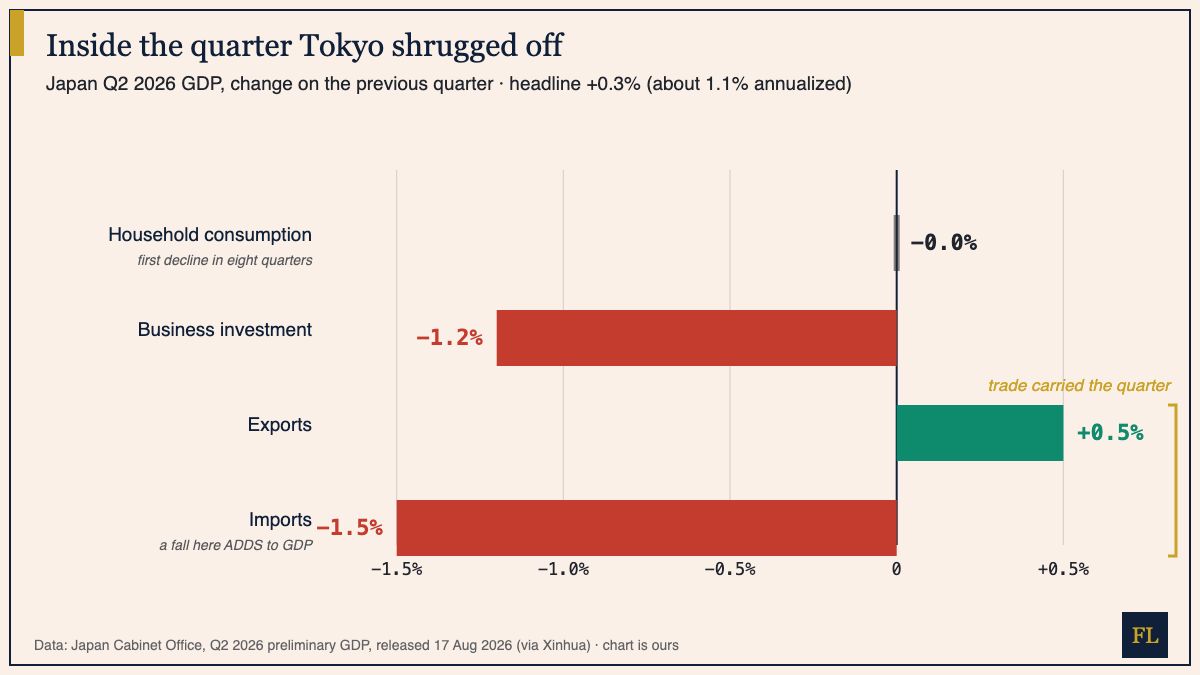
How to read this: two habits. First, read the insides before the headline: inside that "+0.3% growth" quarter, household consumption fell for the first time in eight quarters and business investment dropped 1.2% — Xinhua notes the drag from Middle East disruptions and energy costs. The growth came from trade, and half of that is an arithmetic quirk: imports fell 1.5%, and in GDP accounting money not spent abroad counts as a plus — a "growth" quarter can hide soft demand at home. Second, notice what the stock market did with a bad number: it rose, because the Nikkei extended gains after the data showed the economy expanded less than expected — soft growth keeps easier central-bank policy in view. Markets price the likely response to news, not the news itself; that is why "bad news, good day" is a pattern worth recognizing, not a paradox.
Also on the board: shipping through the Strait of Hormuz nearly stopped this weekend — five vessels transited Saturday and none on Sunday, against 31 the previous weekend — yet Brent crude sat near $88.67, up just 0.17%. A supply scare that does not move the price is itself information: traders are weighing reports of an Iran–Oman shipping arrangement, and of producers quietly moving barrels through anyway.
📅 Tomorrow
Seoul and Jakarta both come back from holiday. Watch two things in our table: whether the KOSPI's paused streak resumes after a Monday the rest of the world spent drifting higher, and whether the onshore won confirms the offshore firming to ≈1,411. In Jakarta, Bank Indonesia's meeting opens — the decision follows midweek, the first test of the post-Warjiyo rate path.
We explain; we never advise. Nothing here is investment advice.
Financial Literature is for educational and informational purposes only. Nothing here is investment, financial, legal, or tax advice, or a recommendation to buy or sell any security. Content is impersonal and not tailored to any individual. Data may contain errors — verify before relying on it. Sources: Google Finance (Nikkei, KOSPI, Hang Seng, JCI, FX); Investing.com (KOSPI historical); AAStocks (Hang Seng close); Trading Economics (Nikkei, Brent/Hormuz shipping); TradingKey (chipmakers, holiday closures); Xinhua (Japan Q2 GDP); FX.co (Bank Indonesia); FXStreet (rupiah, Fed odds, retail sales).
— The Editorial Team