🌏 Nikkei −2.54% — the bond market sent the bill
Japan's 10-year yield hit a 30-year high and Tokyo paid the bill. Seoul opened over 2% up and closed 1.55% down. How to read a day that reverses.

Numbers compiled Tuesday, 18 August 2026, at 7:45 pm in Seoul (UTC+9). Tokyo, Seoul, Hong Kong and Ho Chi Minh City closes are final and settled. Bond and currency rows are late-Tuesday snapshots and say so.
The bond market set Asia's direction today: Japan's 10-year government bond yield climbed to about 2.95% — its highest level since 1996 — and the Nikkei 225 fell 2.54% to 67,460.73, with Trading Economics confirming the 1,759.52-point drop. Seoul's morning told the opposite story before the afternoon corrected it — and that reversal is today's lesson.
📊 The Dashboard — Tuesday, 18 August 2026
| Gauge | Level | Move | What this means |
|---|---|---|---|
| Nikkei 225 (Japan) | 67,460.73 | 🔴 ▼ −2.54% | Closed, settled — two sources agree. The electronics complex gave back Monday's chip rally: Taiyo Yuden fell 11.5%, Murata 9.6%, and Kioxia — Monday's +15% star — dropped 7.6%. When the shock is in your own bond market, your stock market pays first. |
| KOSPI (South Korea) | 6,869.83 | 🔴 ▼ −1.55% | Closed, settled. The full path matters: opened 2.15% higher at 7,127.77, touched 7,216.62, then closed 108.11 points down, ending the five-day streak. Institutions sold about 780 billion won of shares; retail bought about 730 billion. |
| Hang Seng (Hong Kong) | 25,471.15 | 🟢 ▲ +0.07% | Closed, settled — up 17.92 points, flat on the day even though China's July data missed: industrial output grew 4.5% against 5.0% expected, retail sales 0.6% against 1.5%. A market already priced for disappointment is hard to disappoint. |
| USD/JPY | ≈159.6 | ⚪ ≈ flat | Late-Tuesday snapshot — the yen slipped slightly on the very day home yields hit a 30-year high. Remember GDP week's rule: FX prices the difference between two rates, and global yields rose together today. |
| USD/KRW | 1,411.8 | 🟢 ▼ 6.5 won | Onshore, settled. Monday we asked whether the onshore market would confirm the offshore firming to ≈1,411 — it did, closing 6.5 won firmer even on a falling stock day, with foreigners small net buyers of Seoul shares. |
| JGB 10-year yield (Japan) | ≈2.94% | 🔴 ▲ 30-yr high | Late-Tuesday snapshot — touched about 2.95% intraday, a level last seen in 1996. Today's engine; the Spotlight below explains how to read it. |
🌏 The SEA watch — this week's number: Vietnam's VN-Index
The rotation moves to Ho Chi Minh City, and Vietnam quietly finished green on Asia's red day: the VN-Index closed near 1,732, up 0.26%. The bigger picture is a market catching its breath — a record near 1,929 in May, a four-week slide to about 1,651, then a six-session rebound to 1,776 in early August as foreign investors turned net buyers, about 2.4 trillion dong over three sessions. The run at 1,800 stalled; the index now sits below the moving-average zone local analysts watch around 1,760.
Friday is the date on the calendar: 21 August, when FTSE Russell publishes the list of Vietnamese stocks meeting the criteria for its global index series, part of the September review of Vietnam's long-awaited promotion from frontier to emerging-market status. Index inclusion is one of the few calendar events where money moves mechanically — funds that track an index must hold what is in it, so the list itself redirects flows. Our 1997 lens applies calmly here: foreign inflows are the gauge to watch precisely because they can reverse; a scheduled inflow event like Friday's is also a test of whether the buyers stay once the news is out.
⭐ Spotlight: 2.94% — Japan's 10-year yield, a 1996 number
The 10-year Japanese government bond yield is the price Japan's government pays to borrow for a decade — and the baseline against which every yen-denominated asset is measured. For most of thirty years it sat near zero, which pushed Japanese savings abroad in search of income; a 10-year that pays almost 3% starts pulling that money home, and the flow is felt in every market it leaves. Track it now because it is rising for uncomfortable reasons — a proposed consumption-tax cut with no announced funding, and growing expectation of a Bank of Japan rate rise as early as September — and because today showed, live, what stocks do when it moves.
📈 Chart of the Day — one day, four markets
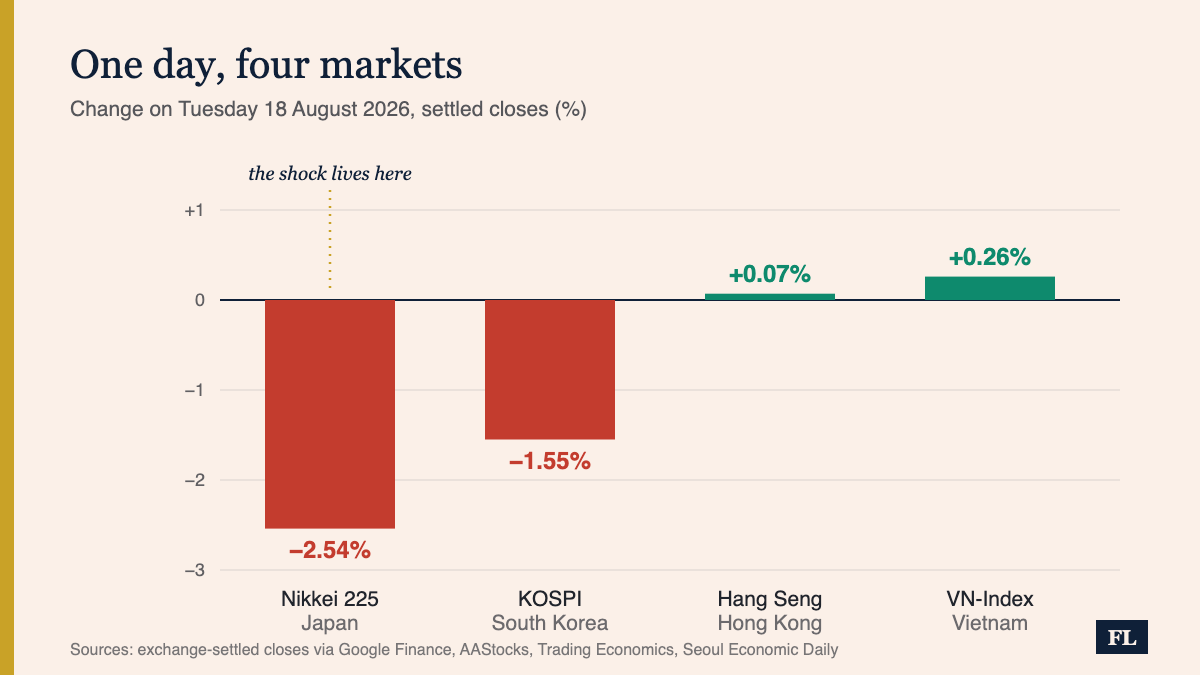
How to read this: when Asia falls together, the cause is usually global; when the board splits like today, you can locate the epicenter by who fell hardest. Japan fell most because the shock — a 30-year high in its own bond yield — is Japanese. Seoul caught the spillover plus its own profit-taking after five up days: rising oil, higher global yields and China's soft July data arrived just as the index touched 7,216 — the morning chip rally that had SK Hynix up more than 6% and Samsung up 3.46% in early trade faded into a 347-point round trip. Hong Kong and Vietnam, each trading on their own local story, barely moved. The skill: before blaming "sentiment," check whose bond market moved — that is usually where the day started.
📅 Tomorrow
Bank Indonesia's rate decision is due Wednesday — the first since Destry Damayanti was nominated as the bank's permanent governor, after a percentage point of rate rises since May. Watch the rupiah's reaction more than the decision itself. In Tokyo, read the 10-year yield before the index: if it keeps climbing toward 3%, stocks stay heavy; if it settles, the equity story resumes. Friday brings FTSE Russell's Vietnam list.
We explain; we never advise. Nothing here is investment advice.
Financial Literature is for educational and informational purposes only. Nothing here is investment, financial, legal, or tax advice, or a recommendation to buy or sell any security. Content is impersonal and not tailored to any individual. Data may contain errors — verify before relying on it. Sources: Google Finance (Nikkei, Hang Seng, USD/JPY); AAStocks (Hang Seng close); Trading Economics (Nikkei, JGB yield, VN-Index); Seoul Economic Daily (KOSPI, China data, oil); Korea JoongAng Daily (KOSPI, won); TradingKey (morning session); The Investor (Vietnam flows, FTSE); Bloomberg (Bank Indonesia).
— The Editorial Team