🌏 KOSPI −3.26% on an AI essay, and why 3:30 is still the close
Seoul fell hardest on a weekend call to slow AI, Tokyo's broad index rose, and Korea's new evening session left the meaning of the close untouched.


Seoul took the region's heaviest fall on the first day its main exchange stayed open until 8 in the evening.
Numbers compiled Monday, 14 September 2026, at 6 pm in Seoul (UTC+9), a 5-min read. The Tokyo, Seoul and Hong Kong closes are final; the currency, bond and oil rows are snapshots.
Yesterday's answer (Saturday's question): B. Japan's import prices in yen and in the contract currency price the same goods on two rulers, so the 8.1-point gap between them is the exchange rate. It is one measurement written twice, never two estimates to choose between and never two numbers to add.
Over the weekend Anthropic's chief executive, Dario Amodei, called on AI companies to slow the pace of development, and OpenAI's Sam Altman backed the call. Chipmakers are the shares most tied to that pace, and Seoul holds the most of them: in May, Samsung Electronics and SK hynix passed half of the KOSPI's total market value. The KOSPI closed 225.54 points lower at 6,684.37, down 3.26% for a third straight fall, with Samsung down 4.05% and SK hynix down 6.35%. Oil added weight: Saudi Arabia's East-West pipeline, its route around the Strait of Hormuz, is still shut after last week's attack.
📊 The Dashboard, Monday, 14 September 2026
| Gauge | Level | Move | What this means |
|---|---|---|---|
| Nikkei 225 (Japan) | 63,492.99 | 🔴 ▼ -0.81% | Closed, final: Google Finance, Yahoo Finance. SoftBank Group alone lost more than a tenth. |
| TOPIX (Japan) | 4,058.21 | 🟢 ▲ +0.74% | Closed: Investing.com. The broad board rose while the 225 fell: a few heavy names, not the whole market. |
| KOSPI (South Korea) | 6,684.37 | 🔴 ▼ -3.26% | Closed, final: Investing.com, Asia Economy. The 3:30 pm close; evening trades do not change it. |
| KOSDAQ (South Korea) | 806.79 | 🔴 ▼ -1.69% | Closed: Money Today. Fewer chipmakers, about half the fall. |
| Hang Seng (Hong Kong) | 24,917.60 | 🟢 ▲ +0.45% | Closed, final: Google Finance, Yahoo Finance. Higher on a day Seoul fell more than 3%. |
| USD/JPY | ≈154.5 | 🔴 ▲ yen weaker | Snapshot: 154.52, from 153.52. A weaker yen makes dollar-priced oil dearer in yen. |
| USD/KRW | 1,347.3 | 🔴 ▲ won weaker, 1.4 won | Seoul's 3:30 pm close. The won barely moved on a day of heavy foreign selling of shares. |
| JGB 10-year yield (Japan) | ≈3.00% | 🔴 ▲ +1 bp | Snapshot: 2.999%, from 2.987%, touching 3.000% in the day; red because a higher yield means a lower bond price. |
| Brent crude | ≈$108.0 | 🔴 ▲ +3.2% | Snapshot, still trading: $107.98, from $104.61. Red because Asia buys crude, not sells it. |
What happened, in plain words
A weekend essay moved Asia's markets by what each index holds, not by where it sits. In Seoul, where two chipmakers are half the index, foreign investors sold a net 3.3 trillion won of shares and individuals bought 2.97 trillion. Tokyo split in two. The Nikkei 225 is weighted by share price and the TOPIX by market value, so heavy technology names such as SoftBank Group, an OpenAI investor, pulled one down while the rest of the market lifted the other, the gap Saturday's explainer walked through. Rates sit behind all of it: the Federal Reserve decides on Wednesday with a rise widely expected, and the Bank of Japan meets Thursday and Friday.
⭐ Spotlight: the official close, 3:30 pm in Seoul
From today the Korea Exchange runs an after-market from 4 pm to 8 pm in which orders match the moment a buyer and a seller agree, replacing an after-hours auction that priced every ten minutes; Nextrade, the alternative venue, already trades from 3:40 pm to 8 pm. The official close does not move with the clock. "The price set in the KRX regular session at 3:30 pm is the day's official close," and the KOSPI's closing level and the next day's price limits are both computed from it; if Samsung or SK hynix rise in the evening, the KOSPI close published that day "is not recalculated". People track the distinction because one share can now carry two evening prices, one per venue, beside a close that was written hours earlier.
📈 Chart of the Day: a twelve-hour day with one close
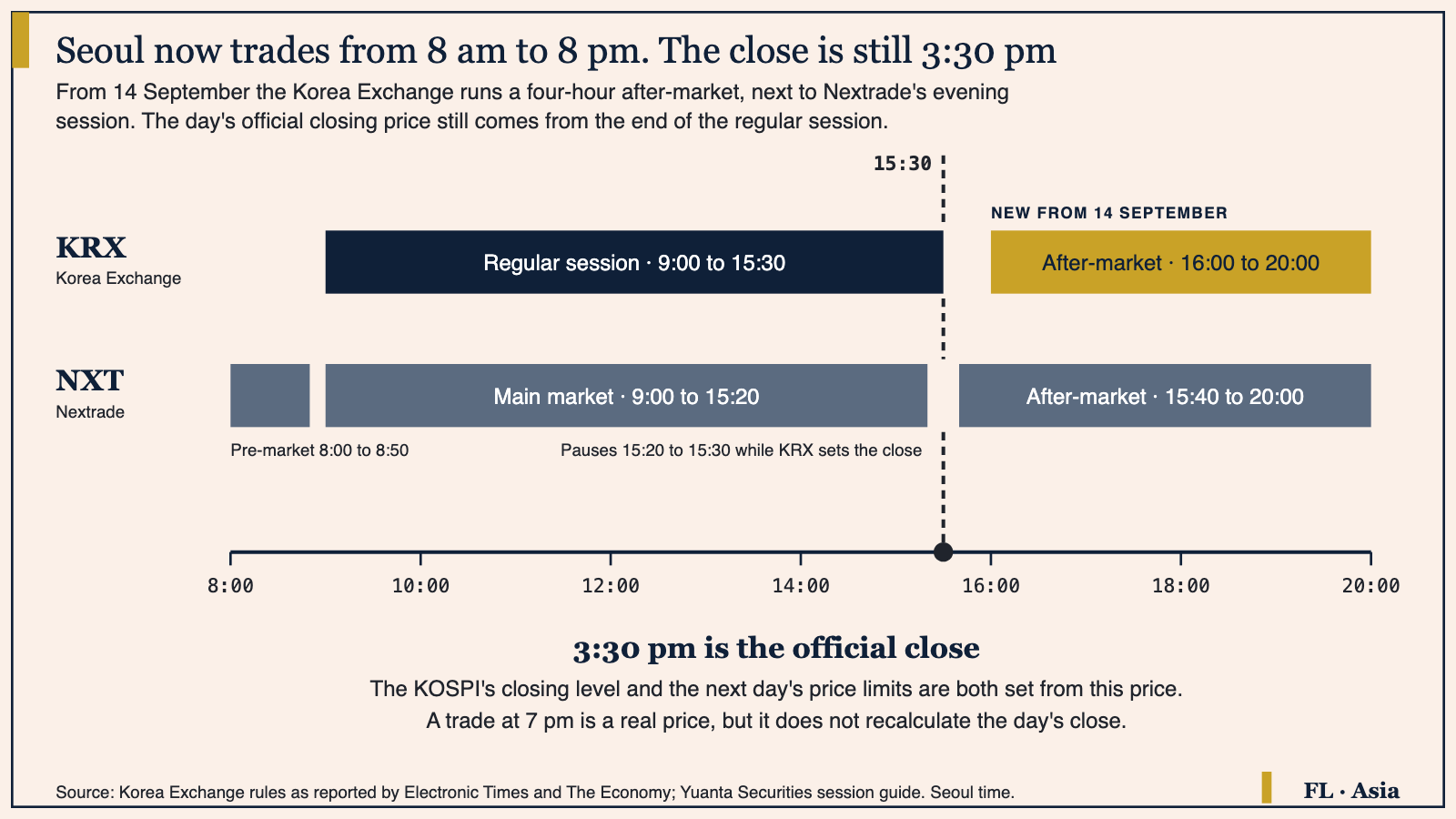
How to read this: a timetable chart is read by its edges, not its bars. Find the edge that produced the number you are about to quote: the KOSPI's close comes from the right-hand end of the dark bar at 15:30, not from the last bar on the page at 20:00. Anything to the right of that line is a real trade at a real price, but it is measured against a close that has already been set. It is the same habit that puts a time on every row of our dashboard.
🌏 SEA watch: the rupiah's price of the day is an average
The rotation moves to Indonesia, where the official rupiah rate is not a close at all. Bank Indonesia's JISDOR is "the weighted average based on the transaction volume and exchange rates" of interbank dollar trades between 9:00 and 15:00 Jakarta time, published at 15:15, so it says where a whole day's trading was centred rather than where it ended. Friday's JISDOR was 17,611 rupiah per dollar, against 17,746 on 31 August, a rupiah about 0.8% firmer over two weeks; Monday's fixing came in at 17,635, while the market quote slipped toward 17,650, a third weaker session. One rule on Bank Indonesia's page is worth keeping: when too few interbank trades land in the window, JISDOR repeats the previous day's rate. A rate that does not change can mean a thin market, not a calm one.
📅 Tomorrow
Tuesday, 10 am in Beijing: China's statistics bureau publishes August industrial output, retail sales, fixed-asset investment and property figures, the month's fullest read on Chinese demand, with the back series on China NBS on the Data Catalog. Watch retail sales against industrial output: the gap says whether households or factories carried August. The Fed's two-day meeting starts the same day; Saturday's letter read the import prices on the Bank of Japan's desk before Friday's decision.
One question. Today's chart showed Seoul trading from 8 am to 8 pm, with the official close at 3:30 pm. Suppose SK hynix trades 2% above its 3:30 price at 7 pm. Which reading is right? A: Monday's KOSPI close is revised to include the 7 pm price. B: Monday's KOSPI close stands; the 7 pm trade is a later price for one share, measured against a close that was already set. C: The 7 pm trade is not a real price, because the market had closed.
Financial Literature is for educational and informational purposes only. Nothing here is investment, financial, legal, or tax advice, or a recommendation to buy or sell any security. Content is impersonal and not tailored to any individual. Data may contain errors, verify before relying on it. We explain; we never advise. Sources: Korea Exchange rules via Financial News, Segye Ilbo, Electronic Times and The Economy, Bank Indonesia, China NBS, Federal Reserve, Google Finance, Yahoo Finance, Investing.com, Trading Economics, Money Today, Asia Economy, Hankyung, Minju Shinmun, Seoul Economic Daily, AP, investingLive.
Forwarded this by a friend? Subscribe here. Found it useful? Forward it to one person who'd want it.
— The Editorial Team