🌍 2.8% — the oil rally reaches German price tags
Germany confirmed July inflation at 2.8% this morning, with energy up 8.3%. How a Gulf strait ends up on a German price tag, in plain words.


Compiled Wednesday, 12 August 2026, mid-morning in Europe (about 10:00 CEST). Every dashboard row is a final Tuesday close; the snapshot beneath the table is live intraday and labeled as such.
Germany's statistics office confirmed this morning that consumer prices rose 2.8% in the year to July — and the energy line inside that number, up 8.3%, is last month's oil turmoil arriving on actual price tags.
📊 The Dashboard — Tuesday, 11 August 2026 (closes)
| Gauge | Level | Move | What this means |
|---|---|---|---|
| STOXX 600 (pan-Europe) | ≈660.8 | ⚪ +0.01% | Flat to the decimal — but flat at the top is still a record, by a whisker. |
| DAX (Germany) | 26,391.43 | 🟢 ▲ +0.26% | Another record close. Frankfurt has set the pace all month. |
| FTSE 100 (UK) | 10,844.20 | 🔴 ▼ −0.17% | A second small slip — London has mostly sat out this record run. |
| CAC 40 (France) | 8,714.95 | 🔴 ▼ −0.13% | Rotation row: Paris gave back Monday's small gain on a cautious day. |
| EUR/USD | ≈1.1540 | ⚪ flat | The euro is parked until this afternoon's US inflation number. |
| GBP/USD | ≈1.3504 | ⚪ flat | The pound is waiting on tomorrow morning's UK growth report. |
| Bund 10Y yield | ≈3.15% | ⚪ eased a touch | Germany's benchmark borrowing rate neared 3.20% mid-session, then slipped back as a Hormuz deal briefly looked closer. |
Wednesday, live: as of mid-morning, Brent crude is near $89.57 — a sixth straight session of gains — and the Bund yield is ticking around 3.16%. These are intraday snapshots, not closes; Wednesday's final board lands in tomorrow's issue.
What happened, in plain words
Tuesday traded on sentences rather than numbers. Early in the day Washington's line hardened — compensation demands on Iran were formally added to the negotiating brief — and oil rose. Then Pakistan's defence minister said Washington and Tehran were “close to some sort of arrangement” on the Strait of Hormuz, reports put parallel talks between Iran and Oman at an advanced stage, and oil handed the gains back. A senior Iranian official closed the day insisting the strait stays shut until Tehran's conditions are met. Net result: Brent spent the session swinging above $88 a barrel and finished modestly higher — headline in, price up; headline out, price down.
The stock board barely acknowledged any of it. The DAX ground out another record close while London and Paris slipped a fraction, and the STOXX 600 moved one-hundredth of a percent. When indices go this still, it usually means investors have already placed their bets and are waiting for a number — and this week's number arrives this afternoon, from Washington.
⭐ Spotlight: Germany's inflation rate — 2.8% (July, final)
The inflation rate measures how much more a typical household's basket of goods and services costs than a year earlier, compiled by Destatis, Germany's federal statistics office. “Final” means this morning's release re-checked end-July's early estimate against complete data — confirmation rather than news, but it carries the detailed breakdown the early number lacks. It sits on our board because the European Central Bank steers interest rates against a 2% target, so every tenth of a percent above that feeds the argument about where rates go next.
📈 Chart of the Day — inside the 2.8%
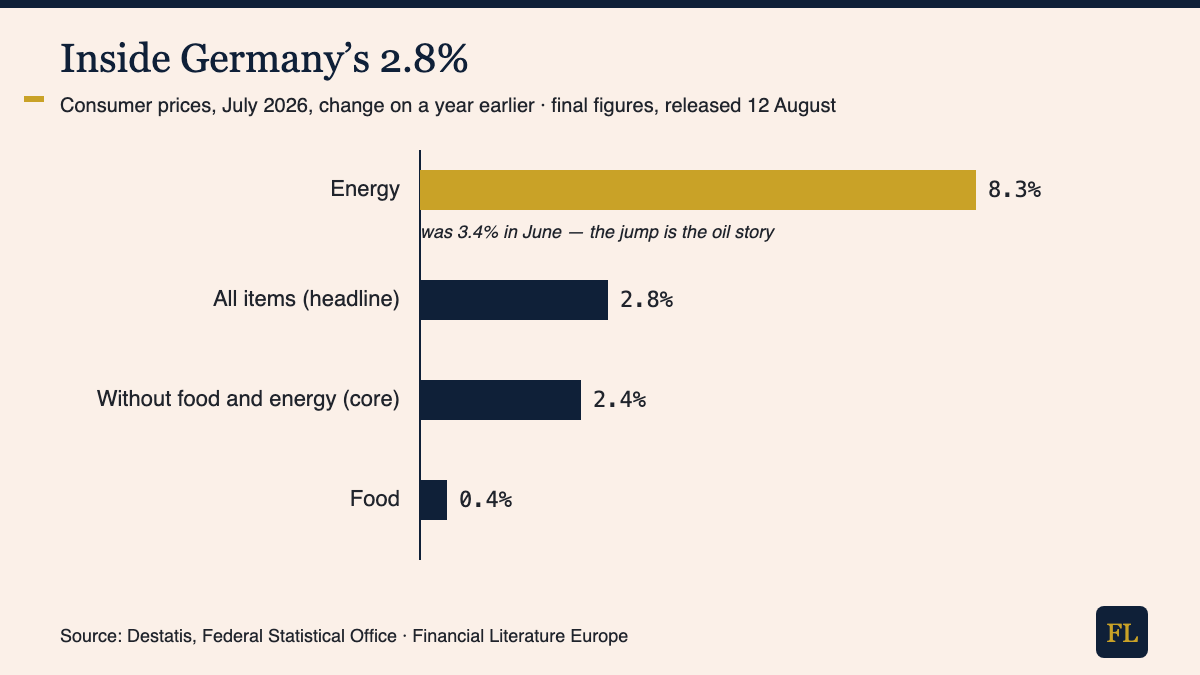
How to read this: “headline” inflation is the average of everything; “core” strips out food and energy, because those two swing with weather and geopolitics rather than with the domestic economy. Now read the gaps. Core at 2.4% is the home-grown part of German inflation, and nearly all the distance from there to the 2.8% headline is the gold bar — energy, up 8.3% in a year, after 3.4% in June. For two issues we have traced the chain oil → expected inflation → bond yields through market prices; today the statistics office printed the same chain in official data. Telling imported heat from home-grown heat is the reading skill here: it is exactly the distinction central bankers argue over when deciding whether a number like 2.8% demands a response.
📅 This afternoon, then tomorrow
The week's main event lands at 14:30 CET: the US consumer-price report (CPI). Forecasters expect inflation of 3.4%, easing from 3.5% — and the market reaction rides on the distance from that expectation, not the number itself. European bond yields and the euro will move with it. One quieter detail for the oil row: US crude inventories rose 9.1 million barrels last week, the biggest build since February — a reminder that supply data can move this gauge even while diplomacy owns the headlines. Tomorrow morning brings UK GDP, the growth report card that shapes what the Bank of England does with rates — and therefore the pound.
We explain; we never advise. Nothing here is investment advice.
Financial Literature is for educational and informational purposes only. Nothing here is investment, financial, legal, or tax advice, or a recommendation to buy or sell any security. Content is impersonal and not tailored to any individual. Data may contain errors — verify before relying on it. Sources: Destatis; Trading Economics; investinglive; CNBC; Investing.com; Alliance News via Yahoo Finance.
— The Editorial Team