🌍 3.1% — British inflation rose on petrol; core and services did not move
UK inflation rose to 3.1% in August from 2.9%, and core held at 2.6%. The whole move was one month's arithmetic. The Bank of England decides on Thursday.


Compiled Wednesday, 16 September 2026, at about 11 in the morning in Frankfurt (CEST, UTC+2), a 5-min read. Index rows are Tuesday's closes, final. The currency, bond and oil rows are Wednesday snapshots, still trading, and say so.
Yesterday's answer (Saturday's question): B. A staff projection is conditional arithmetic, not a promise and not a rate path. It says what inflation would do if a stated set of assumptions holds, and those assumptions were frozen on 19 August with oil assumed to average $88 a barrel this quarter. Brent has spent every session since above that.
Britain's inflation rate rose to 3.1% in August, from 2.9% in July, one day before the Bank of England decides on interest rates.
Two other numbers in the same release did not move at all. Core inflation, which strips out energy, food, alcohol and tobacco, held at 2.6%, and services inflation held at 3.4%. What moved was transport, to 4.6% from 3.6%, and inside transport, motor fuels: petrol averaged 161.3 pence a litre in August, the dearest since November 2022, and diesel 181.8 pence.
Today is also the day the European Central Bank's September rise takes effect. The deposit rate moves to 2.50%, the main refinancing rate to 2.65% and marginal lending to 2.90%, and the Federal Reserve announces its own decision this evening, European time.
📊 The Dashboard, Tuesday, 15 September 2026 (closes)
| Gauge | Level | Move | What this means |
|---|---|---|---|
| STOXX 600 (pan-Europe) | 634.18 | 🔴 ▼ -0.28% | Final: Investing.com and The Irish Times. The lowest close since 12 June. Wednesday morning a little higher, still trading. |
| DAX (Germany) | 25,402.28 | 🔴 ▼ -0.15% | Final: Investing.com and Google Finance. Wednesday 25,452.80 at 9:56 Frankfurt time, still trading. |
| FTSE 100 (UK) | 10,658.13 | 🔴 ▼ -0.37% | Final: Investing.com and The Irish Times. Wednesday 10,690.45 at 9:11 London time, after the inflation figure, still trading. |
| Oslo All Share (Norway, rotation row) | 2,532.42 | 🟢 ▲ +0.19% | Investing.com and Trading Economics. Norway sells oil and gas, so its market reads a dear barrel the opposite way round to everyone else's, and it rose on a day the rest of Europe fell. |
| EUR/USD | 1.1539 | ⚪ euro softer | Tuesday's ECB reference rate, published once a day. Wednesday, still trading: 1.1547. |
| GBP/USD | ≈1.3470 | ⚪ barely moved | Wednesday snapshot, still trading: 1.3470, from 1.3478. An inflation figure in line with forecasts leaves a currency where it was. |
| Bund 10Y yield | 3.53% | 🔴 ▲ +0.4 bp | Tuesday's close, 3.5343% from 3.5306%. Wednesday morning about 3.55%, still trading. Red because a higher yield means a lower price for bonds already issued. |
| Gilt 10Y yield (UK) | 5.38% | 🔴 ▲ +3 bp | Tuesday's close, 5.3848% from 5.3551%, above the 5.28% we wrote about two weeks ago. Wednesday morning about 5.37%, still trading. |
| Brent crude | $108.75 | 🔴 ▲ +2.90% | Investing.com and Trading Economics, a four-month high after attacks closed a Saudi export pipeline. Wednesday about $108, still trading. Europe buys crude, so red when it rises. |
What happened, in plain words
One barrel of oil is doing most of the work in Europe's numbers this month, in two directions at once. Dearer fuel lifts an inflation rate, which is what Britain reported this morning. It also lifts the compensation lenders want for parting with money for ten years, which is why borrowing costs across the continent kept climbing on Tuesday while shares fell: European ten-year yields reached their highest in seventeen years, banks led the STOXX 600 down, and only the market of a country that sells oil finished higher.
The Bank of England will not read this morning's figure as one number. It will read the parts. A central bank can do nothing about the price of a barrel, and fuel costs drop out of the annual comparison on their own once the barrel stops rising. What it can act on is whether the shock has spread into the prices people charge each other, which is what the core and services measures are for, and both stood exactly where they stood in July.
⭐ Spotlight: CPIH, 3.3%
Britain publishes two headline consumer-price measures, and this morning they printed different numbers. CPIH rose 3.3% over the year, two tenths above CPI, because it adds one component CPI leaves out: the cost of living in a home you own, estimated from what that home would rent for. That component rose 3.9%. The statistics office calls CPIH its lead measure, since most households do own, while the Bank of England's 2% target is written against CPI. Which number you quote depends on which question you were asked.
📈 Chart of the Day: one month in, one month out
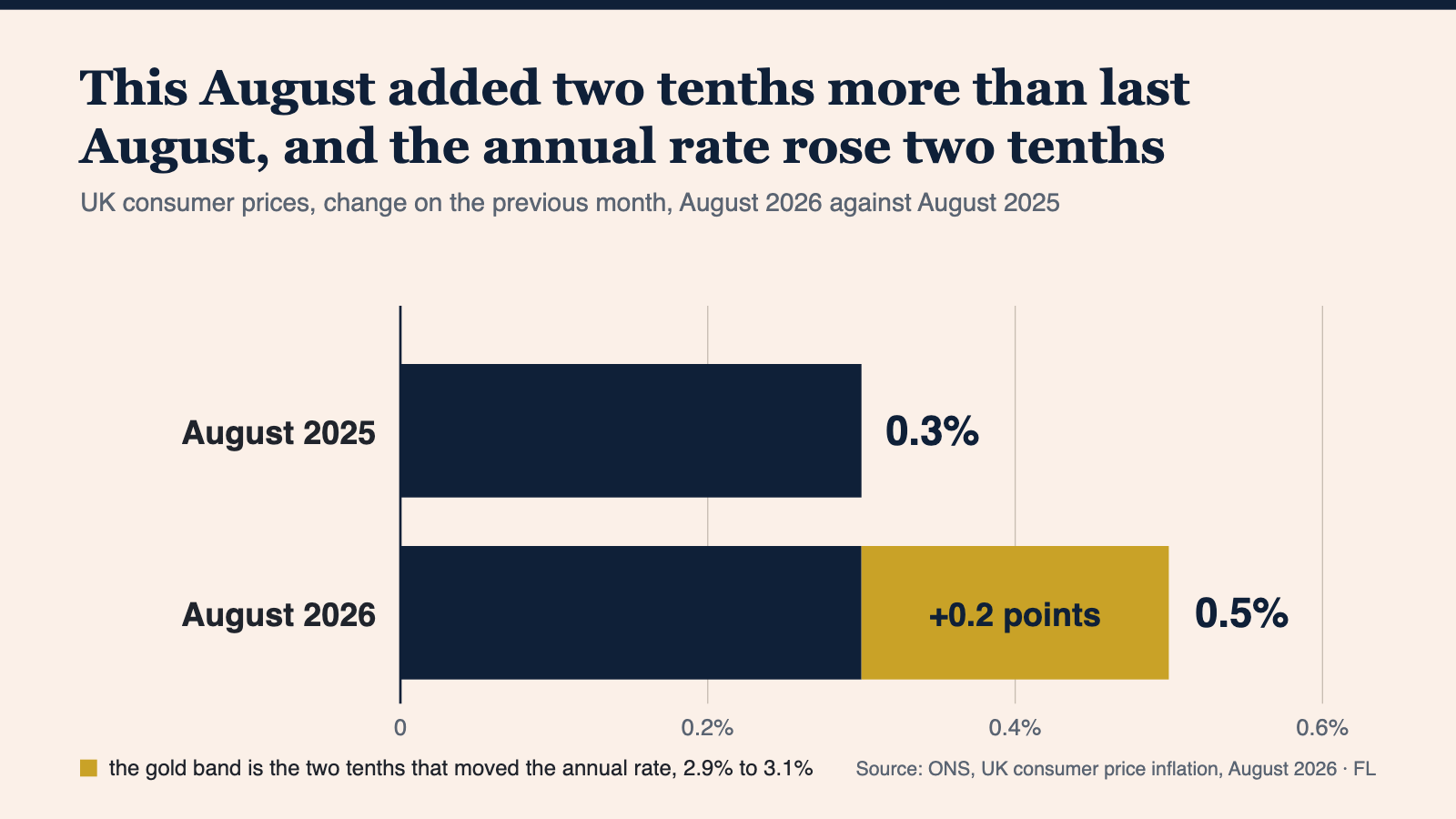
How to read this: an annual rate is twelve monthly changes chained together, so each month one of them leaves the sum and a new one joins it. The rate therefore moves by roughly the difference between the month arriving and the month it replaced: prices rose 0.5% in August 2026 against 0.3% in August 2025, and the annual rate went from 2.9% to 3.1%. So read any change in an annual rate twice, once for the month that arrived and once for the month that dropped out, because a rate can rise in a month when prices rose more slowly than they did the month before. Britain's rate and the euro area's sit on comparable definitions in the OECD Data Explorer on the Data Catalog.
📅 Tomorrow
Two central banks and one statistics office. The Bank of England announces at noon London time on Thursday, with Bank Rate at 3.75% and this morning's figure on the table; the vote split will say more than the level, because it counts how many members read an energy shock as something to act on. Eurostat fills in the euro area's August inflation on Thursday, after a flash estimate of 3.3%. The Federal Reserve decides tonight with fresh projections attached; Saturday's letter explains what a projection round is and what it is not.
One question. Today's chart showed UK consumer prices rising 0.5% in August 2026 against 0.3% in August 2025, with the annual rate moving from 2.9% to 3.1%. Which reading is right? A: Prices rose 3.1% during the month of August. B: The annual rate moved two tenths of a point because the month joining the twelve added 0.5% where the month leaving had added 0.3%. C: A higher annual rate means prices are rising faster every month than they were before.
Financial Literature is for educational and informational purposes only. Nothing here is investment, financial, legal, or tax advice, or a recommendation to buy or sell any security. Content is impersonal and not tailored to any individual. Data may contain errors, verify before relying on it. We explain; we never advise. Sources: UK Office for National Statistics, European Central Bank, Bank of England, Eurostat, Investing.com, Trading Economics, Google Finance, Reuters via The Irish Times.
Forwarded this by a friend? Subscribe here. Found it useful? Forward it to one person who'd want it.
— The Editorial Team