🌍 4.50% — the Fed raised rates, and Saudi Arabia followed within hours
Saudi Arabia raised its rate to 4.50% within hours of the Fed's first rise since 2023. The Bank of England decides at noon London time today.


Compiled Thursday, 17 September 2026, at about 11 in the morning in Frankfurt (CEST, UTC+2), a 5-min read. Every dashboard row is Wednesday's close, final, and the currency, bond and oil rows include Wednesday evening, when the Federal Reserve decided. The Bank of England decides at noon London time today, after this letter was written.
Yesterday's answer: B. An annual rate is twelve monthly changes chained together, so it moves by roughly the gap between the month joining and the month leaving: August 2026 joined at 0.5%, August 2025 left at 0.3%, and Britain's rate went from 2.9% to 3.1%.
Saudi Arabia's central bank raised its repo rate to 4.50% within hours of the Federal Reserve's first rise since 2023, and the central banks of the UAE, Qatar, Bahrain and Oman moved the same night.
The Federal Reserve raised its target range by a quarter point to 3.75% to 4% at 8 pm Frankfurt time on Wednesday, by 12 votes to none, and its statement named the reason in three words: "Inflation remains elevated." This morning Eurostat put the euro area's August inflation at 3.2%, a tenth below its first estimate of 3.3%, with services adding 1.43 points to that figure and energy 1.29. The Bank of England, with Britain's inflation at 3.1%, decides at noon London time today.
📊 The Dashboard, Wednesday, 16 September 2026 (closes)
| Gauge | Level | Move | What this means |
|---|---|---|---|
| STOXX 600 (pan-Europe) | 637.09 | 🟢 ▲ +0.46% | Investing.com and The Irish Times. The first rise in three sessions, up from Tuesday's lowest close since June. |
| DAX (Germany) | 25,537.75 | 🟢 ▲ +0.53% | Investing.com and Trading Economics. A half-point gain is an ordinary day; energy names led, carmakers fell. |
| FTSE 100 (UK) | 10,688.47 | 🟢 ▲ +0.28% | Investing.com and The Irish Times. Housebuilder Barratt Redrow rose nearly 12% on its results. |
| Tadawul All Share (Saudi Arabia, rotation row) | 10,779.96 | ⚪ ▼ -0.02% | Investing.com and Yahoo Finance. Flat on the day. Riyadh trades Sunday to Thursday, so today is its last session of the week. |
| EUR/USD | ≈1.147 | 🔴 ▼ -0.65% | 1.1469 from 1.1544. The euro's biggest one-day fall this week came on the day dollar rates rose. The ECB's reference rate, fixed before the decision, was 1.1537. |
| GBP/USD | 1.3382 | 🔴 ▼ -0.71% | From 1.3478. The pound fell a little more than the euro, one day before its own central bank decides. |
| Bund 10Y yield | 3.51% | 🟢 ▼ -2 bp | 3.5098% from 3.5343%. Green because a lower yield means a higher price for bonds already issued. |
| Gilt 10Y yield (UK) | ≈5.30% | 🟢 ▼ lower | About 5.30%, from 5.38% on Tuesday, a bigger fall than the Bund's on the day oil dropped and Britain's core inflation held still. |
| Brent crude | $105.83 | 🟢 ▼ -2.69% | Investing.com, down from Tuesday's four-month high of $108.75. Europe buys crude, so green when it falls. |
What happened, in plain words
Europe's Wednesday came in two halves. Before the decision, oil fell 2.7% from Tuesday's four-month high and European shares rose for the first time in three sessions, with travel stocks up 1.2% as fuel got cheaper, and Britain's ten-year borrowing cost fell further than Germany's on the morning its core inflation held still. By the end of the day, with the decision out, the euro and the pound were each about 0.7% weaker against the dollar. That is one event reaching two regions by two routes. A European currency floats, so a higher dollar rate shows up first in the exchange rate; the riyal and the dirham are fixed to the dollar, so it shows up in the interest rate instead, which is what five Gulf central banks changed overnight.
⭐ Spotlight: Saudi Arabia's repo rate, 4.50%
The repo rate is what Saudi Arabia's central bank charges banks to borrow from it, and on Wednesday night it rose a quarter point to 4.50%; the UAE's base rate went from 3.65% to 3.90% the same night. The riyal and the dirham are pegged to the dollar, and a fixed exchange rate only holds if money earns about what it would earn in dollars, or savers move it across the peg, so a Gulf policy rate is read as the Fed's decision carried over rather than as a verdict on Gulf inflation. Kuwait kept its rate at 3.50%, and its dinar is tied to a basket of currencies rather than to the dollar alone. The Saudi and US series sit side by side, month by month, in the BIS Data Portal on the Data Catalog.
📈 Chart of the Day: the gap that does not move
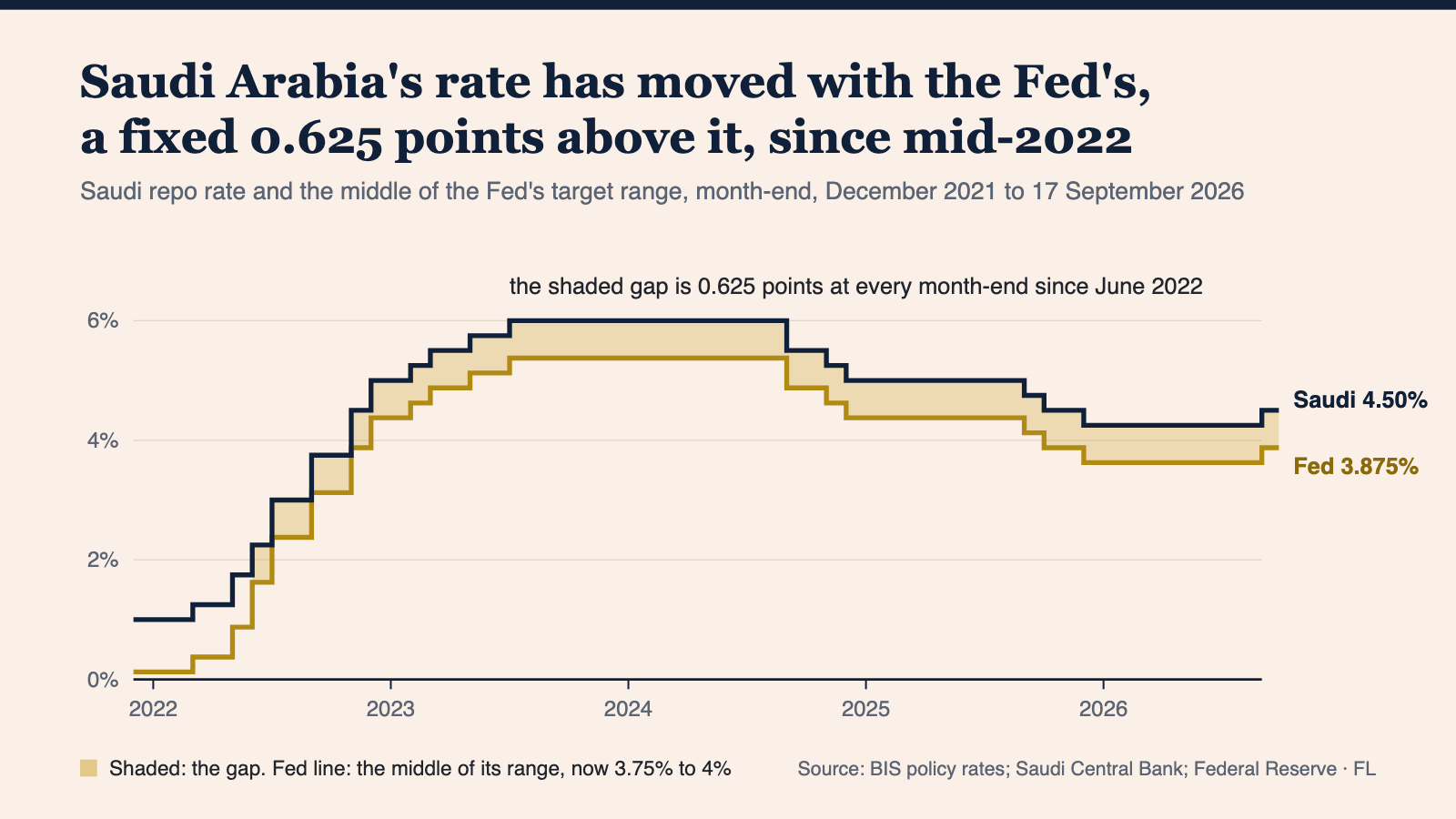
How to read this: when two lines climb and fall together, stop reading the lines and read the distance between them. Here the distance is the same 0.625 points at every month-end since June 2022, through the rises of 2022 and 2023 and the cuts of 2024 and 2025, and a gap that stays fixed while both levels move says one rate is being set off the other. The one narrowing on the chart came in June 2022, when the Fed's range rose three quarters of a point and Saudi Arabia's rate half a point; the day the gap moves again is the day worth noticing.
📅 Tomorrow
First, today. The Bank of England announces at noon London time, with Bank Rate at 3.75%. In July the vote to hold was 6–3, with Megan Greene, Catherine Mann and Huw Pill voting for a rise, so read the count before the rate: a 5–4 hold says something a 6–3 hold does not, and five votes to raise would be a rise. Friday at 7 am London time, the statistics office publishes August retail sales for Great Britain, the first read on shop spending in the month petrol cost the most since November 2022.
One question. Today's chart showed Saudi Arabia's repo rate and the middle of the Fed's range moving in steps, 0.625 points apart at every month-end since June 2022. Which reading is right? A: Saudi rates sit higher because Saudi inflation has been higher than American inflation. B: A gap that stays fixed while both levels move says one rate is being set off the other, so the gap is the thing to watch. C: Two lines moving together show two central banks separately reaching the same view of their own economies.
Financial Literature is for educational and informational purposes only. Nothing here is investment, financial, legal, or tax advice, or a recommendation to buy or sell any security. Content is impersonal and not tailored to any individual. Data may contain errors, verify before relying on it. We explain; we never advise. Sources: Eurostat, Federal Reserve Board, Saudi Central Bank and Central Bank of Kuwait via FX.co, Central Bank of the UAE via Gulf News, BIS, European Central Bank, Bank of England via MoneyWeek, UK Office for National Statistics, Investing.com, Yahoo Finance, The Irish Times, Trading Economics, Zawya, Serrari Group.
Forwarded this by a friend? Subscribe here. Found it useful? Forward it to one person who'd want it.
— The Editorial Team