🌍 2.9% — inflation jumped, and the Bank's gauge cooled
UK inflation rose to 2.9% in July on energy bills — yet services inflation, the Bank of England's watched gauge, eased. One report, three thermometers.

Compiled Wednesday, 19 August 2026, late morning in Europe (about 11:10 am CEST). Index rows are final Tuesday closes, settled and cross-checked; currency, bond, and oil rows are Wednesday-morning snapshots, still moving, and say so. The live paragraph beneath the table covers Wednesday so far.
Britain's inflation rate rose to 2.9% in July — and the pound barely moved, because the number the Bank of England watches most closely went the other way.
📊 The Dashboard — Tuesday, 18 August 2026 (closes)
| Gauge | Level | Move | What this means |
|---|---|---|---|
| STOXX 600 (pan-Europe) | 651.90 | 🔴 ▼ −0.69% | Final. A fifth straight decline and the first with real size — the worst day in nearly a month, with technology down 2.5% as bond yields climbed. |
| DAX (Germany) | 26,128.36 | 🔴 ▼ −0.80% | Final. Morning wires had Frankfurt down only 0.4% — the settled close shows the selling arrived in the afternoon. A close is the day's last word, not its average. |
| FTSE 100 (UK) | 10,728.04 | 🟢 ▲ +0.07% | Final. The six-session losing streak ended — barely. Oil majors did the lifting while energy was one of the few sectors to rise. |
| CAC 40 (France) | 8,509.36 | 🔴 ▼ −0.82% | Rotation row, final. Tuesday's weakest major board — Paris remains the most exposed to rising borrowing costs among the big four. |
| EUR/USD | ≈1.160 | 🟢 ▲ ≈0.2% | Wednesday snapshot, still trading. Markets still price roughly an 84% chance of a September ECB rate rise — the euro keeps trading the gap between two central banks. |
| GBP/USD | ≈1.354 | 🟢 ▲ ≈0.1% | Wednesday snapshot, still trading. The pound rose just 0.08% in the minutes after the inflation print — the market read the report exactly the way today's issue does. |
| Bund 10Y yield | ≈3.27% | ⚪ ≈ flat | Wednesday snapshot. Settled Tuesday at 3.261%, the highest since 2011 — our sources differ on whether that means March or April of that year; on "15-year high" they agree. |
Wednesday, live: as of late morning the STOXX 600 is roughly flat near 652, with basic-resources shares up about 0.6% on firmer gold and technology down about 0.4% on those same bond yields. Brent crude trades near $92.3, up about 1.4% — a fourth straight daily gain with the Strait of Hormuz still shut. Snapshots, not closes; Wednesday's final board lands tomorrow.
What happened, in plain words
The UK's July inflation report landed this morning: consumer prices rose 2.9% over the year, up from 2.6% in June — the first acceleration since March, and exactly what forecasters expected. The cause is mostly one bill: Ofgem's energy price cap rose about 13% on 1 July, and household gas prices jumped 14.7% on the month — the sharpest rise since October 2022 — with electricity up 3.6%. Food, going the other way, slowed to 1.3% from 1.7%.
Here is the reading skill: one report carries several thermometers, and today they disagree. The headline (everything) jumped to 2.9%. Core (which strips out food and energy) sat still at 2.6%. And services inflation — haircuts, insurance, rents, restaurant meals; the costs an economy generates by itself — eased to 3.4% from 3.6%. Pantheon Macroeconomics' Robert Wood put it plainly: "Lower services inflation partly offsets the inflation boost from energy." That split is why sterling shrugged: an energy-cap jump is imported weather, while services is the gauge that tells the Bank of England whether higher oil is leaking into home-grown prices — Governor Andrew Bailey has said that if the Middle East conflict persists and second-round effects appear, rates will likely need to rise. Today, the second-round gauge cooled — the same story yesterday's 2.8% private-sector pay number told from the wage side.
A correction, in our own ledger. Yesterday's "Tomorrow" section relied on a year-old markets preview: it put the July consensus near 4%, June at 3.6%, and the Jackson Hole gathering at 21–23 August. The settled facts: June was 2.6%, the July consensus was 2.9% (and was met), and Jackson Hole runs 27–29 August — next week. The error is ours, and it is the exact habit this letter preaches: before trusting a number, check when it was true.
⭐ Spotlight: UK services inflation — 3.4% (July)
Services inflation is the annual price change of the roughly half of the UK consumer basket that is services rather than goods — insurance, rents, hospitality, transport fares — published by the ONS inside every monthly inflation report. The Bank of England watches it more closely than the headline because services prices are made mostly of British wages, so they reveal whether inflation is home-grown and self-sustaining rather than imported through an energy bill or an exchange rate. Today it did exactly the job it exists to do: the headline jumped on gas, services eased to 3.4% — and that combination, more than either number alone, is why markets barely repriced the Bank.
📈 Chart of the Day — one report, three thermometers
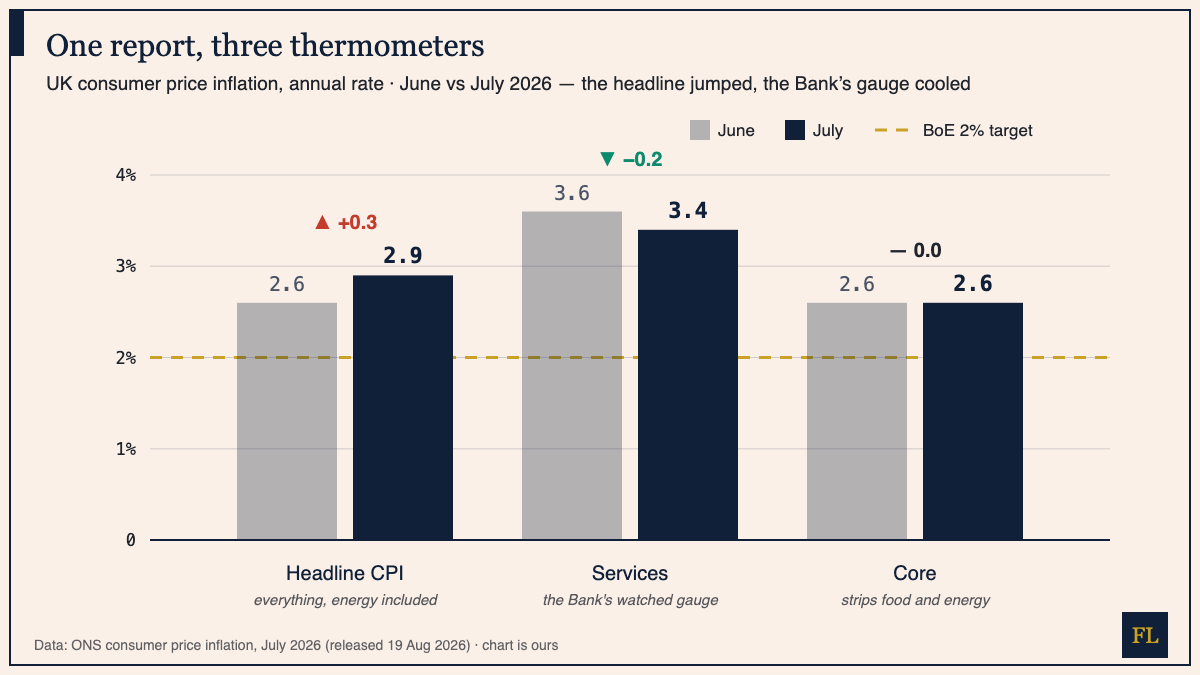
How to read this: three thermometers, one economy — they differ because each strips out different things, and the disagreement is the information. When the headline rises while services falls, the jump is coming from outside (an energy cap, an oil strait), not from the economy's own pricing. Yesterday we practised the same skill on one pay average hiding two pay rises; today's version: when inflation makes headlines, ask which inflation. The habit: find the gauge the central bank reads before deciding what a print "means".
📅 Tomorrow
Tonight at 8 pm CEST, after Europe closes, the Federal Reserve publishes minutes of its 28–29 July meeting — Thursday's open here will be Europe's first chance to price whatever they reveal, with Bund yields already at 15-year highs. The region's own next marker is Friday's flash PMIs, the first read of August activity — and the last big data before the Jackson Hole symposium opens on 27 August.
We explain; we never advise. Nothing here is investment advice.
Financial Literature is for educational and informational purposes only. Nothing here is investment, financial, legal, or tax advice, or a recommendation to buy or sell any security. Content is impersonal and not tailored to any individual. Data may contain errors — verify before relying on it. Sources: ONS consumer price inflation, July 2026; MoneyWeek live coverage; FXStreet (CPI report); G. Benigno's CPI note; Investing.com historical (STOXX 600, DAX, FTSE 100, CAC 40); Reuters via Yahoo Finance (Tuesday wrap); Trading Economics (EUR, Bund, Brent, Wednesday session); Finance Calendar (Jackson Hole); Equals Money (FOMC minutes).
— The Editorial Team