🌍 6.1% vs 2.8% — one country, two pay rises
Britain's average pay grew 3.5% — public wages up 6.1%, private just 2.8%. What one average hides, and why tomorrow's inflation print is the real test.


Compiled Tuesday, 18 August 2026, late morning in Europe (about 11:30 am CEST). Index rows are final Monday closes, settled and cross-checked; currency and bond rows are Tuesday-morning snapshots, still moving, and say so. The live paragraph beneath the table covers Tuesday so far.
Britain's official pay number came out this morning at 3.5% — but the public sector's raise was 6.1% and the private sector's just 2.8%, and that gap is the day's whole lesson.
📊 The Dashboard — Monday, 17 August 2026 (closes)
| Gauge | Level | Move | What this means |
|---|---|---|---|
| STOXX 600 (pan-Europe) | 656.41 | 🔴 ▼ −0.22% | Final. A fourth small daily decline in a row — together the four cost less than half a percent, a drift rather than a slide, as rising bond yields lean on shares. |
| DAX (Germany) | 26,338.61 | 🔴 ▼ −0.38% | Final. Gave back most of Friday's gain — Frankfurt led the week's scoreboard, but higher borrowing costs are now pressing on the leader too. |
| FTSE 100 (UK) | 10,720.30 | 🔴 ▼ −0.28% | Final. A sixth consecutive losing session — Friday's issue counted five, and Monday's afternoon fade kept the streak alive. |
| CAC 40 (France) | 8,579.60 | 🔴 ▼ −0.66% | Rotation row, final. Monday's weakest major board — Paris is the most exposed to the bond move, with France's 10-year borrowing rate near a 16-year high. |
| EUR/USD | ≈1.157 | ⚪ ≈ flat | Tuesday snapshot, still trading. Markets continue to price roughly an 84% chance of a September ECB rate rise — the euro is holding last week's gains rather than adding to them. |
| GBP/USD | ≈1.353 | 🔴 ▼ ≈0.1% | Tuesday snapshot, still trading. The pound slipped from Monday's three-month high after this morning's jobs report — softer pay data reads as less pressure on the Bank of England. |
| Bund 10Y yield | ≈3.25% | ⚪ +3 bp | Tuesday snapshot. Germany's benchmark borrowing rate crossed to its highest since March 2011 — the number quietly driving most of this table. |
Tuesday, live: as of late morning the STOXX 600 was down a few tenths of a percent near 653, with energy shares up 0.6% as Brent moved above $91, while basic-resources stocks dropped about 1% as higher yields pressured gold and other metals. The FTSE 100 was roughly flat — BP and Shell up 1.4–1.8% offsetting the miners — which, if it holds, would finally end the losing streak. One bright spot from Germany: the ZEW investor-sentiment survey rose for a third straight month this morning, with early prints near 30 against July's 26.3. Snapshots, not closes; Tuesday's final board lands tomorrow.
What happened, in plain words
The UK's monthly jobs report landed this morning, and the headline said "steady": unemployment held at 4.9% in the three months to June — though forecasters had expected a tick down to 4.8%. Under the headline, the cooling continued: payrolled employees fell 94,000 over the year on July's provisional count, and job vacancies slipped to 707,000 — the lowest in more than five years. ING's James Smith put it plainly: "If the UK economy really is picking up speed, then there's little sign of it in the jobs market."
But the day's reading skill is in the pay numbers. Average regular pay grew 3.5% over the year — up a touch from 3.4%. Quote that number alone and Britain sounds fine. But the average is a blend of two very different economies: public-sector regular wages rose 6.1%, while private-sector pay — most of the workforce — grew just 2.8%, which one data provider notes is its weakest pace since late 2020. The 3.5% is almost nobody's actual raise: it sits between two numbers, close to neither. On the ONS's own inflation-adjusted measure, average regular pay grew just 0.5% in real terms — and tomorrow's inflation print will show how much of the cash raise prices are currently eating.
⭐ Spotlight: UK regular pay growth — 3.5% (April–June 2026)
Average weekly earnings growth — "regular pay" strips out bonuses — is the Office for National Statistics' measure of how fast British paycheques are rising, published monthly alongside the jobs figures. It sits on our board because it is one of the Bank of England's most-watched numbers: wages are the main cost in a services economy, so fast pay growth can keep inflation circulating (each raise chases the last price rise, and vice versa), while cooling pay — like today's private-sector 2.8% — takes pressure off. The catch you now know: it is an average, and this morning it is hiding a 6.1%-versus-2.8% split between the public and private sectors.
📈 Chart of the Day — one average, two raises
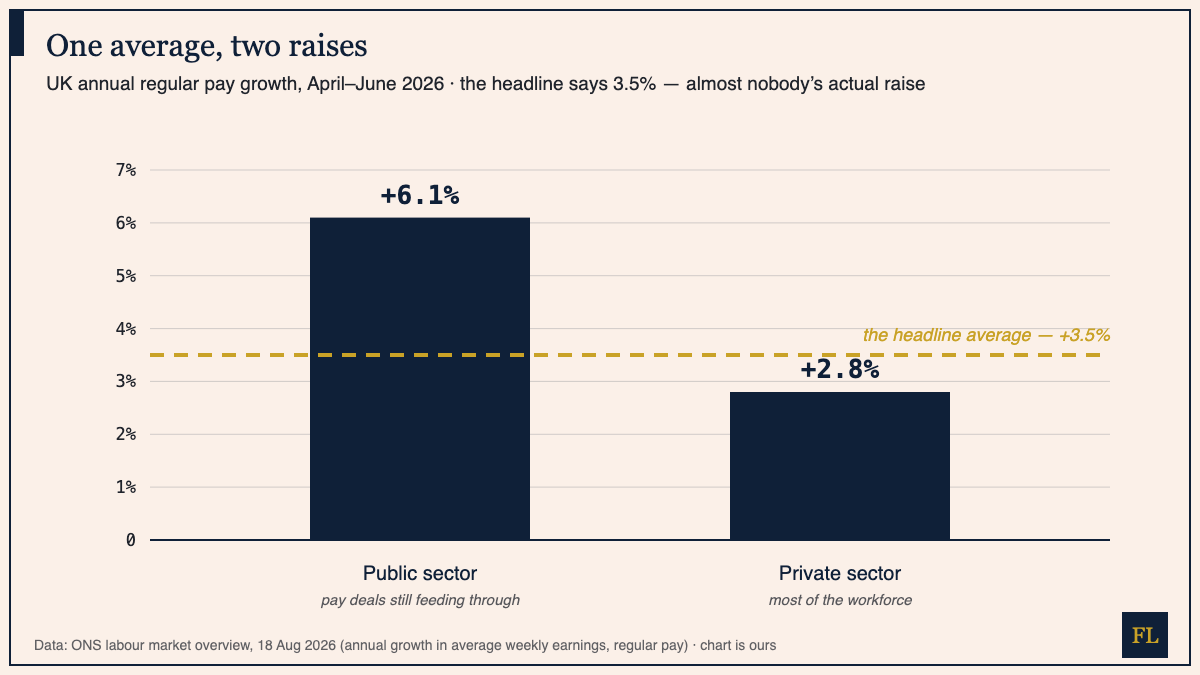
How to read this: the gold dashed line is the number that makes headlines — and notice that it touches neither bar. Last week we practised this skill on stock indices (asking which index before believing "Europe fell"); today it is statistics: an average is a recipe, and you want to know the ingredients. Habit to build: when a single number describes many people — average pay, average house price, average return — ask what the biggest groups inside it are doing. The answer is often two stories, not one.
📅 Tomorrow
Wednesday morning is the week's main event: UK July inflation, where forecasters expect the headline rate rose to slightly below 4.0%, from June's 3.6%. The Bank of England has projected a 4.0% peak in September — a near-4 July would bring that test forward, and set today's 2.8% private-sector raise against a price number well above it. The pound's reaction will be the verdict to watch. Also tomorrow: minutes from the Fed's last meeting, ahead of Thursday's flash PMIs and the Jackson Hole central-bank gathering, 21–23 August.
We explain; we never advise. Nothing here is investment advice.
Financial Literature is for educational and informational purposes only. Nothing here is investment, financial, legal, or tax advice, or a recommendation to buy or sell any security. Content is impersonal and not tailored to any individual. Data may contain errors — verify before relying on it. Sources: ONS labour market overview, August 2026; Proactive Investors (jobs coverage); Investing.com historical (STOXX 600, DAX, FTSE 100, CAC 40); Xinhua via Bastille Post (Monday closes); Trading Economics (FTSE, GBP, EUR, Bund); Reuters via ts2 (Tuesday session); Investing.com calendar (ZEW); FXStreet (week ahead).
— The Editorial Team