🌍 Washington bought the bonds — Europe's banks fell anyway
The US Treasury doubled long-bond buybacks to $4bn an operation; yields and the dollar fell — yet BNP and ING dropped 2.4%. A flat index hid a split market.

Compiled Thursday, 20 August 2026, mid-morning in Europe (about 10:20 am CEST). Index rows are final Wednesday closes, settled and cross-checked; currency, bond, and oil rows are Thursday-morning snapshots, still moving, and say so. The live paragraph beneath the table covers Thursday so far.
Long-term bond yields fell on both sides of the Atlantic on Wednesday — not because any central bank moved, but because the US Treasury said it would buy back twice as many of its own long bonds. Europe's banks fell anyway.
📊 The Dashboard — Wednesday, 19 August 2026 (closes)
| Gauge | Level | Move | What this means |
|---|---|---|---|
| STOXX 600 (pan-Europe) | 651.16 | 🔴 ▼ −0.11% | Final. A sixth straight daily decline by our ledger — the longest run since November 2025, yet the six together cost barely 1.5%. Today's chart shows why "flat" was the wrong word for Wednesday. |
| DAX (Germany) | 26,091.33 | 🔴 ▼ −0.14% | Final. A small step lower as Infineon slid 4% on worries about US AI spending — Frankfurt's chip exposure is the channel through which an American tech wobble arrives here. |
| FTSE 100 (UK) | 10,743.35 | 🟢 ▲ +0.14% | Final. A second modest gain, carried by miners — Rio Tinto rose 4% and Glencore 5% on firmer gold. London's index is heavy in diggers and drillers, so a commodity day flatters it. |
| CAC 40 (France) | 8,501.91 | 🔴 ▼ −0.09% | Rotation row, final. Nearly unchanged, but the average hides a tug-of-war: BNP Paribas fell 2.4% while LVMH gained about 2%. Paris is a bank-and-luxury index; Wednesday they pulled opposite ways. |
| EUR/USD | ≈1.169 | 🟢 ▲ ≈0.1% | Thursday snapshot, still trading. The euro reached about $1.167 on Wednesday, its highest in three months, as the dollar weakened after the Treasury announcement — the move is mostly a dollar story, not a euro one. |
| GBP/USD | ≈1.363 | 🟢 ▲ ≈0.2% | Thursday snapshot, still trading. Sterling strengthened to around $1.356 on Wednesday and has climbed further this morning — the same weaker dollar, read through a different pair. |
| Bund 10Y yield | ≈3.25% | 🟢 ▼ ≈1 bp | Thursday snapshot. Trading Economics marked Wednesday at 3.27%, the highest since May 2011, before the late pullback that followed Washington's buyback news; this morning it sits just below Tuesday's settle. A green arrow here means borrowing got cheaper, not that anything "went up". |
Thursday, live: as of mid-morning European shares are little changed, with the Euro STOXX 50 near 6,438, carmakers higher (BMW up 1.4%, Volkswagen 1%) and SAP, BASF and Rheinmetall down around 1.3–1.5%. Brent crude trades near $93, up more than 4% so far this week, with the US–Iran impasse unresolved. Snapshots, not closes; Thursday's final board lands tomorrow.
What happened, in plain words
Two things arrived from Washington on Wednesday, and it matters which one moved markets. First, at lunchtime in New York, the Treasury announced it would double its "liquidity support" buybacks of longer-dated bonds from $2 billion to at least $4 billion per operation, covering maturities from 10 to 30 years, from 9 September to 4 November. Within minutes, the 30-year US yield fell roughly 10 basis points to about 5.19% from close to its highest level in 19 years, the dollar index dropped 0.7%, and the pressure that had been pushing German and French yields to multi-year highs eased too. DZ Bank's René Albrecht put the motive plainly: "They fear the pain of 5% or higher yields on the long-end, not only because it raises the interest rate costs for the government but also for the private sector."
Second, after Europe closed, the Federal Reserve published minutes of its July meeting. They read hawkish — "many participants assessed that policy tightening would likely be necessary if inflation did not decline" — and yet markets now price only a 34% chance of a September US rate rise, down from about 60% three weeks ago. Hawkish words, falling odds: the minutes described July; the buyback described September. Markets trade the nearer date.
Here is the reading skill. A yield can fall for two very different reasons: because a central bank is expected to cut (cheaper money for everyone), or because a big buyer shows up for a particular bond (less supply to absorb). Wednesday was the second kind. That is why European banks — BNP Paribas and ING down 2.4% each; Santander, UniCredit and Intesa Sanpaolo off 1.3% — did not celebrate: banks earn the gap between short and long rates, and a long-end rally engineered by a buyer narrows that gap without lowering anyone's funding cost. Miners rose on the weaker dollar and firmer gold; luxury rose on a calmer rate outlook; chipmakers fell on US AI-sector doubts. Add it up and the STOXX 600 printed −0.11%. The index was quiet. The market was not.
⭐ Spotlight: the US–German 10-year gap — about 1.4 percentage points
The "transatlantic spread" is simply the US 10-year Treasury yield minus the German 10-year Bund yield. Wednesday it ran roughly 1.4 points — Reuters reported the US 10-year near 4.65% after the buyback news, against a Bund settle near 3.26% (we print the gap as approximate because the two legs were marked at different moments). Why anyone tracks it: money tends to flow toward the higher safe yield, so when the gap narrows — as it did Wednesday, with US yields falling faster than German ones — the dollar usually weakens against the euro. That is the mechanism behind today's EUR/USD row, and it is why a Treasury press release in Washington can lift the price of a coffee in Frankfurt's exchange-rate terms.
📈 Chart of the Day — one flat index, two markets underneath
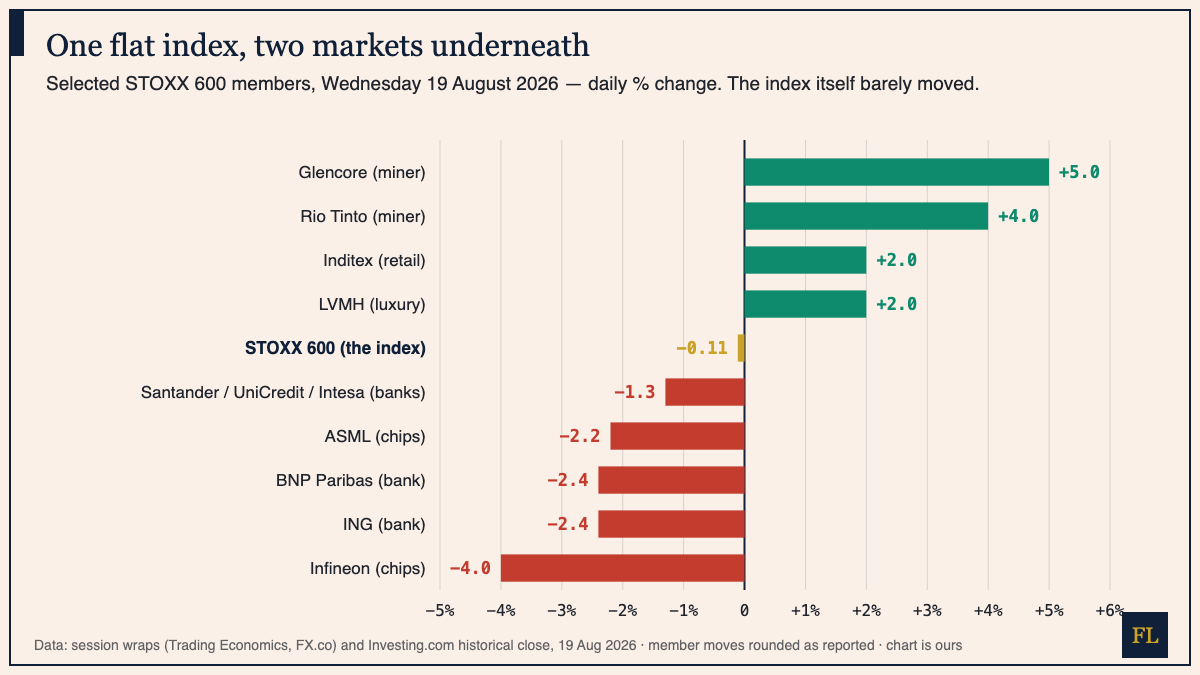
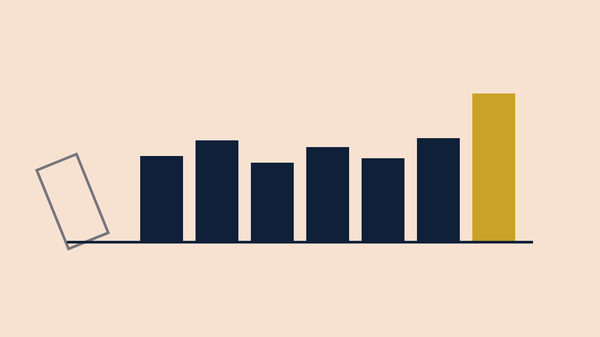
How to read this: the gold bar is the index; every other bar is a member. When the index sits near zero while members fan out four or five points either side, the day's information is in the spread, not the average — a market sorting winners from losers by one driver (here: who benefits from a weaker dollar and lower long yields, and who does not). Yesterday's lesson was "which inflation?"; today's is "which part of the index?". The habit: whenever a headline says "markets were flat", look for the widest bars before believing it.
📅 Tomorrow
Friday brings the August flash PMIs — France at 9:15, Germany at 9:30 and the euro area at 10:00 CEST — the first survey read on whether July's return to growth survived higher oil and higher yields. Watch the services line against 50, the line between expansion and contraction. After that the calendar thins until Jackson Hole opens on 27 August.
We explain; we never advise. Nothing here is investment advice.
Financial Literature is for educational and informational purposes only. Nothing here is investment, financial, legal, or tax advice, or a recommendation to buy or sell any security. Content is impersonal and not tailored to any individual. Data may contain errors — verify before relying on it. Sources: Investing.com historical (STOXX 600, DAX, FTSE 100, CAC 40); Trading Economics (session wrap, EUR, GBP, Bund, Brent); FX.co (Wednesday wrap); Investing.com (losing streak); Reuters via Yahoo Finance (Treasury buybacks); Global Banking & Finance (Reuters instant view); FXStreet (FOMC minutes); Investing.com calendar (flash PMI); Finance Calendar (Jackson Hole).
— The Editorial Team