🌎 +0.2% — the Treasury stepped into its own bond market
The Treasury will at least double buybacks of 10–30-year debt; the 30-year yield backed off 2007 highs and stocks rose 0.2%. Plus Fed minutes and Walmart.

Compiled Thursday, 20 August 2026, about 7:30 a.m. in New York (Eastern Time), before the opening bell. Stock index rows are final Wednesday closes, cross-checked against two settled sources; bond yields, currencies and oil trade around the clock, so those rows are Thursday-morning snapshots and labeled as such.
The US Treasury stepped into its own bond market Wednesday — it will at least double its buybacks of 10- to 30-year debt from 9 September — and the longest yields, which had just touched 2007 highs, backed off; stocks rose 0.2% for their first gain in four days.
📊 The Dashboard — Wednesday, 19 August 2026 (closes)
| Gauge | Level | Move | What this means |
|---|---|---|---|
| S&P 500 (500 big US firms) | 7,707.98 | 🟢 ▲ +0.2% | Final. Up 16.22 points — a small step after three small steps back; Investing.com's settled row agrees to the cent. Still about 1% below last week's record. |
| Nasdaq Composite (tech-heavy) | 26,331.09 | 🟢 ▲ +0.2% | Final. Up 41.38 points — it recovered only a sliver of Tuesday's 355-point chip sell-off. Technology actually lagged the market Wednesday. |
| Dow (30 blue-chip firms) | 53,463.05 | 🟢 ▲ +0.2% | Final. Up 119.65 points. Three boards, one identical 0.2% — a relief day, not a rotation day. |
| Russell 2000 (2,000 smaller firms) | ≈3,033 | 🟢 ▲ +0.5% | Rotation row, final. The day's best board — smaller firms borrow more, so they gain most when long-term borrowing costs ease. (Our two sources differ by under a point on the exact close; the 0.5% agrees.) |
| US 10-year Treasury yield | ≈4.68% | 🔴 ▼ lower on the week | Thursday snapshot. Settled at 4.71% Tuesday, traded as low as about 4.64% after the Treasury's announcement, and sits near 4.68% this morning — off Monday's 20-month high of 4.75%. |
| Dollar index (DXY) | ≈98.7 | 🔴 ▼ 3-month low | Thursday snapshot. Slipped below 99 to near its lowest in three months — lower long yields make dollars slightly less rewarding to hold. The calm row finally moved. |
| USD/CAD | ≈1.377 | 🔴 ▼ ≈0.3% | Thursday snapshot. After four weeks inside a half-percent band around 1.388, the pair broke below it — a softer dollar plus crude near $87, which helps Canada's export income. |
| USD/MXN | ≈16.98 | ⚪ ≈ flat | Thursday snapshot. The peso edged just under 17, the line it has hugged all month — a weak-dollar day shows up here as a whisker, not a move. |
What happened, in plain words
Monday the 30-year yield closed at 5.31%, its first finish above 5.3% since June 2007. Wednesday the Treasury Department answered. In a two-paragraph notice, it said it is "increasing, by at least double" its liquidity-support buybacks of 10-to-30-year bonds: the maximum per operation goes from $2 billion to at least $4 billion, starting 9 September and running through the 4 November refunding. The stated reason is liquidity — the Treasury says it routinely receives "significant volume of high-quality offers" in those longer maturities. The market read it as something more: the government saying it notices when its longest borrowing costs hit 19-year highs. The 30-year yield fell as much as 9 basis points to about 5.19%; the 10-year slipped below 4.65%.
Here is the chain to read. A buyback means the Treasury purchases old bonds back from investors with cash — the opposite of an auction. Extra demand for a bond lifts its price, and a bond's yield moves opposite to its price, so larger buybacks of 30-year paper tend to push 30-year yields down. The sums are modest next to a market measured in trillions, which is why the move was 9 basis points, not 90. What moved the price was less the dollars than the signal: a buyer of last resort has said where it is standing. Stocks took the hint — relief in long-term rates is relief in the rate used to value every long-lived asset, and small firms (Russell +0.5%) felt it most.
At 2 p.m., the Fed's minutes of its 28–29 July meeting reminded everyone why yields were high in the first place. "Several participants favored an increase of 25 basis points" at that meeting; "many participants assessed that policy tightening would likely be necessary if inflation did not decline"; and three officials — Hammack, Kashkari and Logan — voted against holding rates at 3½–3¾%. Many also said the Middle East re-escalation "significantly clouded the inflation outlook." So Wednesday's picture is two arms of Washington leaning in opposite directions: the Fed hinting that short-term rates may go up, the Treasury working to keep long-term rates from running away. Readers of this letter have watched that tension all week — in a survey's inflation line, in a 30-year close, in chip stocks. Wednesday it got official stationery.
The fourth register
Then Thursday before dawn, the week's last and largest cash-register report: Walmart. US comparable sales grew 2.6% — a clear slowdown from 4.1% last quarter and 4.6% a year ago — but Walmart says 125 basis points of that gap is pharmacy deflation from new maximum-fair-price drug rules, not shoppers. Transactions rose 1.5% and the average ticket 1.1%; e-commerce grew 24%; advertising 38%. Adjusted earnings of $0.81 a share beat the company's own $0.72–0.74 guidance, helped by tariff refunds it says it is pushing into lower prices, and it raised its full-year outlook. Read all four together — Home Depot +1.7%, Target +3.8%, Lowe's +0.2%, Walmart +2.6% — and the week's verdict holds: a shopper who tells surveys she is miserable and keeps showing up, more often, for smaller baskets.
⭐ Spotlight: Treasury buybacks — at least $4 billion per operation
A Treasury buyback is the government repurchasing its own older bonds for cash, in scheduled operations where dealers offer bonds and the Treasury picks the best-priced ones. The program began in 2024 as plumbing — "liquidity support," so that older, less-traded bonds have a reliable buyer and the whole market trades more smoothly. Watchers care about Wednesday's change because of where the extra money is pointed: only the 10-to-30-year sector, exactly where yields were setting multi-decade highs. When a tool built for plumbing is aimed at the one pipe under the most pressure, markets read intent, whatever the press release says.
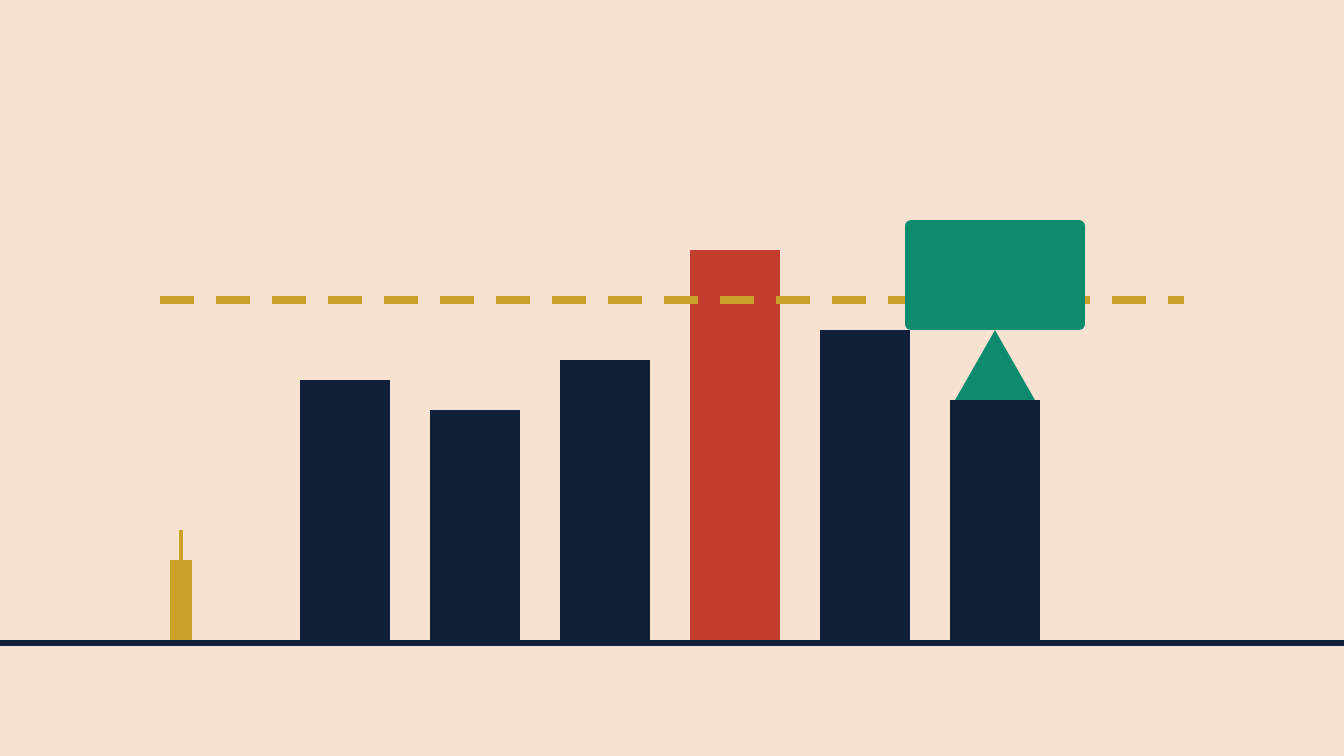
📈 Chart of the Day — the long bond, and the day the Treasury stepped in
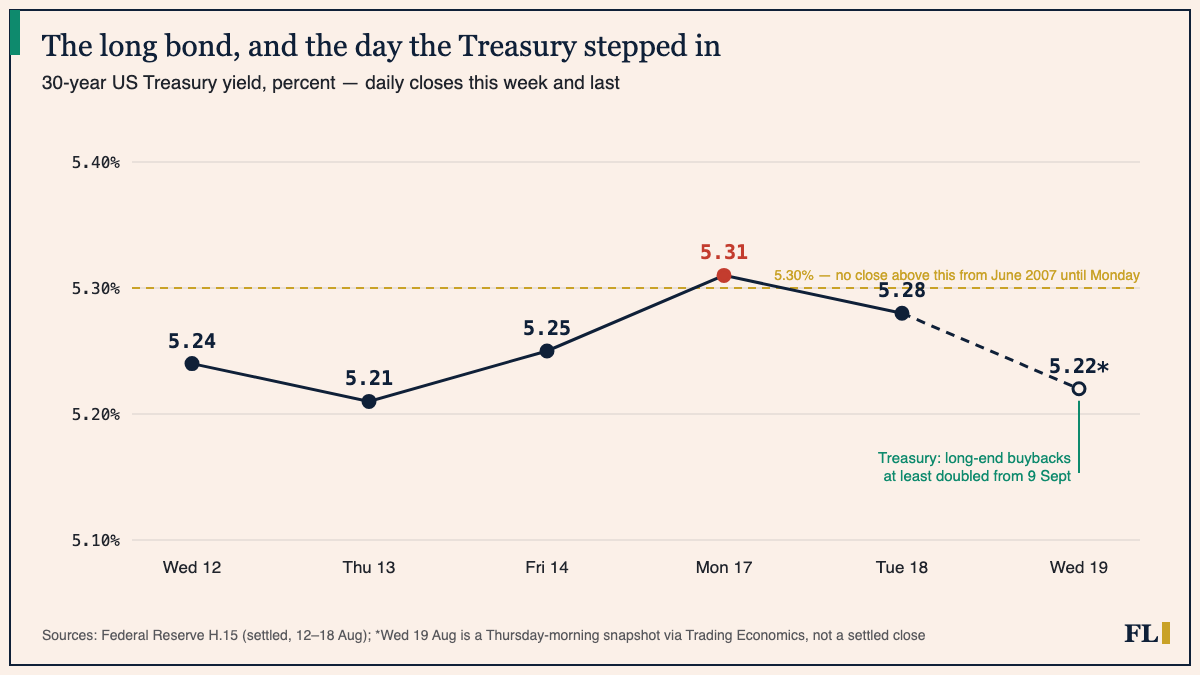
How to read this: the gold dashed line is a threshold, not a target — it marks the level no close had crossed since 2007, so a dot above it (Monday, in brick) is a historical event, and dots below it are ordinary. The hollow dot with the asterisk is a snapshot, not a settled close; we draw it dashed so you never mistake a live quote for a record. The habit: when a chart marks an intervention, look at where the line was heading before it — here, already easing Tuesday — before crediting the intervention with the whole move.
📅 Tomorrow
Friday brings the flash August PMIs at 9:45 a.m. ET — the first read of this month's business activity, with the composite expected around 53.2 after July's 54.5 (above 50 means growth). Then the calendar goes quiet until the Jackson Hole symposium, 27–29 August, where the Fed chair's speech will be read against those minutes.
We explain; we never advise. Nothing here is investment advice.
Financial Literature is for educational and informational purposes only. Nothing here is investment, financial, legal, or tax advice, or a recommendation to buy or sell any security. Content is impersonal and not tailored to any individual. Data may contain errors — verify before relying on it. Sources: AP (Wednesday closes, via WTOP); Investing.com historical (S&P 500); US Treasury press release (19 Aug); Federal Reserve FOMC minutes, 28–29 July; Federal Reserve H.15; Trading Economics (10-year, 30-year, DXY, USD/CAD, USD/MXN, crude, US session, calendar); Walmart Q2 FY27 results (SEC 8-K); Walmart Q1 FY27 presentation (SEC); Finance Calendar (Jackson Hole).
— The Editorial Team