🌎 $104B — the order book that answered a red Tuesday
Wall Street slipped into CPI morning — then CoreWeave and Super Micro posted enormous order books after the bell. How to read a backlog, in plain words.


Compiled Wednesday, 12 August 2026, about 7:00 a.m. in New York (Eastern Time). Stock index rows are final Tuesday closes; bond yields and currencies trade around the clock, so those rows are live snapshots and labeled as such.
Wall Street drifted lower for a second day ahead of this morning's inflation report — and then, after the closing bell, two AI-infrastructure companies unveiled order books large enough to change the subject.
📊 The Dashboard — Tuesday, 11 August 2026 (closes)
| Gauge | Level | Move | What this means |
|---|---|---|---|
| S&P 500 (500 big US firms) | 7,728.20 | 🔴 ▼ −0.3% | Final. A second small slip — three quiet days since Friday's record close. |
| Nasdaq Composite (tech-heavy) | 26,445.45 | 🔴 ▼ −0.6% | Final. Alphabet, Apple and Amazon all fell; the big platforms led the decline again. |
| Dow (30 blue-chip firms) | 53,791.85 | 🔴 ▼ −0.3% | Final. Drifting with the pack on a cautious day. |
| Russell 2000 (2,000 smaller firms) | 3,027.12 | 🟢 ▲ +0.3% | Final. Rotation row: smaller firms rose on a red day. They carry more debt, so a day of easing yields helps them first — Monday's lesson running in reverse. |
| US 10-year Treasury yield | ≈4.68% | ⚪ easing | Live snapshot. A second session of gentle decline as traders position for the inflation number. |
| Dollar index (DXY) | ≈99.9 | ⚪ ≈ flat | Live snapshot. Parked — the dollar is waiting for 8:30 a.m. like everyone else. |
| USD/CAD | ≈1.393 | ⚪ ≈ flat | Live snapshot. The Canadian dollar sits at an eight-week high after strong Canadian jobs data. |
| USD/MXN | ≈17.06 | ⚪ ≈ flat | Live snapshot. The peso stays firm — Mexico's 6.50% policy rate against the Fed's 3.50–3.75% keeps it in demand. |
What happened, in plain words
Tuesday itself was a holding pattern. The standoff over the Strait of Hormuz hardened — Washington rejected Iran's compensation demand, and Iran's foreign minister said there was "no possibility of restarting negotiations" under current conditions — so oil rose again: Brent climbed about 1.4% to finish near $88.91 a barrel, and gold touched its highest level in roughly two months, the classic quiet signal that some investors are reaching for insurance. Stocks eased rather than fell: the whole board moved a fraction of a percent, the kind of day markets produce when everyone is waiting for one number — this morning's inflation report.
The real news landed after the close. CoreWeave, which rents out AI computing capacity, reported quarterly revenue of $2.58 billion — 112% more than a year earlier — a smaller loss than analysts expected ($1.03 per share against a $1.20 forecast), and a revenue backlog of $104 billion. Its shares jumped about 14% in extended trading. An hour apart, Super Micro, which builds AI servers, reported quarterly revenue of $11.12 billion — slightly under the $11.26 billion analysts expected — yet its shares rose about 9%, because it forecast $65–72 billion of revenue for its new fiscal year against a $54.43 billion consensus, on the back of more than $60 billion in new orders. Monday's issue asked whether the AI build-out spending was still accelerating; Tuesday night, the order books answered.
⭐ Spotlight: revenue backlog — $104 billion
A backlog is the value of signed contracts a company has not yet delivered — work already sold, revenue not yet earned. People track it because an income statement describes the past, while backlog is the future already under contract: CoreWeave's $104 billion is roughly forty times what it earned this whole quarter. It is also the number that explains Tuesday night's puzzle — how a company can report less revenue than expected and still jump 9%: the market was reading the order book, not the quarter.
📈 Chart of the Day — the quarter vs the forecast
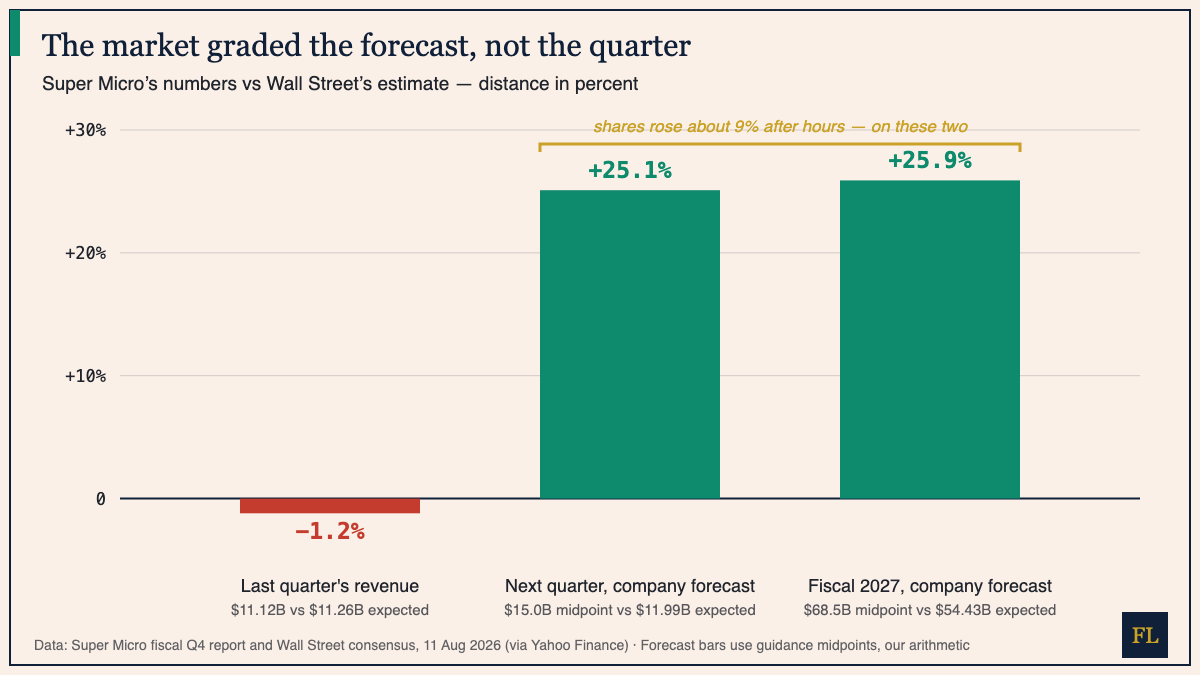
How to read this: each bar is the distance between Super Micro's number and Wall Street's estimate for it. The left bar is the quarter that already happened — 1.2% short. The two right bars are the company's own forecasts, roughly 25% above what analysts had penciled in. The stock rose on the night: this is Monday's "graded on a curve" habit taken one step further — markets grade against expectations, and they weigh the future more than the past. Carry one caution with the teal bars: a forecast is a promise, not a delivery, and the market will re-grade it every quarter.
📅 This morning: the number itself
July CPI lands at 8:30 a.m. ET. Consensus, per compiled forecasts: prices up 0.1% on the month and 3.4% over the year, with core (food and energy stripped out) at 0.1% and 2.5%. Two reading habits for the print: the gap between 3.4% headline and 2.5% core is mostly energy — last month's oil turmoil arriving on US price tags — and the 10-year yield's first move from ≈4.68% will tell you whether the number changed the Fed story, with futures traders still split on a September rate rise. Wholesale prices (PPI) follow tomorrow.
We explain; we never advise. Nothing here is investment advice.
Financial Literature is for educational and informational purposes only. Nothing here is investment, financial, legal, or tax advice, or a recommendation to buy or sell any security. Content is impersonal and not tailored to any individual. Data may contain errors — verify before relying on it. Sources: STL.News (index closes, Brent, gold); Yahoo Finance (Tuesday session); SiliconANGLE (CoreWeave results); Yahoo Finance (Super Micro results); Trading Economics (yield, dollar, peso, Canadian dollar snapshots); Investrade (CPI consensus).
— The Editorial Team