🌎 5.31% — the 30-year hasn't closed this high since 2007
The 30-year Treasury just closed above 5.3% for the first time since 2007. Oil rose, stocks slipped — and Home Depot's registers answered the surveys.

Compiled Tuesday, 18 August 2026, about 7:30 a.m. in New York (Eastern Time), before the opening bell. Stock index rows are final Monday closes; bond yields and currencies trade around the clock, so those rows are Tuesday-morning snapshots and labeled as such.
The US government's longest-term borrowing cost crossed a line Monday: the 30-year Treasury yield closed at 5.31% — its first finish above 5.3% since June 2007 — as oil jumped and stocks quietly stepped back.
📊 The Dashboard — Monday, 17 August 2026 (closes)
| Gauge | Level | Move | What this means |
|---|---|---|---|
| S&P 500 (500 big US firms) | 7,745.06 | 🔴 ▼ −0.5% | Final. Fell 40.70 points as oil and long-term yields climbed — a measured step back that leaves the index near last week's record. |
| Nasdaq Composite (tech-heavy) | 26,644.91 | 🔴 ▼ −0.3% | Final. The day's smallest slip among the big boards — higher yields hit evenly, not tech-first, this time. |
| Dow (30 blue-chip firms) | 53,459.78 | 🔴 ▼ −0.5% | Final. Down 272.63 points — broad and orderly, not a rush for the exits. |
| US 10-year Treasury yield | ≈4.74% | ⚪ ▲ rising | Tuesday snapshot. Rose to about 4.72% Monday and drifted near 4.74% early Tuesday — but the real move was further out the curve (see Spotlight). |
| Dollar index (DXY) | ≈99.7 | ⚪ ≈ flat | Tuesday snapshot. Barely moved — the calm row on a jumpy day. |
| USD/CAD | ≈1.388 | ⚪ ≈ flat | Tuesday snapshot. A fourth week inside its half-percent band. |
| USD/MXN | ≈17.05 | ⚪ ≈ flat | Tuesday snapshot. The peso still hugs the 17 line it has held all month. |
What happened, in plain words
Monday's push came from the war, through the oil market, into the bond market. Hopes for progress in US–Iran talks faded — a memorandum of understanding between the two expired Monday, with an Iranian official telling Reuters the country was prepared to turn "fully offensive" — and worries returned about shipping through the Strait of Hormuz, the channel a fifth of the world's oil passes through. US crude climbed roughly 3% to above $83 a barrel.
Here is the chain to read: dearer oil feeds expected inflation, and expected inflation is exactly what long-term bonds cannot forgive — it eats three decades of fixed coupons. So while the 10-year rose modestly, the 30-year yield closed at 5.31%, a level last seen when the first iPhone was new. Yesterday we watched the inflation-expectations line in a survey; Monday, the longest bond on the curve priced the same worry. Stocks read the higher yields and eased half a percent — near records, gently, but paying attention.
The registers answered
Then, Tuesday before dawn, the week's first cash-register report arrived. Home Depot reported $47.9 billion in quarterly sales, up 5.7%, with comparable sales up 1.7% and US comparable sales up 1.3% — and adjusted earnings of $4.92 a share beat the $4.73 analysts expected. It also reaffirmed its full-year outlook. Recall Friday's survey: sentiment at 51.0, deep gloom. The registers disagree — politely. The average ticket rose 2.8% to $92.50, and the company's finance chief said customers "continued to engage in smaller projects." People feel worse than they are behaving: still spending, just on smaller things. That nuance — gloomy mood, cautious-but-real spending — is this week's question, and three more retailers get to answer it.
⭐ Spotlight: the 30-year Treasury yield — 5.31%
The 30-year yield is what investors demand to lend the US government money for three decades, which makes it the market's longest-range guess about inflation and debt supply. It matters to ordinary life because it anchors other long-term borrowing — US mortgage rates track long Treasury yields far more closely than they track the Fed's overnight rate. That is why watchers care that it just did something it has not done in nineteen years: a close above 5.3% says the market wants real compensation before it locks money away until the 2050s.
📈 Chart of the Day — the survey and the register
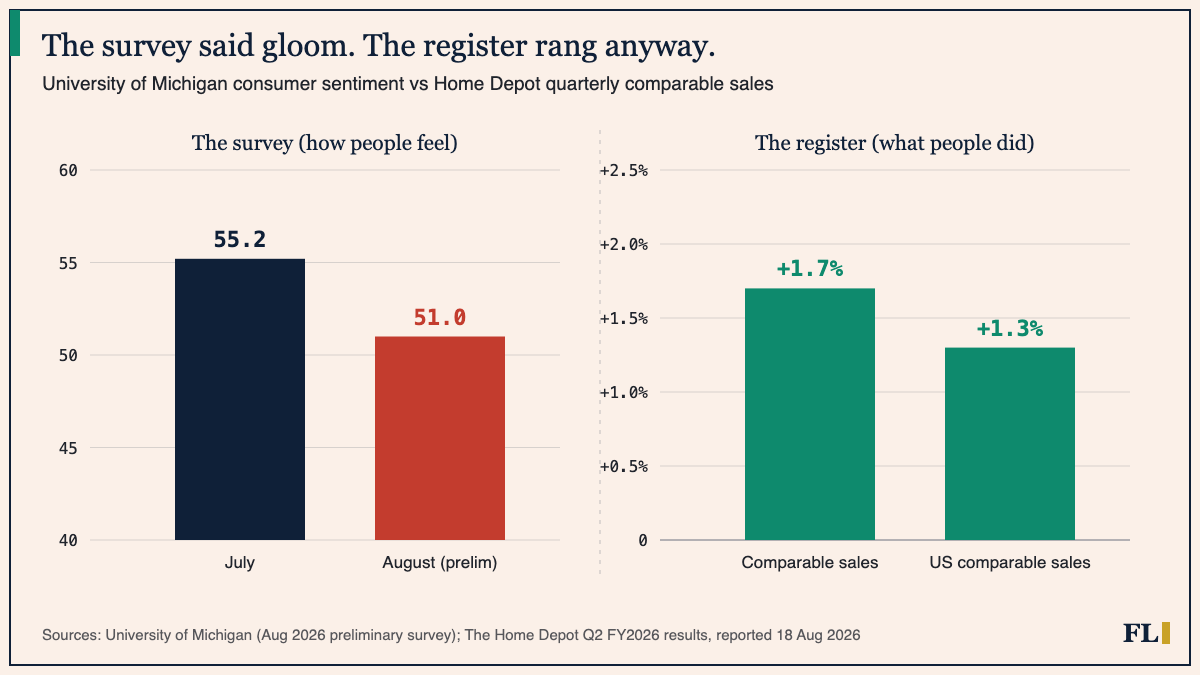
How to read this: the left panel measures how people feel (a survey level); the right panel measures what they did (sales at stores open at least a year, in percent). Different units, same shopper. When the two disagree, don't pick a winner — read the gap: mood this gloomy with receipts still growing usually means caution, not collapse. Watch which panel the next data point moves toward.
📅 Tomorrow
Wednesday is the week's crowded day: Target and Lowe's report before the open — two more register checks on the gloomy-shopper question — and the Federal Reserve releases the minutes of its July meeting at 2 p.m., with Walmart closing the parade Thursday. Watch whether the minutes show the committee reading inflation the way the 30-year bond just did.
We explain; we never advise. Nothing here is investment advice.
Financial Literature is for educational and informational purposes only. Nothing here is investment, financial, legal, or tax advice, or a recommendation to buy or sell any security. Content is impersonal and not tailored to any individual. Data may contain errors — verify before relying on it. Sources: Eurasia Business News (index closes, oil, Treasury yields); Yahoo Finance (Monday session, US–Iran developments, yields); Trading Economics (bond yields, currencies); The Home Depot (Q2 FY2026 results); Investing.com (analyst estimates); Reuters via Yahoo Finance (University of Michigan survey); Yahoo Finance (week-ahead calendar).
— The Editorial Team