🌎 51 — the mood fell, and yields rose anyway
Consumer sentiment fell to 51 on inflation worries — yet bond yields rose. The needle inside a gloomy survey that markets actually read, in plain words.

Compiled Monday, 17 August 2026, about 7:00 a.m. in New York (Eastern Time), before the opening bell. Stock index rows are final Friday closes; bond yields and currencies trade around the clock, so those rows are Monday-morning snapshots and labeled as such.
Americans' economic mood slumped in early August — the University of Michigan's sentiment gauge fell to 51.0 — and bond yields rose anyway, which is the day's whole lesson.
📊 The Dashboard — Friday, 14 August 2026 (closes)
| Gauge | Level | Move | What this means |
|---|---|---|---|
| S&P 500 (500 big US firms) | 7,785.76 | 🔴 ▼ −0.2% | Final. Slipped 13.23 points from Thursday's record — yet still logged a third straight weekly gain (+0.4%). A quiet fade, not a flight. |
| Nasdaq Composite (tech-heavy) | 26,729.16 | 🔴 ▼ −0.3% | Final. Gave back 73.86 points Friday; barely positive for the week at +0.1%. |
| Dow (30 blue-chip firms) | 53,732.41 | 🔴 ▼ −0.2% | Final. The week's laggard at −0.6% — the only major board to finish the week lower. |
| Russell 2000 (2,000 smaller firms) | 3,068.42 | 🟢 ▲ +0.5% | Final. Rotation row: a fresh record close while the big boards slipped — up 23.6% in 2026, still the year's best board as easing rate worries keep lifting smaller firms. |
| US 10-year Treasury yield | ≈4.70% | ⚪ firm | Monday snapshot. Rose 5 basis points Friday to 4.67% even as stocks and the mood fell — today's lesson lives in this row — and held near 4.70% early Monday. |
| Dollar index (DXY) | ≈99.5 | ⚪ ▼ ≈0.2% | Monday snapshot. Drifting slightly lower; little net change from Friday. |
| USD/CAD | ≈1.386 | ⚪ ≈ flat | Monday snapshot. Still parked in its half-percent band, a third week running. |
| USD/MXN | ≈17.01 | ⚪ ≈ flat | Monday snapshot. The peso holds the 17 line it has hugged all month. |
Monday, early: stock futures pointed modestly higher before the open, ahead of a week of retailer earnings — we could not pin the futures numbers to a settled source by press time, so direction only. Snapshots, not promises.
What happened, in plain words
Friday's only fresh number was a survey, and it was a bad one. The University of Michigan's preliminary August consumer sentiment index fell to 51.0 from July's 55.2 — forecasters expected roughly 55 — ending two months of slow repair. The reason households gave was prices: worries about inflation tied to the Middle East conflict, with the survey window (28 July–10 August) catching national average gasoline above $4 a gallon. The gloom was broad — sharpest among older, lower-income, and less-educated consumers — and only 8% of households expect their income to outpace inflation over the next year, down from 18% in December 2024.
Stocks barely reacted: the S&P 500 eased 0.2% off Thursday's record and still banked a third straight weekly gain, because the week's cool inflation prints had already done the heavy lifting — markets now put roughly two-in-three odds on the Fed holding rates in September, up from below half a month ago.
The bond market is the puzzle worth solving. A gloomy consumer usually means slower spending, gentler inflation, and lower yields — yet the 10-year yield rose 5 basis points to 4.67% on Friday. The answer sits inside the same survey: the year-ahead inflation-expectations line ticked up to 4.3% from 4.2% — a fifth straight month above 4%. Bond investors skim past the mood needle and read that one, because expected inflation eats the fixed coupons a bond pays. One survey, two needles, opposite directions — and each market picked its own.
⭐ Spotlight: the inflation-expectations line
Inside the University of Michigan's monthly consumer survey — the mood gauge Wall Street has read for decades — households are asked what they expect prices to do over the next year and over the long run. Markets often shrug at the headline mood, but the expectations lines have teeth: the Federal Reserve tracks them closely because expected inflation can become actual inflation, as workers ask for raises and firms pre-emptively raise prices to match it. That is why a survey about feelings can move the bond market: it is the economy's most-watched measure of where households think prices are headed.
📈 Chart of the Day — one survey, two needles
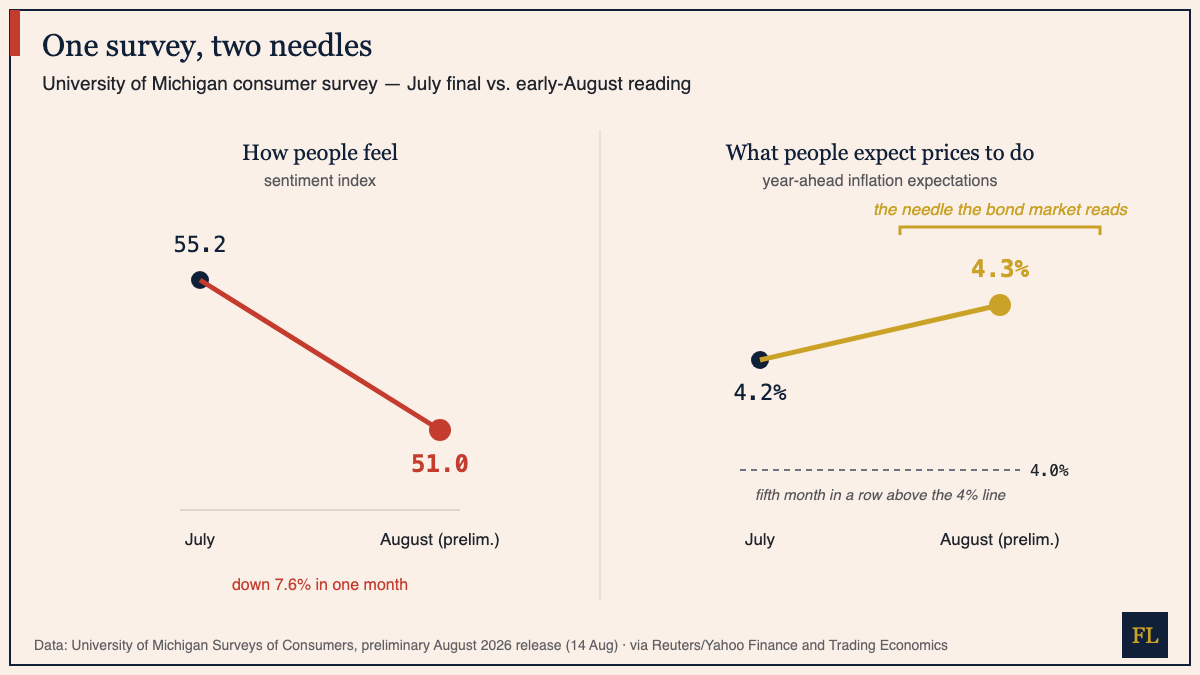
How to read this: both panels come from the same Friday release — the left needle is how people feel, the right needle is what they expect prices to do. When a report moves markets "the wrong way," check whether it contains more than one needle: stocks and bonds are allowed to read different lines of the same page. Friday they did — and the 5-point yield rise tells you which panel the bond market graded.
📅 Tomorrow
The surveys have had their say; this week the cash registers talk. Home Depot reports before Tuesday's open — first of a retailer parade that brings Target and Lowe's on Wednesday morning, the Fed's July-meeting minutes Wednesday at 2 p.m., and Walmart on Thursday. Watch whether actual receipts confirm the gloomy shopper the surveys keep describing.
We explain; we never advise. Nothing here is investment advice.
Financial Literature is for educational and informational purposes only. Nothing here is investment, financial, legal, or tax advice, or a recommendation to buy or sell any security. Content is impersonal and not tailored to any individual. Data may contain errors — verify before relying on it. Sources: AP via The Globe and Mail (index closes, weekly and yearly context); Yahoo Finance (Friday session, Treasury yields); Reuters via Yahoo Finance (University of Michigan survey); Trading Economics (10-year yield, rate odds, currencies, sentiment history); Yahoo Finance (week-ahead earnings and Fed calendar).
— The Editorial Team