🌎 Nasdaq −1.3% — the AI trade sank; the registers rang
Chip stocks dragged the Nasdaq down 1.3% — while Target's comparable sales jumped 3.8%. Two readings of the same economy, decoded in plain words.


Compiled Wednesday, 19 August 2026, about 7:30 a.m. in New York (Eastern Time), before the opening bell. Stock index rows are final Tuesday closes; bond yields and currencies trade around the clock, so those rows are Wednesday-morning snapshots and labeled as such.
The AI trade and the American shopper swapped roles Tuesday: chip stocks dragged the Nasdaq down 1.3%, and Wednesday before dawn Target reported its strongest quarter in years.
📊 The Dashboard — Tuesday, 18 August 2026 (closes)
| Gauge | Level | Move | What this means |
|---|---|---|---|
| S&P 500 (500 big US firms) | 7,691.76 | 🔴 ▼ −0.7% | Final. Fell 53.30 points — a third straight modest loss since Thursday's record, each one orderly. |
| Nasdaq Composite (tech-heavy) | 26,289.71 | 🔴 ▼ −1.3% | Final. The day's damage lived here: down 355.20 points as chip stocks sold off. Still up 13.1% in 2026. |
| Dow (30 blue-chip firms) | 53,343.40 | 🔴 ▼ −0.2% | Final. Barely scratched — Tuesday was a tech story, not an everything story. |
| Russell 2000 (2,000 smaller firms) | 3,017.89 | 🔴 ▼ −1.3% | Final. Monday's record-setter joined the slide, down 39.65 points — still 2026's best board at +21.6%. |
| US 10-year Treasury yield | ≈4.69% | ⚪ ▼ easing | Wednesday snapshot. Slipped below 4.7% as investors wait for this afternoon's Fed minutes; the 30-year eased to about 5.28% after Monday's 5.31% milestone close. |
| Dollar index (DXY) | ≈99.4 | ⚪ ≈ flat | Wednesday snapshot. Barely moved — still the calm row. |
| USD/CAD | ≈1.388 | ⚪ ≈ flat | Wednesday snapshot. A fourth week inside its half-percent band. |
| USD/MXN | ≈17.04 | ⚪ ≈ flat | Wednesday snapshot. The peso keeps hugging the 17 line it has held all month. |
What happened, in plain words
Tuesday's selling was narrow and specific. Nvidia fell more than 2%, with AMD and Intel sinking alongside it, and the AP's market wrap named Nvidia, Micron and Broadcom as some of the heaviest weights on the market, "amid criticism that their prices shot too high in the frenzy around AI." That is why the Nasdaq lost 1.3% while the Dow lost 0.2% — when one theme is repricing, the boards that hold more of it fall harder. The backdrop had not changed: oil stayed elevated near $91 a barrel for Brent on the US–Iran standoff, and long-term yields held close to Monday's multi-decade highs. Monday the worry showed up in the bond market; Tuesday it moved to the most expensive stocks. Same worry, different room.
The registers rang — three of four
Then came Wednesday's pre-dawn earnings, and the shopper looked nothing like the gloomy surveys. Target's comparable sales rose 3.8% — analysts expected about 2.4% — driven by 3.6% more transactions, with digital sales up 8.7% and same-day delivery growing more than 25%. The company raised its full-year sales outlook to about 5%. One reading skill before the headlines dazzle you: Target's earnings per share "doubled" to $4.11 from $2.05 — but $1.65 of that came from a one-time $994 million tariff refund. Strip the refund out and the quarter is still strong — but it is the traffic, not the windfall, that can repeat next quarter. When a profit "doubles," always look for the line that says one-time.
Lowe's told a quieter story: comparable sales up 0.2% — a fifth straight positive quarter, led by Pro contractors and online (+15.7%) — with adjusted earnings up 1.6%. Note that Lowe's total sales jumped to $26.0 billion from $24.0 billion, mostly because it bought another company; the 0.2% comp is the honest row. Add Monday's sentiment reading of 51 and this week's pattern is now three registers deep: people say they feel terrible, keep spending on everyday baskets, and stay cautious on big home projects.
⭐ Spotlight: comparable sales — +3.8% vs +0.2%
Comparable sales (or "comps") measure growth only at stores and websites open at least twelve months, which strips out growth a retailer simply bought — new stores, acquisitions. That makes it the cleanest answer to the question that matters: is the same shopper, at the same store, spending more than last year? This week it also showed why the gauge exists: Lowe's total sales grew over 8% while its comps grew 0.2% — the first number describes the company's shopping spree, the second describes yours.
📈 Chart of the Day — three registers, one shopper
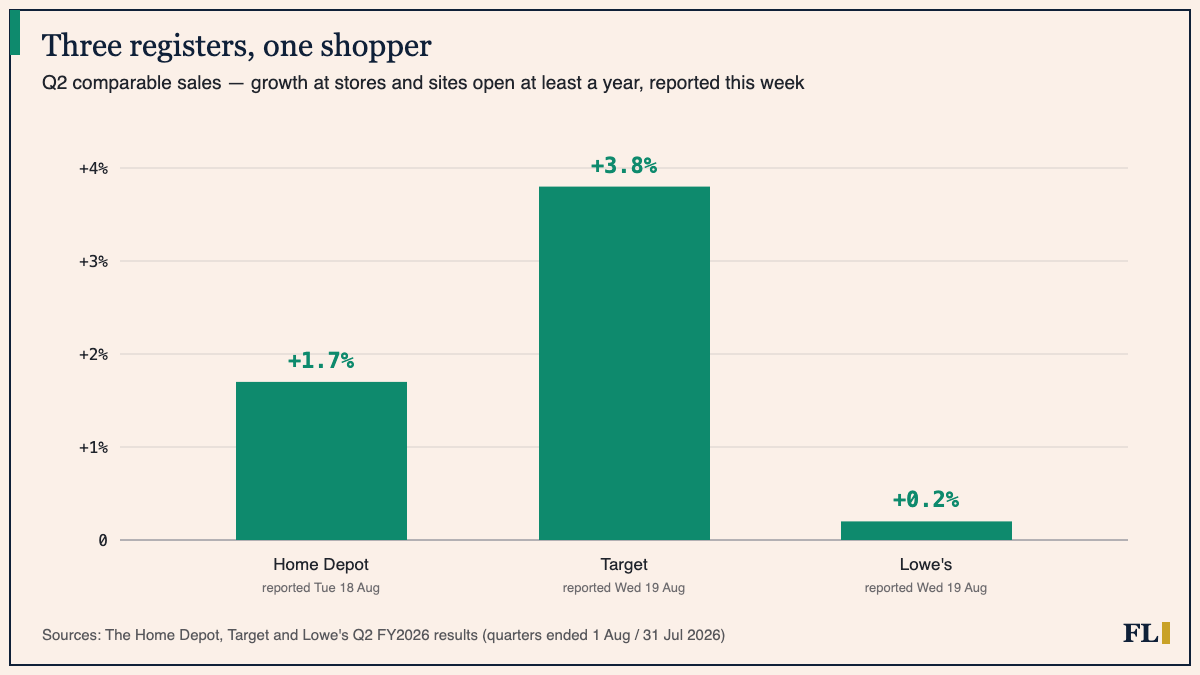
How to read this: all three bars measure the same thing — sales growth at locations open at least a year — so the spread between them is information, not noise. The same cautious shopper is choosing everyday baskets and small trips (Target) over big home projects (Lowe's), with Home Depot's smaller-projects middle ground in between. One tall bar says less about the economy than the shape of all three together.
📅 Later today, and tomorrow
This afternoon at 2 p.m. Eastern, the Federal Reserve releases the minutes of its July meeting — the one where the committee voted 9–3 to hold rates at 3.50–3.75%. Read the minutes for how the three dissenters argued, and whether more of the committee is reading inflation the way the 30-year bond has all week. Then Thursday before the open, the biggest register of all: Walmart reports at 7 a.m. Eastern — the final and largest of the week's four checks on the American shopper.
We explain; we never advise. Nothing here is investment advice.
Financial Literature is for educational and informational purposes only. Nothing here is investment, financial, legal, or tax advice, or a recommendation to buy or sell any security. Content is impersonal and not tailored to any individual. Data may contain errors — verify before relying on it. Sources: AP via The Globe and Mail (index closes); Yahoo Finance (Tuesday session, chip stocks, oil); Trading Economics (bond yields, currencies); Target (Q2 FY2026 results); AP (Target's tariff refund); Lowe's (Q2 FY2026 results); Oninvest (Fed minutes preview); Walmart (earnings schedule).
— The Editorial Team