🌏 BOK 3.00% — the decision was old news; the dots weren't
Korea's second straight hike; the KOSPI rose 1.5% on Nvidia anyway. Today: how to read a central-bank dot plot — and Jakarta's current-account gauge.

Numbers compiled Thursday, 27 August 2026, at 4:30 pm in Seoul (UTC+9) — a 3-min read. Seoul and Tokyo closes are settled; Hong Kong and Jakarta were still trading and are labeled as snapshots, as are currency and bond rows.
The Bank of Korea raised its base rate to 3.00% this morning, and the stock market rose anyway. Six of seven board members voted for the second straight quarter-point hike — Governor Shin Hyun-song called it "preemptive action" — and the bank lifted its 2026 growth forecast to 3.3% from 2.6%. The KOSPI closed up 1.53%, because the hike was expected and Nvidia's overnight numbers — revenue $96.2 billion, up 106% in a year, next quarter guided to $108 billion — were bigger than expected. Today: the part of a rate decision that actually moves — the dots.
📊 The Dashboard — Thursday, 27 August 2026
| Gauge | Level | Move | What this means |
|---|---|---|---|
| KOSPI (South Korea) | 6,912.37 | 🟢 ▲ +1.53% | Closed, settled — Google Finance and Investing.com agree. Yesterday's candle lesson, in reverse: it opened at 6,996.12, up 2.76%, with Samsung Electronics +3.25% and SK hynix +5.45% in the first minutes — and the open was the day's high. It then gave half back: a gain made at the bell, not built through the afternoon. |
| KOSDAQ (South Korea, rotation row) | 837.65 | 🟢 ▲ +1.30% | Closed — Investing.com's row. Today's money went where the Nvidia supply chain lives. |
| Nikkei 225 (Japan) | 66,131.98 | 🔴 ▼ −0.20% | Closed, settled — Google Finance and Yahoo Finance's row agree. Same Nvidia news, flat finish: Kioxia +5% on a new chip plant, Advantest −3.1% despite supplying Nvidia. Good news for an industry is not good news for every company in it. |
| Hang Seng (Hong Kong) | ≈25,560 | 🔴 ▼ ≈ −0.4% | Still trading at compile — Google Finance's 3:28 pm print (−0.37%) and Trading Economics (−0.36%); a snapshot. The drag:Alibaba's HK$80 billion share placement — new shares mean each existing share owns a little less. |
| USD/KRW | ≈1,381 | 🟢 ▼ won firmer | Late-afternoon snapshot — about 1,380.5, against Wednesday's 3:30 close of 1,384.8; the won's strongest since September 2025. A higher rate pays won-holders a little more — the textbook direction, delivered quietly. |
| USD/JPY | ≈159.3 | ⚪ ≈ flat | Late-afternoon snapshot — 159.29. Still while Seoul hiked; Tokyo's own inflation print lands tomorrow morning. |
| BOK base rate (South Korea) | 3.00% | ▲ +25 bp | Decided 27 Aug — the highest since January 2025; one member, Hwang Kun-il, voted to hold at 2.75%. The 3-year government bond, the market's own guess at where this rate is heading, closed Wednesday at 3.816% — above 3.00% before the vote: the bond market expected more hikes than this one. |
🌏 The SEA watch — this week's number: Indonesia's current account
The rotation returns to Jakarta on a day the city watched the streets more than the screens.Indonesia deployed 18,504 security personnel around parliament for an anti-corruption rally demanding an asset-forfeiture bill — a year after the August 2025 unrest that left 11 dead. Wednesday sold ahead of it — the IDX Composite closed near 6,406, down about 1.5%; Thursday bought back:about 6,490, up 1.3% at 2:15 pm Jakarta time — still trading, so a snapshot. The rupiah sat atabout 17,735 per dollar.
The gauge to learn is the one 1997 was read through: the current account — a country's cash-flow statement with the world: trade in goods and services, plus the dividends and interest crossing the border.Bank Indonesia reported a second-quarter deficit of $12.5 billion, 3.3% of GDP, from $3.6 billion (1.0%) in the first quarter (3.30% versus 1.09%, on FX.co's tally). Bank Indonesia called the drivers temporary:pricier oil imports, more imports of raw materials and capital goods as the economy grew, and bigger dividend and interest payments to foreign investors. The reading: a deficit is not a verdict, it is a bill — paid with money coming in (foreign investment, borrowing) or with reserves. So read the two rows together.Reserves slipped to $145.3 billion in July from $145.6 billion, as Bank Indonesia repaid government debt and intervened to support the rupiah — still 5.5 months of imports, well above the three-month benchmark. In 1997, deficits were paid with short-term dollar borrowing under pegged currencies; today the rupiah floats and reserve cover is deep. We describe, we don't call. But a deficit that tripled in one quarter is exactly the number this column exists to make sure you noticed.
⭐ Spotlight: the dot plot — a forecast by the people who set the rate
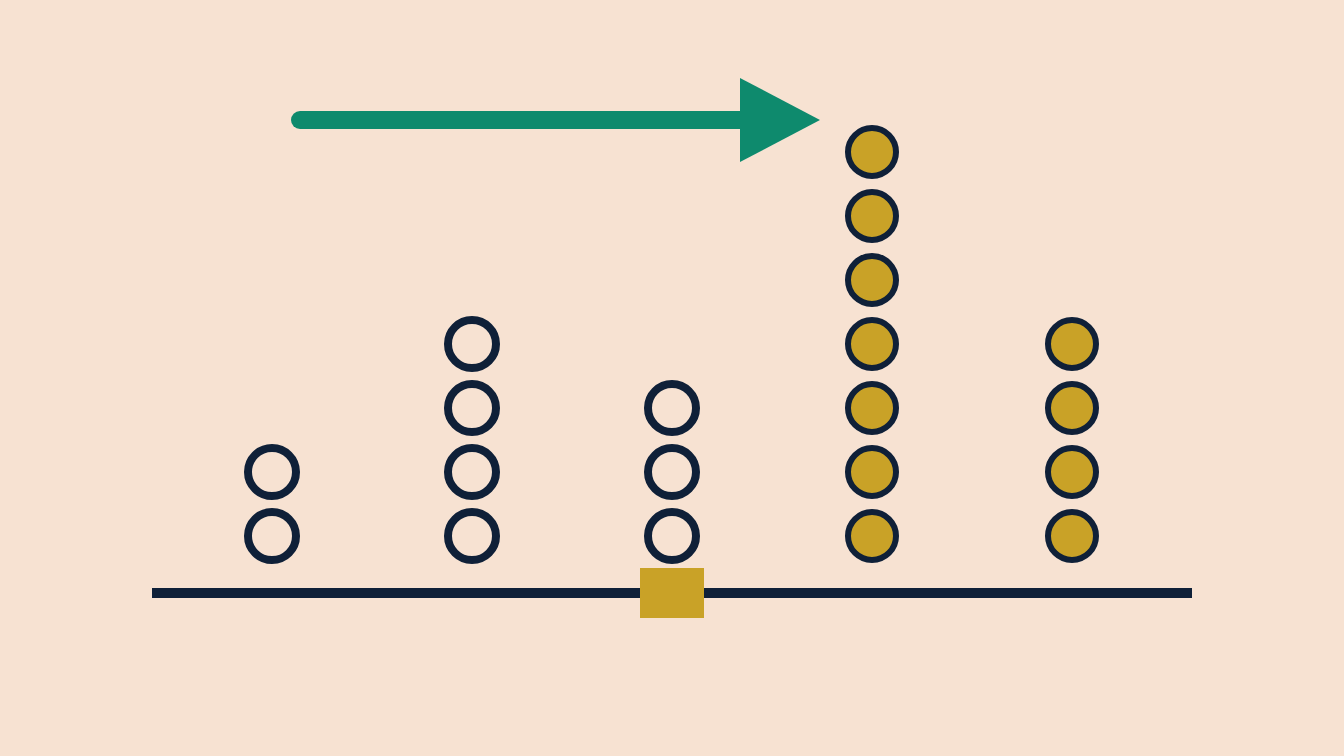
Today the Bank of Korea also published a dot plot: each board member anonymously marks where they expect the base rate in six months, one dot each.In August, 16 of 21 dots sit above today's 3.00% — ten at 3.25% and six at 3.50% — with five at 3.00% and none below. In May, ten of 21 sat at 3.00% and seven at 2.75%. Why anyone tracks it: the decision says what the bank did; the dots say what it thinks it will do — and the gap between the two is where prices move. Today's hike was expected; the dots moving a full notch in three months is the news. One caution: a dot is one member's view on that day, conditional on the data. The May dots were wrong within a quarter — not a flaw in the tool, but the tool showing how much the picture changed.
📈 Chart of the Day — the dots moved before the rate did
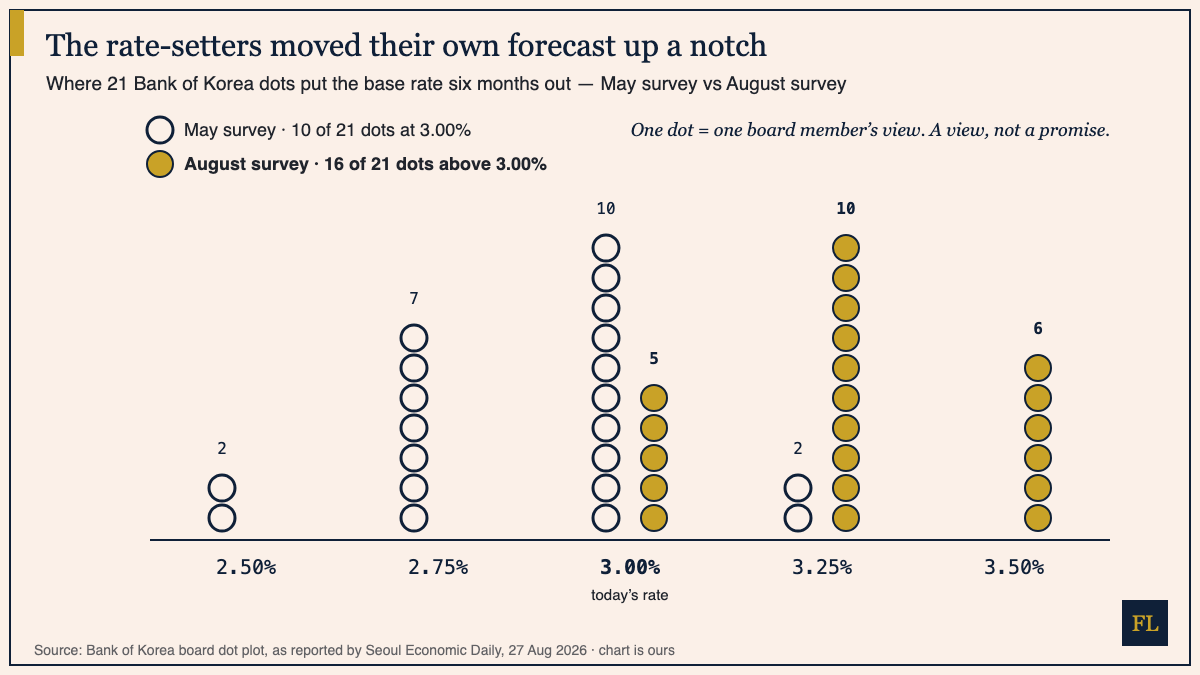
How to read this: hollow circles are May, gold are August; each column is a rate level, each circle one board member. Don't look for a line — look for the pile. In May the tallest pile sat on 3.00%; in August it sits on 3.25%, with a new pile at 3.50%. That shift, not any single dot, is the message. Then compare the piles to the actual rate: 3.00% today, with the August piles already above it — what the 3-year bond yield said in the dashboard, drawn by different people.
📅 Tomorrow
Tokyo's August consumer prices land at 8:30 am Tokyo time on Friday — core (ex-fresh food) was 1.9% in July, and forecasters expect a touch less; headline was 2.0%. Tokyo prints a month before the national figure, so it moves the yen. At 11 pm Seoul time,Fed Chair Kevin Warsh gives his first Jackson Hole keynote (10 am ET) — the speech Asia's Monday open will trade; by Monday you can check what the dollar rows did with it. Missed this week's candle lesson?It's in Tuesday's issue.
We explain; we never advise. Nothing here is investment advice.
Financial Literature is for educational and informational purposes only. Nothing here is investment, financial, legal, or tax advice, or a recommendation to buy or sell any security. Content is impersonal and not tailored to any individual. Data may contain errors — verify before relying on it. Sources: Google Finance (KOSPI, Nikkei, Hang Seng, IDX Composite, USD/KRW, USD/JPY, USD/IDR); Investing.com (KOSPI, KOSDAQ, Tokyo CPI calendar); Yahoo Finance (Nikkei); Trading Economics (Tokyo, Hong Kong, won, Indonesia reserves); The Korea Herald (BOK); Seoul Economic Daily (dot plot, Seoul open); BetaNews (KTB yields); Nvidia; Bank Indonesia via Indonesia Investments; Antara; Jakarta Globe; FXStreet; Regards of Wall Street.
Forwarded this by a friend? Subscribe here. Found it useful? Forward it to one person who'd want it.
— The Editorial Team