🌏 Japan's rate is 1.0%. The rate it is judged against is a range
A Bank of Japan board member set today's 1.0% policy rate against a neutral range of 1.1% to 2.5%, and said why the second one cannot be a number.

A Bank of Japan board member spent this morning in Fukui explaining the one interest rate nobody can write down.
Numbers compiled Thursday, 10 September 2026, at 4:30 pm in Seoul (UTC+9), a 5-min read. The Tokyo and Seoul closes are final; the Hong Kong, currency, bond and oil rows are snapshots near the close.
Yesterday's answer: B. A producer price index is collected at each stage of production, and the further a stage sits from the raw material, the less of a commodity move reaches it. One release can carry a large rise upstream and a small fall downstream, and neither says what households paid at the till.
MASU Kazuyuki, a member of the Bank of Japan's Policy Board, spoke to local business leaders in Fukui this morning, eight days before the Bank next decides on rates. He put the Bank's policy rate at 1.0%. He then put the rate that neither heats nor cools the economy somewhere between 1.1% and 2.5%, and said in the same breath that it "cannot be expressed as a specific figure". Today's lesson is that second rate: what it is, and what a reader should do with a figure a central bank openly calls an estimate.
📊 The Dashboard, Thursday, 10 September 2026
| Gauge | Level | Move | What this means |
|---|---|---|---|
| Nikkei 225 (Japan) | 65,270.95 | 🟢 ▲ +0.20% | Closed, final: Google Finance, Yahoo Finance. Tokyo was up as much as 0.8% and kept a quarter of it. |
| TOPIX (Japan) | 4,054.58 | 🟢 ▲ +0.20% | Closed: Investing.com. The broad gauge matched the 225, so a few large shares did not drive this. |
| KOSPI (South Korea) | 7,033.92 | 🔴 ▼ -0.25% | Closed, final: Money Today, Asia Economy. Seoul traded as low as 6,898.45 and came back 135 points. |
| KOSDAQ (South Korea) | 836.92 | 🟢 ▲ +0.79% | Closed: Asia Economy. Korea's smaller-company board went the other way. |
| Hang Seng (Hong Kong) | ≈24,951 | 🔴 ▼ ≈1.3% | Still trading when compiled: 24,951.46 at 3:06 pm in Hong Kong, from 25,274.96. |
| USD/JPY | ≈153.5 | 🟢 ▼ yen firmer | Snapshot, still trading: 153.55, near 152.89, its strongest in about seven months. A stronger yen shrinks the yen value of what exporters earn abroad. |
| USD/KRW | 1,339.2 | 🔴 ▲ won weaker | Seoul's 3:30 pm close, 3.1 won weaker. A weaker won raises the won price of imported oil. |
| JGB 10-year yield (Japan) | ≈2.91% | 🔴 ▲ +2 bp | Snapshot: 2.906%, from 2.885%. Red because a higher yield means a lower bond price. |
| Brent crude | ≈$100.8 | 🟢 ▼ -0.4% | Snapshot, still trading: $100.82, from $101.21. Green because Asia's large economies buy crude, not sell it. |
What happened, in plain words
The closes were small and the day was not. Seoul opened lower, fell as far as 6,898.45 in the morning and finished 17.72 points down; foreign investors sold a net 2.49 trillion won of Korean shares while institutions bought 461.5 billion and individuals 362.2 billion. Tokyo did the mirror image, up as much as 0.8% before closing 0.20% higher. Two facts sat under both: Brent crude is above $100 a barrel on the fighting around Iran, and the Bank of Japan meets on 17 and 18 September with a rate rise widely expected. For a Japanese exporter those pull opposite ways, dearer fuel against a firmer yen, and an index that cannot choose closes flat.
⭐ Spotlight: the real interest rate
Every rate you see quoted is nominal, the number written on the contract. The real interest rate is that number with expected inflation taken out, and it is the one that decides whether borrowing is really cheap. Masu showed the Bank's estimates: the 1-year and 10-year real rates were "significantly negative" until last year and now sit "at around 0 percent", while rates out to about two years are still below zero. He then named what a negative real rate does, in a shopkeeper's terms. Property bought with borrowed money can gain more than the loan costs. Firms may "hasten their investment more than is necessary". Savings "lose their real value". Hence his line that this "should be addressed as soon as possible".
📈 Chart of the Day: a range, not a number
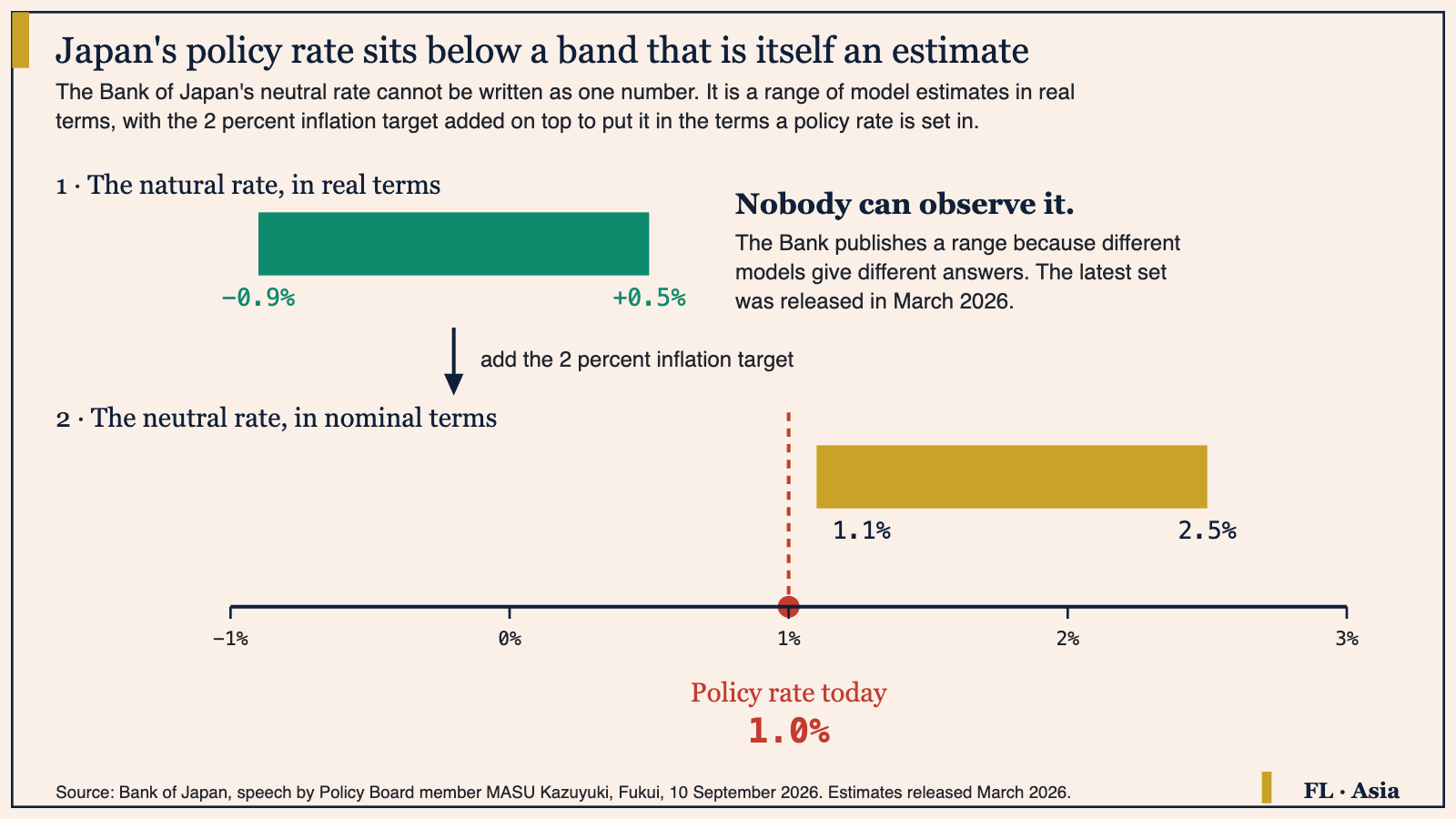
How to read this: when a chart hands you a band instead of a line, ask first what the width is made of. Here it is not a forecast: several models were asked the same question about a rate nobody can observe and came back with different answers, so the honest drawing shows all of them. Read a marker against the nearest edge, not the middle: the middle is an average of guesses, the edges are the guesses. Then read the arithmetic between the two bands: a real rate becomes a nominal one by adding the inflation target, so the whole band would move if the target did. The Bank's series sit on Bank of Japan on the Data Catalog.
🌏 SEA watch: the central bank with no policy rate
The rotation moves to Singapore, where the Straits Times Index was 5,696 in the afternoon, 0.58% lower and still trading, and the Singapore dollar about 1.264 per dollar. Everything above assumes a central bank sets an interest rate. Singapore's does not. "Monetary policy in Singapore is centred on the exchange rate," the Monetary Authority of Singapore says, because in an economy whose trade in goods and services runs at more than 300% of GDP, "the exchange rate has a much stronger influence on inflation than the interest rate". So the instrument is a band, not a level. MAS steers the Singapore dollar against a trade-weighted basket and holds that index inside a sloping band, buying and selling US dollars in the spot market to do it. In July it chose to "increase the rate of appreciation of the policy band very slightly", leaving the band's width and centre alone. The next statement is due no later than 14 October. Where the instrument is a currency path there is no neutral rate to sit below, and the argument is about the slope of the band instead.
📅 Tomorrow
Friday, 8:50 am in Tokyo: the Bank of Japan publishes its corporate goods price index for August, the gauge Masu singled out this morning, because firms now pass costs on more readily than before. July's reading was 7.2% above a year earlier. The line underneath to watch is import prices, up 29.1% on the year in yen terms, where crude and a weak currency arrive first. Yesterday's letter read the same gauge for China; Tuesday's traced the wiring between a Japanese rate, the yen and Tokyo's exporters.
One question. Today's chart showed a policy rate of 1.0% and a neutral range of 1.1% to 2.5%. Which reading is right? A: The range is the Bank's target for its policy rate, as 2% is its target for inflation. B: The range is what several models say about a rate nobody can observe, put into nominal terms by adding the 2% inflation target. C: A policy rate below the range means the Bank has missed its inflation target.
Financial Literature is for educational and informational purposes only. Nothing here is investment, financial, legal, or tax advice, or a recommendation to buy or sell any security. Content is impersonal and not tailored to any individual. Data may contain errors, verify before relying on it. We explain; we never advise. Sources: Bank of Japan, Monetary Authority of Singapore, Google Finance, Yahoo Finance, Investing.com, Trading Economics, FXStreet, Money Today, Asia Economy, Financial News, EBN.
Forwarded this by a friend? Subscribe here. Found it useful? Forward it to one person who'd want it.
— The Editorial Team