🌏 Japan grew faster than first thought, and the Nikkei fell 1.7%
Tokyo's index sank 1.7% on a better growth number, because the yen jumped. Seoul touched 7,171.52 before lunch and closed 0.58% lower.

Numbers compiled Tuesday, 8 September 2026, at 6:30 pm in Seoul (UTC+9), a 5-min read. The Seoul and Tokyo closes are final; the Hong Kong level and the currency, bond and oil rows are snapshots taken near the close.
Yesterday's answer: B. The Nikkei 225 is a price-weighted average of 225 shares and TOPIX is a market-value-weighted index of the whole Prime Market, so a jump in a few expensive technology shares lifts one gauge far more than the other. Both closes were right.
Japan's economy grew at an annualised 1.4% in the spring, revised up from a first estimate of 1.1%, and Tokyo's market fell on the news: the Nikkei 225 closed 1.70% lower at 65,269.33. Those two sentences belong together. A firmer economy makes a Bank of Japan rate rise look likelier, a higher rate makes the yen more attractive to hold, and a stronger yen shrinks the yen value of everything Japanese exporters earn abroad. Toyota fell 4.1% and Panasonic 5.8%. Today's lesson is that wiring.
📊 The Dashboard, Tuesday, 8 September 2026
| Gauge | Level | Move | What this means |
|---|---|---|---|
| Nikkei 225 (Japan) | 65,269.33 | 🔴 ▼ -1.70% | Closed, final: Google Finance, Yahoo Finance. The index opened higher and closed at the bottom of its day. |
| TOPIX (Japan) | 4,050.33 | 🔴 ▼ -1.83% | Closed: Investing.com. Japan's broad gauge fell further than the 225, so this was not a chip story. |
| KOSPI (South Korea) | 6,954.52 | 🔴 ▼ -0.58% | Closed, final: Google Finance, Investing.com. Seoul traded as high as 7,171.52 and gave all of it back. |
| KOSDAQ (South Korea) | 811.88 | 🔴 ▼ -1.25% | Closed: Investing.com. Korea's smaller-company board fell twice as far as the main board. |
| Hang Seng (Hong Kong) | ≈25,283 | 🔴 ▼ ≈0.5% | Closed: Trading Economics; the AP wrap filed 25,345.04 late in the session. A second quiet day down. |
| USD/JPY | ≈153.7 | 🟢 ▼ yen firmer | Snapshot, still trading: 153.73, from 154.34. The yen touched 152.89, its strongest since February. |
| USD/KRW | 1,345.6 | 🔴 ▲ won weaker | Seoul's 3:30 pm close, 5.1 won weaker and the first rise in five sessions. A weaker won raises the won price of imported oil. |
| JGB 10-year yield (Japan) | ≈2.90% | 🟢 ▼ -1 bp | Snapshot: 2.896%, from 2.907%. Green because a lower yield means a higher bond price. |
What happened, in plain words
The revision itself was small. The Cabinet Office now puts April-to-June growth at 0.4% on the previous quarter rather than 0.3%, with business investment down 0.9% instead of 1.2% and household spending flat. It landed on a market already leaning one way. Japan's policy rate is 1%, its highest since 1995, and traders now treat a further quarter-point rise at the Bank of Japan's meeting on 17 and 18 September as close to settled. That expectation, not the growth number, is what moved the yen and the exporters.
Seoul told the second half of the same story with different actors. The KOSPI opened 0.72% higher at 7,045.79 and crossed 7,000 for the first time in fifteen sessions, then spent the afternoon handing it back. Korean brokerages pointed at oil: Brent crude climbed above $98, a six-week high, after a third strike in two months on Saudi Aramco's 400,000-barrel-a-day Jizan refinery, and at caution before Friday's American inflation report. Asia buys most of its oil from somewhere else, so that bill lands here.
🌏 The SEA watch: China's exports to Southeast Asia, up 30.2%
China's customs agency reported August exports 25% higher than a year earlier and a trade surplus of $119.09 billion. Underneath the headline sits the line this edition watches: shipments to Southeast Asia rose 30.2%, against 6.6% to the European Union. Vietnam is where that arrives first. Vietnamese imports rose 37.9% in August to $54.91 billion while exports rose 26% to $54.80 billion, an eighth straight monthly deficit, and the eight-month gap of $20.46 billion is a record. A trade deficit means more foreign currency leaving a country than arriving. The difference has to be covered by borrowing, by spending reserves, or by letting the currency fall, and those are the three gauges 1997 was read on. Worth learning while nothing is on fire.
⭐ Spotlight: 0.4% and 1.4% are the same number
Japan's growth was published twice this morning, and both figures describe one three-month period. The quarterly rate, 0.4%, is how much bigger the economy was in April to June than in January to March. The annualised rate, 1.4%, answers a different question: if the economy kept growing at that pace for four quarters running, how much bigger would it be after a year? Compounding the quarterly rate four times is all "annualised" means, which is why the annual figure runs roughly four times the quarterly one. Japan and the United States lead with the annualised number. The euro area and Britain lead with the quarter. Eurostat's second estimate, published yesterday, put euro-area growth at 0.6% for the very same quarter, which is more than Japan's 0.4%, though a reader comparing 0.6% with 1.4% would conclude the opposite.
📈 Chart of the Day: one revision, two rulers
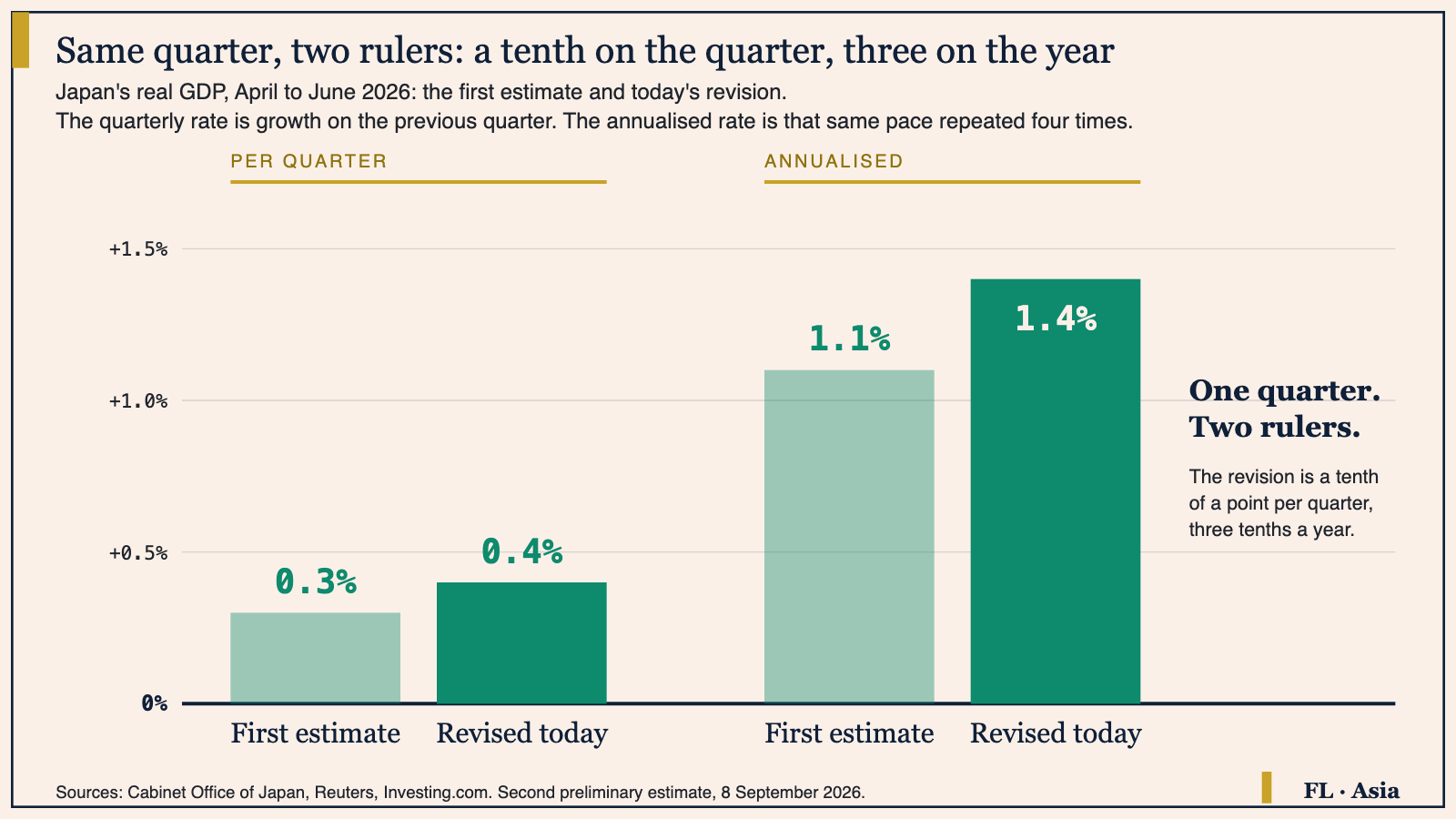
How to read this: a growth number means nothing until you know its ruler. Ask two things before you compare any two of them: is this growth on the previous quarter or on the same quarter a year earlier, and has it been annualised. Annualising magnifies revisions exactly as it magnifies growth, which is why the same correction looks three times larger in the right-hand pair than in the left. When two growth figures seem to disagree, the usual answer is not that one is wrong. They are answering different questions.
📅 Tomorrow
Wednesday, 9:30 am Beijing: China publishes August consumer and producer prices, after consumer prices rose 0.5% in the year to July. Yesterday's letter read the two ways to average a market. Our new notebook takes today's currency question from the other side.
One question. Today's chart showed Japan's April-to-June growth as 0.4% and as 1.4%, for the same three months. Which reading is right? A: The economy grew 0.4% in the spring and is forecast to grow 1.4% over the coming year. B: Both describe that one quarter, 0.4% being growth on the previous quarter and 1.4% being what a year would look like if that pace repeated four times. C: 1.4% is the growth so far in 2026 and 0.4% is the part of it that arrived in the second quarter.
Financial Literature is for educational and informational purposes only. Nothing here is investment, financial, legal, or tax advice, or a recommendation to buy or sell any security. Content is impersonal and not tailored to any individual. Data may contain errors, verify before relying on it. We explain; we never advise. Sources: Cabinet Office of Japan, Bank of Japan, Eurostat, Google Finance, Yahoo Finance, Investing.com, Trading Economics, AP, Seoul Economic Daily, Money Today, eToday, FXStreet, The Star, OilPrice.com.
Forwarded this by a friend? Subscribe here. Found it useful? Forward it to one person who'd want it.
— The Editorial Team