🌏 KOSPI +4.61% — and in Tokyo more shares fell than rose
Seoul closed 4.61% up, five points short of 7,000. Tokyo's Nikkei rose 2.12% while 883 Prime shares fell and 630 rose. An index is a recipe.

Numbers compiled Monday, 7 September 2026, at 7:30 pm in Seoul (UTC+9), a 5-min read. The Seoul, Tokyo and Hong Kong closes are final; the currency and bond rows are snapshots. Wall Street is shut for Labor Day.
Yesterday's answer: B — because nominal counts the money that left the household and real counts what it bought once the price index is taken out, so when prices are rising the real fall is the larger of the two, and the gap between them is inflation.
Seoul's KOSPI closed at 6,995.39, up 4.61%, five points short of 7,000. Tokyo's Nikkei 225 rose 2.12% — and on the Tokyo Prime Market 883 shares fell while 630 rose. Both of those sentences are true about the same session. Today's lesson is why: an index is a recipe, and today the ingredients that mattered were memory chips.
📊 The Dashboard, Monday, 7 September 2026
| Gauge | Level | Move | What this means |
|---|---|---|---|
| KOSPI (South Korea) | 6,995.39 | 🟢 ▲ +4.61% | Closed, final: Google Finance, Investing.com. Samsung Electronics closed 5.68% higher at 270,000 won and SK hynix 8.26% higher at 1,783,000 won; foreigners bought a net 503.4 billion won while retail investors sold 3.72 trillion. |
| KOSDAQ (South Korea, rotation row) | 822.19 | 🟢 ▲ +1.07% | Closed: Investing.com, Seoul Economic Daily. Korea's board of smaller companies rose too, at a quarter of the main board's pace. |
| Nikkei 225 (Japan) | 66,399.84 | 🟢 ▲ +2.12% | Closed, final: Google Finance, Yahoo Finance. Kioxia rose 7.2%, SoftBank Group 6.1% and Fujikura 5.9%. |
| TOPIX (Japan) | 4,125.80 | 🟢 ▲ +0.55% | Closed: Investing.com, News on Japan. The same market counted a different way, and it barely moved. |
| Hang Seng (Hong Kong) | 25,413.12 | 🔴 ▼ -0.93% | Closed: Google Finance, AP. Hong Kong's board owns little memory manufacturing; it sat out the day. Shanghai's composite added 0.1%. |
| USD/KRW | 1,340.5 | 🟢 ▼ won firmer | Seoul's 3:30 pm close, 9.9 won firmer, corroborated by Financial News. Foreign money buying Korean shares has to buy won first. |
| USD/JPY | ≈155.9 | 🟢 ▼ yen firmer | Snapshot, still trading: 155.95, from 156.22. |
| JGB 10-year yield (Japan) | ≈2.93% | 🔴 ▲ +2 bp | Snapshot: 2.934%, from 2.912%. Red because a higher yield means a lower bond price. |
What happened, in plain words
Friday's American jobs report was strong. Employers added 162,000 jobs in August against the 53,000 economists expected, and the unemployment rate held at 4.1%. Wall Street read that as a reason the Federal Reserve might raise rates this month and sold: the S&P 500 fell 0.4%, the Dow 0.5% and the Nasdaq 0.3%. Asia bought anyway, because the part of Wall Street that rose on Friday was the part Korea and Japan sell into: semiconductors. Nvidia agreed last week to buy the model library Hugging Face for $12.93 billion. "The AI complex continues to provide local equity markets with its most dependable growth pulse," said Stephen Innes of SPI Asset Management.
Two things made the day quieter than it looked. American markets were closed for Labor Day, so there was no New York session to argue with Asia's verdict. And Brent crude was around $96 a barrel, near a seven-week high, as Iran said it would declare an exclusion zone for shipping outside the Strait of Hormuz. Asia imports most of its oil. That bill arrives later, and it arrives everywhere.
🌏 The SEA watch: the Philippines, 6.1% inflation and a 62-peso dollar
The rotation moves to Manila, where the PSEi eased 0.11% to 6,083.68. Philippine consumer prices rose 6.1% in the year to August, down from 6.2% in July and a fourth straight month of easing; the national statistician, Dennis Mapa, said the rate "is still high". Core inflation was 4.1%, against a central-bank target band of 2% to 4%, and transport costs rose 13.5% after 11.9%, on fuel. That is the chain worth learning: an oil importer whose currency is weak pays for crude twice. The peso is around 62.6 to the dollar, about a tenth weaker than a year ago and close to its record low. A weaker peso raises the peso price of a barrel even when the dollar price stands still, which is why the transport line moves before almost anything else. We describe the gauge; we do not call anything with it.
⭐ Spotlight: two ways to average a market
Every index is an average, and the averaging rule is a choice. Nikkei Inc.'s own guidebook says the Nikkei Stock Average "is comprised of 225 stocks listed on the Tokyo Stock Exchange Prime Market and calculated as an adjusted price weight index": a share priced at 50,000 yen counts far more than one priced at 800, whatever the companies are worth. The exchange's own TOPIX, by contrast, is "a free-float adjusted market capitalization-weighted index" covering the whole Prime Market, so each company counts in proportion to the value of its tradable shares. On a day when a handful of expensive chip and technology shares jump, the price-weighted 225 flies and the broad value-weighted index strolls. Korea's main board has the opposite problem from the same family: Samsung Electronics and SK hynix together passed half of the KOSPI's entire market value in May, so a KOSPI chart is now substantially a memory-chip chart. Nothing is wrong with any of these gauges. They are answering different questions.
📈 Chart of the Day: one session, four answers
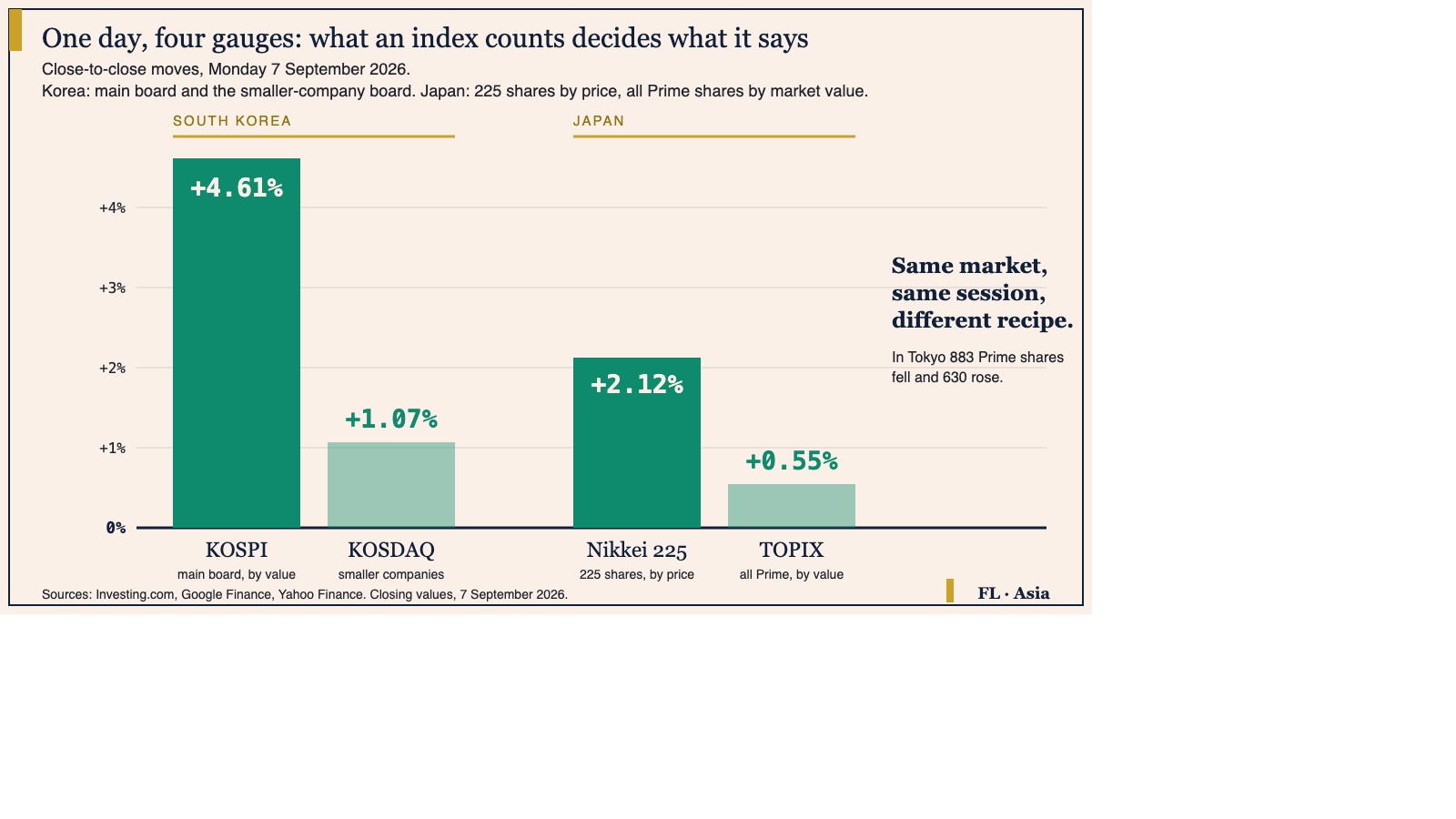
How to read this: before you compare two index moves, find out what each one counts and how it weights what it counts. Ask three questions: how many companies are in it, are they weighted by share price or by market value, and how much of the total sits in the top two or three names. A number that looks like a verdict on a whole economy is often a verdict on a handful of its largest listed companies. When a narrow index and a broad one from the same market disagree, the disagreement is the information.
📅 Tomorrow
Two releases, both before Asia's lunch. China publishes August trade at about 11 am Beijing time, after a July surplus of $112.5 billion. And Japan revises its second-quarter GDP at 8:50 am Tokyo, first estimated at 0.3% on the quarter. Friday's letter read the household half of that number.
One question. Today's chart showed Japan's Nikkei 225 up 2.12% and Japan's TOPIX up 0.55%, for the same session in the same market. Which reading is right? A: One of the two is wrong, and the bigger move is the one the exchange settles. B: The two indexes weight shares differently, the 225 by share price and TOPIX by market value across the whole Prime Market, so a jump in a few high-priced shares lifts one far more than the other. C: The gap of 1.57 points is the amount foreign investors bought.
Financial Literature is for educational and informational purposes only. Nothing here is investment, financial, legal, or tax advice, or a recommendation to buy or sell any security. Content is impersonal and not tailored to any individual. Data may contain errors, verify before relying on it. We explain; we never advise. Sources: Nikkei Inc., Japan Exchange Group, Google Finance, Yahoo Finance, Investing.com, BusinessKorea, Money Today, News on Japan, AP, CNBC, Trading Economics, Philstar, NVIDIA.
Forwarded this by a friend? Subscribe here. Found it useful? Forward it to one person who'd want it.
— The Editorial Team