🌍 5.28% — Britain's ten-year borrowing cost, the highest since 2008
Gilts at a 2008 high, Bunds at a 2011 high, Treasuries at a 3-year high after new US strikes on Iran. Tuesday's closes, and how to read a 10-year yield.

Compiled Wednesday, 2 September 2026, at about 11:00 am in Frankfurt (CEST, UTC+2), a 5-min read. Index rows are final Tuesday closes; bond and currency rows are Wednesday-morning snapshots, still trading, and say so.
Yesterday's answer: B — because core, the index without energy, food, alcohol and tobacco, slipped from 2.5% to 2.4% while energy jumped from 10.3% to 14.3%; the headline rise came from one line.
Britain's ten-year gilt yield reached 5.28% this morning, its highest since June 2008, as renewed US airstrikes on Iran sent Brent above $95 and Germany's Bund yield to its highest since April 2011. Today's lesson is what a ten-year yield is, and how to compare six of them.
📊 The Dashboard, Tuesday, 1 September 2026 (closes)
| Gauge | Level | Move | What this means |
|---|---|---|---|
| STOXX 600 (pan-Europe) | 647.46 | 🔴 ▼ −0.56% | Final (Investing.com, Google Finance). A one-month low: energy and health care rose, basic resources, travel and financials fell. |
| DAX (Germany) | 25,970.11 | 🔴 ▼ −1.10% | Final (Investing.com, Google Finance). Europe's weakest big board for a second day. |
| FTSE 100 (UK) | 10,789.28 | 🔴 ▼ −0.32% | Final (Investing.com, Google Finance), back from Monday's holiday. BP and Shell rose with crude; AstraZeneca fell despite a positive trial. |
| CAC 40 (France) | 8,301.85 | 🔴 ▼ −0.39% | Rotation row, final (Investing.com, Google Finance). Air Liquide +2.1% on a reported Elliott stake. |
| EUR/USD | 1.1590 | ⚪ flat | Tuesday's ECB reference rate, from 1.1596. Wednesday, still trading: 1.1577 at 10:54 am. |
| GBP/USD | ≈1.351 | ⚪ flat | Wednesday snapshot, still trading: 1.3507 at 10:55 am. Note what is not happening: yields at a 2008 high with a steady pound. In a run on a country, both move against it. |
| Bund 10Y yield | 3.34% | 🔴 ▲ +2 bp | Tuesday close (Trading Economics, Investing.com). Wednesday, still trading: 3.39% at 10:53 am, the highest since April 2011. Red because a higher yield means a lower bond price. |
| Gilt 10Y yield (Spotlight row) | 5.28% | 🔴 ▲ +6 bp | Wednesday snapshot, 10:55 am London (Investing.com, Trading Economics), from about 5.2% at Tuesday's close. The 30-year is near 5.90%, its highest since 1998. |
Wednesday, live: at about 10:40 am the STOXX 600 is at 645.3, down 0.3%; the DAX down 0.4% at 25,866; the CAC 40 down 0.4%; the FTSE 100 down 0.3% at 10,729. Lottomatica fell 6.3% after announcing a bid for Spain's Cirsa; Nokia rose about 2% on rejoining the Euro STOXX 50. Brent is about $95. Snapshots, not closes.
What happened, in plain words
Tuesday belonged to the bond market. Germany's 30-year yield reached a 15-year high and France's ten-year its highest since 2008, while the US ten-year Treasury yield rose to 4.79%, its highest since January 2025, with money markets pricing a 65% chance of a Federal Reserve rate rise on 16 September. Shares followed the yields down: the S&P 500 lost 0.71% and the Nasdaq 1.03%. US data: the ISM manufacturing index slipped to 54.6 from 55.6, an eighth month of growth, and its prices index stayed at 71.1, far above the 50 line. Europe's own movers were company stories: Novartis +7.0% on a Phase III result, Partners Group −7.5% after a revenue miss and a CEO exit.
Then, overnight, the United States launched a barrage of airstrikes on Iran; Brent rose to $95.45, the US ten-year touched 4.81%, and Asia sold hard, South Korea's KOSPI down 3.99% and the Nikkei 2.85%. This morning the same logic reached Europe's bond desks: dearer oil means higher expected inflation, which means more rate rises. Money markets now put a near-40% chance on the ECB's deposit rate reaching 3% by March 2027, from 25% a week ago; it is 2.25% today, with a decision next Thursday in Berlin. (Yesterday's letter read the inflation print behind it.)
⭐ Spotlight: the ten-year gilt yield, 5.28%
A gilt is a loan to the British government; the ten-year yield is the return a buyer locks in by holding one for a decade at today's price. The market sets it: when buyers demand more, they pay less for the bond, and the yield rises. People track it for three reasons. It is the interest bill on new government borrowing; it is the reference for the swap rates behind fixed mortgages (five-year mortgage swaps are at 4.52%, a level last seen in November 2023, Bloomberg reports); and it is the market's summary of where Bank Rate and inflation are heading. Bank Rate is 3.75%, held on 29 July by a 6–3 vote, the dissenters wanting 4%; the next decision is 17 September. Trading Economics reads the market as pricing about 32 basis points of tightening by year-end, with a November rise near 70% likely. June 2008 was before the financial crisis; the yield has not been this high in the 18 years since.
The other pressure is supply. Chancellor John Healey delivers his first Budget on 28 October, and Bloomberg Economics estimates that higher borrowing costs and inflation have already eaten £12 billion of the £23.6 billion cushion against the government's own fiscal rules. A yield of 5.28% is not a verdict on Britain's solvency; it is the price at which today's buyers will lend for ten years, given oil, the Bank, and how much paper is coming.
📈 Chart of the Day: six governments, one maturity
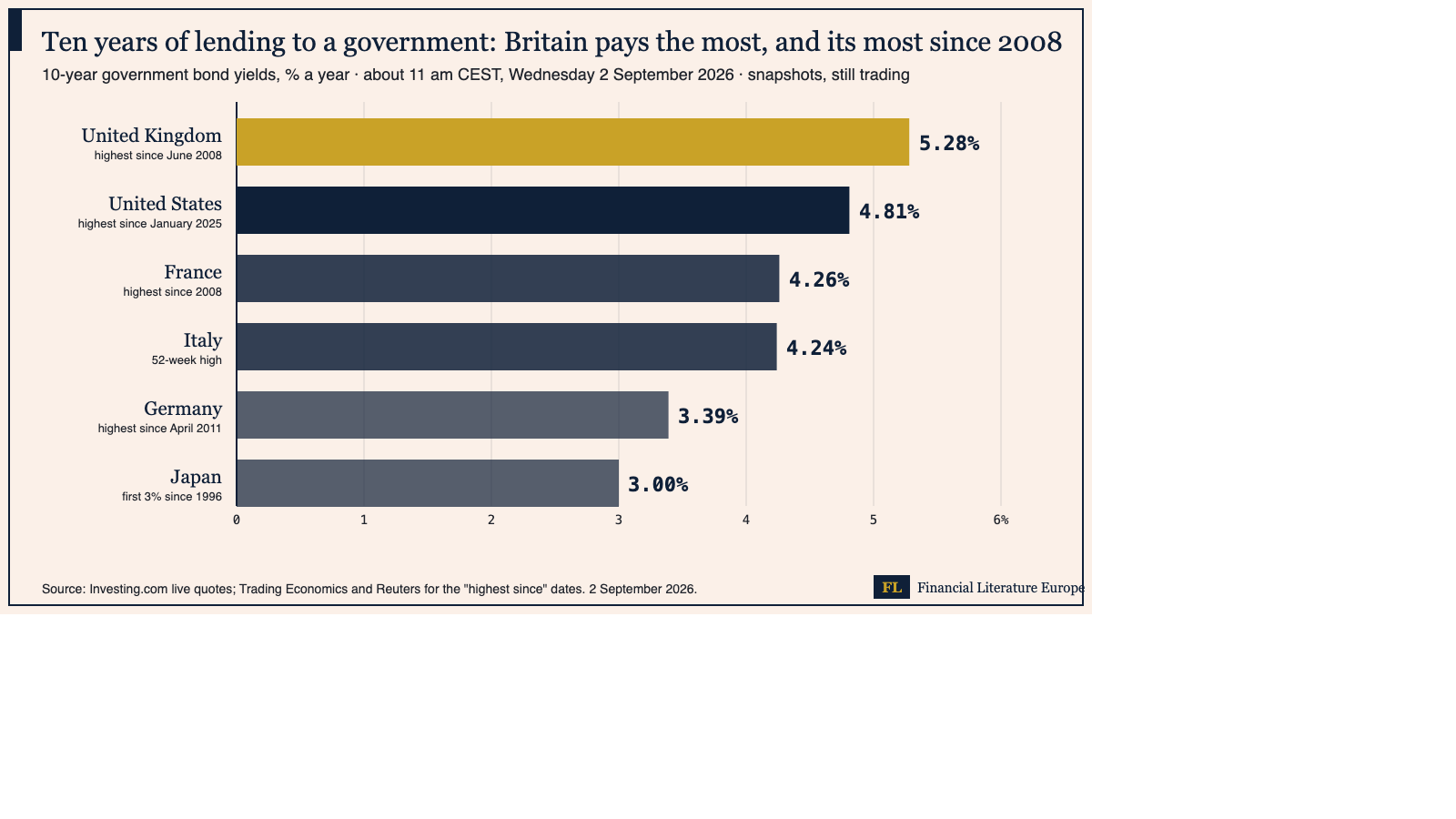
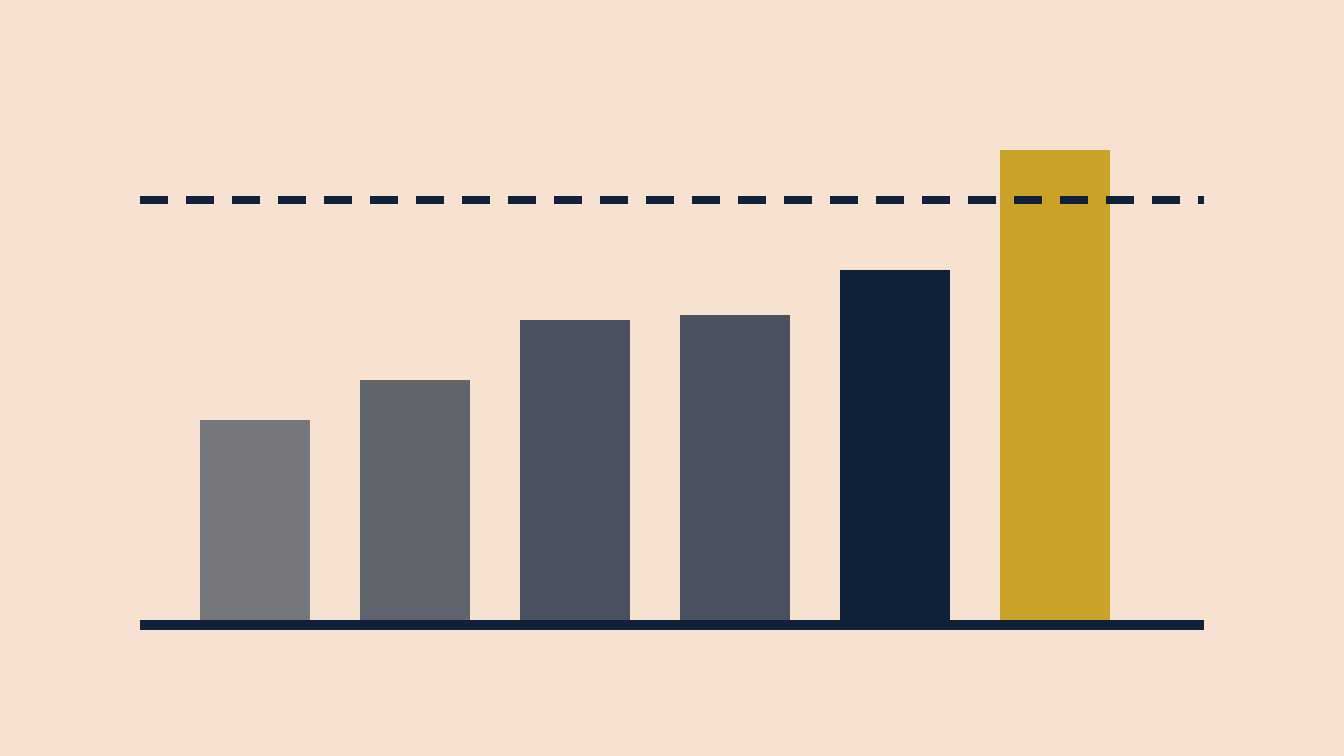
How to read this: compare like with like, the same maturity across countries, then read each bar as a price, not a grade. A ten-year yield is roughly the policy rates the market expects over the decade, plus the inflation it expects, plus a premium for uncertainty and for how much debt is being sold. So the 1.9-point gap between Britain and Germany is mostly a different expected path for Bank Rate and prices, and a heavier borrowing calendar; it is not a ranking of who repays. And every bar that lengthened today did so because bonds already in circulation fell in price.
📅 Tomorrow
This afternoon: Bundesbank president Nagel and vice-president Buch speak; 2:15 pm, the US ADP private payrolls estimate, consensus 47,000. Thursday, 10 am: final August PMIs (flash composite 52.1, services 51.7); 11 am, July producer prices. Friday, 2:30 pm: the US jobs report. The ECB decides on 10 September; the Bank of England on 17 September.
One question. Today's chart showed the UK ten-year yield at 5.28% and Germany's at 3.39%. Which reading is right? A: Investors expect Britain to default, so they charge it more. B: The gap is mostly a different expected path for policy rates and inflation over ten years, plus a premium for uncertainty and supply; both numbers are prices for borrowing, not grades. C: Holders of UK gilts earned 5.28% on Wednesday, because the yield rose.
Forwarded this by a friend? Subscribe here. Found it useful? Forward it to one person who'd want it.
We explain; we never advise. Nothing here is investment advice.
Financial Literature is for educational and informational purposes only. Nothing here is investment, financial, legal, or tax advice, or a recommendation to buy or sell any security. Content is impersonal and not tailored to any individual. Data may contain errors — verify before relying on it. Sources: Investing.com (indices, yields, Brent, Reuters), Google Finance, Trading Economics, ECB via Frankfurter, Newsquawk, Yahoo Finance (Reuters), ISM via PR Newswire, ECB, MoneyWeek, Briefs (Bloomberg).
— The Editorial Team