🌏 Exports +68.7% — one product is almost half the total
Korea's August exports hit $98.25bn, chips $46.65bn of it. Also: Japan's 10-year yield at 3% for the first time since 1996, and Vietnam's import cover.


Numbers compiled Tuesday, 1 September 2026, at 4:40 pm in Seoul (UTC+9), a 4-min read. Seoul and Tokyo closes are final; Hong Kong, currency and bond rows are snapshots.
Yesterday's answer: B — because a PMI is a diffusion index: 50 is the even split between firms reporting better and worse, so a reading that rises but stays under 50 means manufacturing is shrinking in fewer places, not that output grew.
Korea sold $98.25 billion of goods abroad in August, 68.7% more than a year earlier, and $46.65 billion of it, 47.5%, was semiconductors. The KOSPI added 0.23%. In Tokyo, the government's ten-year borrowing cost touched 3% for the first time since 1996. Today's lesson is how to read a growth rate that is really two growth rates wearing one number.
📊 The Dashboard — Tuesday, 1 September 2026
| Gauge | Level | Move | What this means |
|---|---|---|---|
| KOSPI (South Korea) | 6,835.80 | 🟢 ▲ +0.23% | Closed, final: Google Finance, Investing.com. Opened lower on oil and US yields, Samsung down 1.83% and SK hynix 1.08% at 9:12 am, traded a 6,732 to 6,857 range, closed up. A quiet day by this month's standards. |
| KOSDAQ (South Korea, rotation row) | 821.25 | 🔴 ▼ −1.56% | Closed: Investing.com. The big board rose and the small-cap board fell: the export number flatters the exporters, not everyone. |
| Nikkei 225 (Japan) | 66,215.34 | 🔴 ▼ −0.15% | Closed, final: Google Finance, Yahoo Finance. The low was 65,576.61, 1.1% down; most of the fall was bought back. A flat index on a day the bond market made history. |
| Hang Seng (Hong Kong) | ≈25,334 | 🔴 ▼ ≈ −0.9% | Still trading at compile: Google Finance, 3:15 pm (−0.84%), Investing.com (−0.91%). A snapshot. Shein fell about 10% below its offer price on its first day. |
| USD/KRW | 1,370.4 | 🔴 ▲ won weaker | Seoul's 3:30 pm close, 1.8 won weaker. A record surplus and a weaker won on the same day; the Spotlight explains why that is normal. |
| USD/JPY | ≈159.96 | 🔴 ▲ yen weaker | Snapshot: Google Finance, from 159.75. Still under 160, the level where Tokyo acted in July. Finance Minister Katayama said "orderly JPY movement is critical". |
| JGB 10-year yield (Japan) | ≈2.99% | 🔴 ▲ +5 bp | Snapshot: 2.993% at compile, from 2.941%, after touching 3.001%. The first 3% print since September 1996. It was half this level a year ago. |
What happened, in plain words
Two big numbers, one from each side of the Sea of Japan. In Seoul, the trade ministry said exports rose for a 15th straight month and beat the 62.6% economists expected; imports rose 22.6% to $63.51 billion, leaving a $34.75 billion surplus. The same morning the government proposed a record 820.9 trillion won budget for 2027, up 12.8%, paid for by tax revenue that is projected to jump 49.8% on the chip boom. In Tokyo, the ten-year yield crossed 3% as investors priced a Bank of Japan hike on 18 September and a bigger-spending government. And in the background, Brent crude rose 3.7% to about $91.7 on the collapse of the US-Iran ceasefire framework, while futures put the odds of a September Fed rate rise at 66%. Dearer oil and dearer dollars are why Asia's equity boards barely moved on Korea's best export month ever.
🌏 The SEA watch — this week's number: Vietnam's import cover
The rotation returns to Ho Chi Minh City, where the exchange is shut until Thursday for National Day; the VN-Index went into the holiday at 1,832, its seventh straight gain. The gauge to learn is import cover: a country's foreign-exchange reserves divided by what it spends on imports each month. It answers one question: if the dollars stopped arriving, how many months could the country keep buying what it needs? The old rule of thumb is at least three months. Vietnam's reserves were about $87.6 billion in June, while imports ran $340 billion in the first seven months of the year, about $48 billion a month, and one Vietnamese economist put cover at "only 1.9-2 months of imports". Why it belongs in a 1997 lens: Thailand's reserves looked fine until the market tested them. Two caveats keep this descriptive. Most of Vietnam's imports are inputs for factories that re-export, so the dollars come back; and the same economist calls the deficit no short-term concern. The number says how thin the cushion is, not what happens next. We describe; we don't call.
⭐ Spotlight: $34.75 billion — what a trade surplus does to a currency, and when
A trade surplus is dollars earned abroad that exceed dollars spent abroad. Exporters eventually sell those dollars for won to pay wages, suppliers and taxes, so a surplus is a steady buyer of the won. That is why yesterday's month-end dollar selling pushed the won firmer. But "eventually" is the word. The surplus arrives over weeks as companies choose when to convert; today's price was set by faster money: an oil bill that just got 3.7% dearer and a two-in-three chance of a US rate rise, both of which buy dollars now. So the surplus and the weaker won can share a day without contradiction. Read a surplus as a tide and the daily rate as the waves on top of it.
📈 Chart of the Day — one number, two speeds
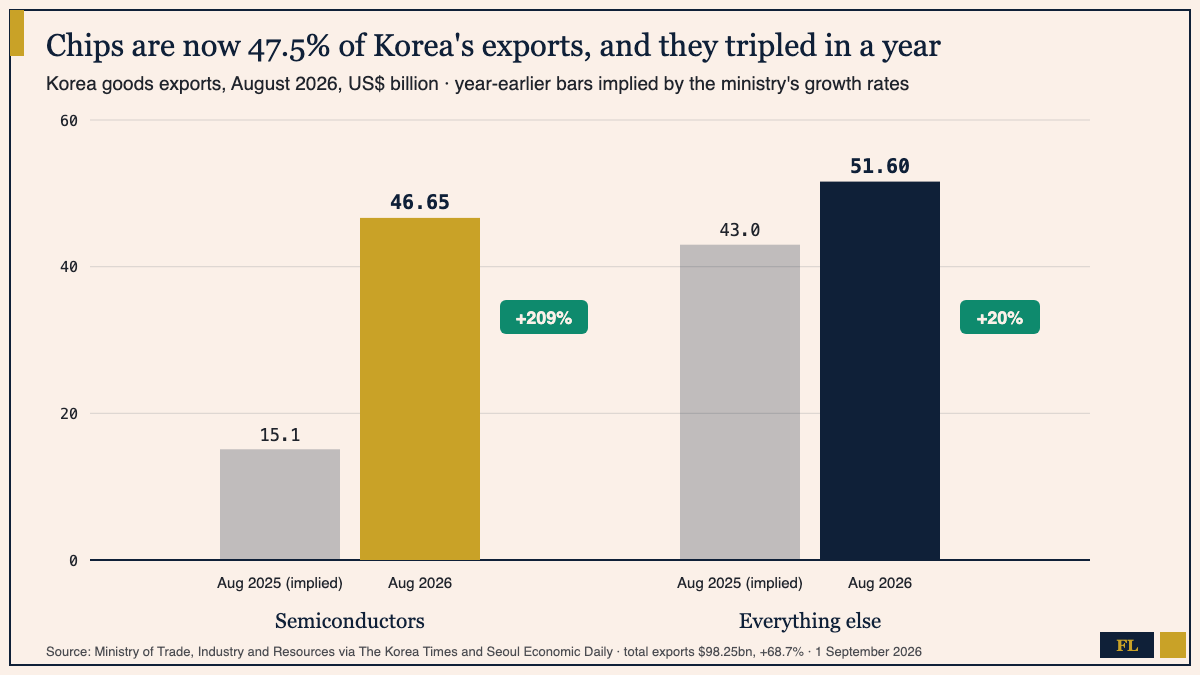
How to read this: a headline growth rate is a weighted average of its parts, so before you repeat it, ask what share each part has and how fast each grew. Chips are 47.5% of exports and rose 209%; the trade minister said non-chip exports grew 20%. Work the ministry's rates backwards and chips were about $15 billion a year ago, everything else about $43 billion: roughly four fifths of the $40 billion increase came from one product. The 68.7% is true, and it describes almost nobody: most of Korea's exporters grew at about 20%, and car exports fell 29.8%. When one part dominates, read the part, not the average.
📅 Tomorrow
Wednesday 8 am Seoul: Korea's August consumer prices. Forecasts have inflation back above 3% after July's 2.8%, partly because last August's mobile-fee discounts drop out of the comparison. Watch the JGB row too: the Bank of Japan decides on 18 September. Related reading: what the Bank of Korea's dot plot says about the next move.
One question. Today's chart showed exports up 68.7%, with chips up 209% and everything else up 20%. Which reading is right? A: Most of Korea's exporters grew their sales by about 69%. B: The headline is an average; one product with almost half the total drove most of the increase, and the rest grew about 20%. C: Non-chip exports must have fallen, because chips tripled.
Financial Literature is for educational and informational purposes only. Nothing here is investment, financial, legal, or tax advice, or a recommendation to buy or sell any security. Content is impersonal and not tailored to any individual. Data may contain errors — verify before relying on it. We explain; we never advise. Sources: Ministry of Trade, Industry and Resources via The Korea Times and Seoul Economic Daily, Reuters via Investing.com, Google Finance, Yahoo Finance, Money Today, The Korea Herald, FXStreet, Investing.com, Viet Nam News, The Investor, European Central Bank.
Forwarded this by a friend? Subscribe here. Found it useful? Forward it to one person who'd want it.
— The Editorial Team