🌏 KOSPI +0.26% — a 243-point swing that closed 17 points up
Seoul's 1% morning became a 1.9% afternoon loss and a flat close. The yen at a one-month high under 157 on BoJ hawks. China's two services surveys disagree

Numbers compiled Thursday, 3 September 2026, at 6:45 pm in Seoul (UTC+9), a 5-min read. Seoul, Tokyo and Hong Kong closes are final; Bangkok, currency and bond rows are snapshots.
Yesterday's answer: B — because a yearly rate compares two months: August 2025 was unusually low after SK Telecom's one-off discount, prices rose only 0.2% on the month, and the jump fades once that month leaves the comparison.
The KOSPI closed up 0.26% at 6,579.48 after a 243-point day: more than 1% up until 2 pm, 1.88% down 27 minutes later, then most of the way back. The yen rose to a one-month high after a Bank of Japan board member said rate rises should come "nimbly". And China's private services survey printed 51.4 for August while the official one stayed at 49.0. Today's lesson is why two surveys of one economy disagree.
📊 The Dashboard, Thursday, 3 September 2026
| Gauge | Level | Move | What this means |
|---|---|---|---|
| KOSPI (South Korea) | 6,579.48 | 🟢 ▲ +0.26% | Closed, final: Google Finance, Investing.com. Opened at 6,650.33, low 6,439.49. Samsung Electronics closed 0.20% lower and SK hynix 1.05% lower; individuals sold a net 1.16 trillion won while "other corporations", the buyback accounts, bought 1.61 trillion. The buybacks held the board. |
| KOSDAQ (South Korea, rotation row) | 790.21 | 🔴 ▼ −1.71% | Closed: Seoul Economic Daily. The buying sat in two big names; the small-cap board had none of it. |
| Nikkei 225 (Japan) | 64,214.48 | 🔴 ▼ −0.17% | Closed, final: Google Finance, Yahoo Finance. The broader TOPIX rose 0.50% to 4,102.04: a red 225, a green market, because a stronger yen weighs most on the exporters that dominate the 225. |
| Hang Seng (Hong Kong) | 25,213.31 | 🔴 ▼ −0.39% | Closed: Google Finance, Yahoo Finance. Opened 0.6% up and faded. |
| USD/KRW | 1,359.3 | 🟢 ▼ won firmer | Seoul's 3:30 pm close, 9.4 won firmer. The won tends to follow the yen; today it did. |
| USD/JPY | ≈156.8 | 🟢 ▼ yen firmer | Snapshot at 5:43 pm Seoul: Google Finance, from 158.93. High 156.36, the yen's strongest in a month. |
| JGB 10-year yield (Japan) | ≈2.95% | 🟢 ▼ −5 bp | Snapshot, 1:32 pm Seoul: 2.951%, from 3.002%. Under 3% again; yields eased everywhere on Thursday, Germany's for the first time in seven sessions. |
What happened, in plain words
Wall Street rose on Wednesday: S&P 500 up 0.5% to 7,666.60, Dow up 0.6%, Nasdaq up 0.5%. ADP said private employers added 38,000 jobs in August against 47,000 expected, and New York Fed president John Williams said "There are no clear signs right now that a September rate hike would be needed to bring down inflation"; futures put the odds of a 16 September rise at 66.2% by the close, and 61% this morning. Brent traded near $95.5 at midday Seoul, from Wednesday's $95.63 close.
The yen. Late on Wednesday the dollar fell 1% against the yen in under 30 minutes, a move that looked like official buying, though none was confirmed. Then board member Hajime Takata said the Bank of Japan should raise rates "nimbly to counter intensifying inflationary pressures, rather than adhere to a fixed semiannual pace". Governor Ueda had said the bank would "debate raising interest rates, including in September"; swaps price a 25 basis point rise on 18 September.
The reading exercise. Seoul's range was 243 points, 3.7% of the index; the close was 17 points. Yuanta's Lee Jae-won said weekly options expiry amplified the swing; Daishin's Lee Kyung-min said "no clear negative catalysts emerged". Read the close as the verdict and the range as the argument: the market tried both directions and settled where it started.
🌏 The SEA watch — this week's number: Thailand's current account
The rotation returns to Bangkok. The SET was 1,577 at 11:25 am, up 0.13% and still trading; the baht was 33.0 per dollar at 5:48 pm Seoul, 0.6% firmer with the yen. The gauge to learn is the current account: a country's running total with the rest of the world, exports minus imports of goods and services, plus investment income. A deficit means it spends more abroad than it earns and borrows the gap. Thailand ran a record $7.6 billion deficit in April, beating the $4.1 billion of April 2013; June was $3.5 billion, July $1.6 billion; FX.co has the same figures. The Bank of Thailand calls the deficit temporary, dearer oil and lost tourism. Why it belongs in a 1997 lens: the IMF's record has Thailand's deficit at 7.9% of GDP in 1996, the year before the baht was cut loose on 2 July 1997. Three monthly deficits, each smaller than the last: read the direction, then the size. We describe; we don't call.
⭐ Spotlight: China's services PMI, 51.4, and the official 49.0
Two surveys asked China's service firms about August. The RatingDog services PMI, compiled by S&P Global, rose to 51.4 from 50.4, above the 50.6 expected; its composite index rose to 52.1 from 50.8. The statistics bureau's non-manufacturing index stayed at 49.0. Same for factories: RatingDog 51.5, official 49.8. One concept: the sample. The private survey leans towards smaller, private, often export-facing firms; the official one towards larger, state-linked companies. Inside the private survey, employment rose for a fourth month, the longest run since 2023, and input prices for an 18th month; RatingDog's Yao Yu called it a "modest rebound following July's weakest outturn since September 2024". Read 51.4 as "small private firms grew, a little" and 49.0 as "large ones shrank, a little". The gap is the finding.
📈 Chart of the Day: two surveys, one month
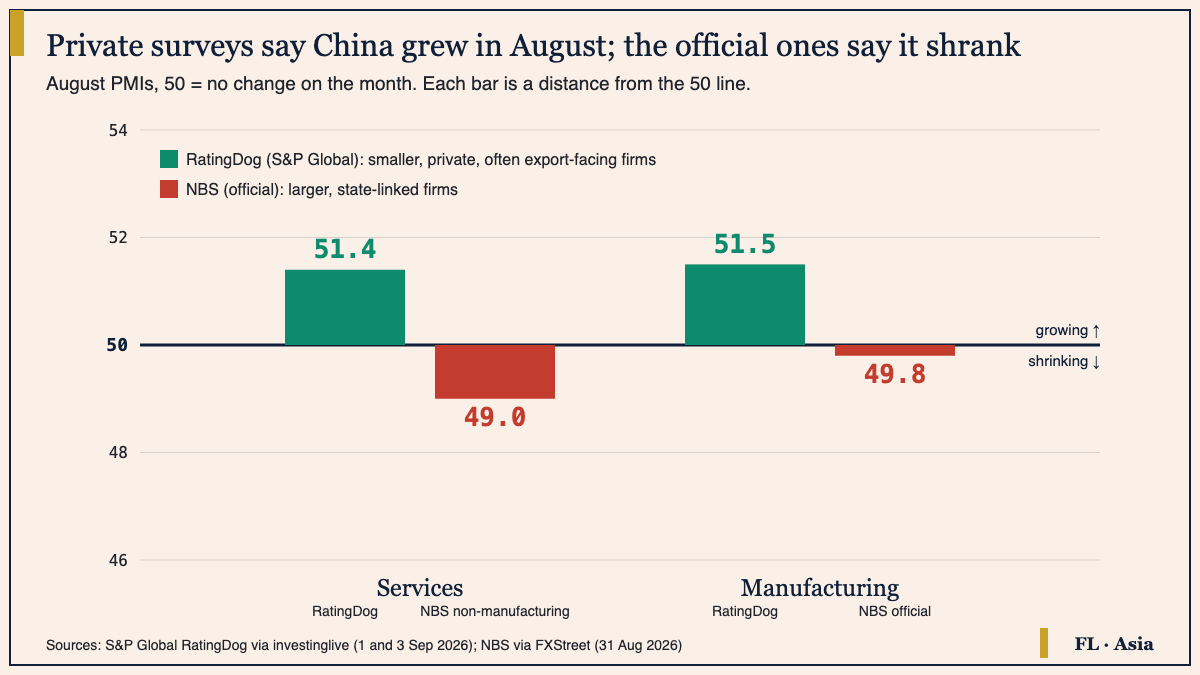
How to read this: before you compare two readings, check that they measure the same thing: the sample, the sectors covered, and whether 50 means the same. Each bar is a distance from 50, teal above, brick below. Opposite directions in both sectors is not a contradiction: it tells you which part of the economy grew. Read each distance, then the gap.
📅 Tomorrow
Friday, 8:30 am Tokyo: Japan's July household spending, forecast up 2.6% on the month after June's 6.4% fall. Friday, 9:30 pm Seoul: the US jobs report; forecasts sit near 56,000 to 58,000 jobs with unemployment at 4.1%. Monday's letter read the official factory PMI; today's read its private twin. Yesterday's read the 4% fall.
One question. Today's chart showed China's private services survey at 51.4 and the official non-manufacturing survey at 49.0 for the same month. Which reading is right? A: One of them must be wrong, and the official one is the reliable one. B: They sample different firms, smaller private companies against larger state-linked ones, so both can be true and the gap says which part grew. C: Averaging them gives 50.2, so China's services were flat.
Financial Literature is for educational and informational purposes only. Nothing here is investment, financial, legal, or tax advice, or a recommendation to buy or sell any security. Content is impersonal and not tailored to any individual. Data may contain errors — verify before relying on it. We explain; we never advise. Sources: S&P Global RatingDog via investinglive and FXStreet, China National Bureau of Statistics via FXStreet, Google Finance, Yahoo Finance, Investing.com, Seoul Economic Daily, Money Today, Reuters via AOL, AP via WTOP, Trading Economics, FX.co, The Nation (Thailand), IMF, Federal Reserve History.
Forwarded this by a friend? Subscribe here. Found it useful? Forward it to one person who'd want it.
— The Editorial Team