🌏 KOSPI −3.99% — the oil shock arrived through the bond market
Brent near $95 and a 4.81% US 10-year sent Seoul down 4%; Hong Kong closed flat. Korea's inflation: 3.1%, and 0.58 points of it is last year's phone bill.


Numbers compiled Wednesday, 2 September 2026, at 6:00 pm in Seoul (UTC+9), a 5-min read. Seoul, Tokyo and Hong Kong closes are final; Jakarta, currency and bond rows are snapshots.
Yesterday's answer: B — because a headline growth rate is a weighted average: chips, 47.5% of exports, rose 209% and the larger rest about 20%, so 68.7% described the blend, not the typical exporter.
The KOSPI fell 3.99% to 6,562.72, Samsung Electronics down 4.02% and SK hynix 4.73%, after renewed US airstrikes on Iran pushed Brent crude towards $95 and the US ten-year Treasury yield to 4.81%, its highest in almost three years. The Hang Seng closed flat. Korea's August inflation printed 3.1%; today's lesson is how much of it is last year's phone bill.
📊 The Dashboard, Wednesday, 2 September 2026
| Gauge | Level | Move | What this means |
|---|---|---|---|
| KOSPI (South Korea) | 6,562.72 | 🔴 ▼ −3.99% | Closed, final: Google Finance, Investing.com. Opened 3.08% lower and stayed down; foreigners sold a net 1.91 trillion won, institutions about 2 trillion, individuals bought 2.3 trillion. Low 6,558.30: no afternoon rescue of the 31 August kind. |
| KOSDAQ (South Korea, rotation row) | 803.98 | 🔴 ▼ −2.10% | Closed: Seoul Economic Daily. The small-cap board fell half as far: the selling was aimed at the largest names. |
| Nikkei 225 (Japan) | 64,325.64 | 🔴 ▼ −2.85% | Closed, final: Google Finance, Yahoo Finance. Low 64,215.47. |
| Hang Seng (Hong Kong) | 25,311.21 | ⚪ −0.07% | Closed: Google Finance, Investing.com. Down more than 1% in the morning, closed at the day's high. Same oil, same yields, few chipmakers: the quiet gauge is today's reading exercise. |
| USD/KRW | 1,368.7 | 🟢 ▼ won firmer | Seoul's 3:30 pm close, 1.7 won firmer. Shares down 4% and the currency up is not a 1997 pattern; in a currency run, both fall together. |
| USD/JPY | ≈159.76 | 🟢 ▼ yen firmer | Snapshot at 5:53 pm Seoul: Google Finance, from a 160.20 New York close. Overnight the dollar crossed 160 yen, where Tokyo acted in July; back under by afternoon. |
| JGB 10-year yield (Japan) | ≈3.00% | ⚪ flat | Snapshot: 3.004% at compile, from 3.005%, after touching 3.027%. A second day at 3%; yesterday's was the first since 1996. |
What happened, in plain words
The United States launched a barrage of airstrikes on Iran, and Brent traded as high as $96.99 and sat near $95 at compile, a five-week high. Dearer oil means higher expected inflation, which means higher interest rates, so bonds fell everywhere: the US ten-year yield reached 4.81%, its highest since January 2025, and futures now price a 67% chance of a Federal Reserve rate rise on 16 September, from 39.6% a week earlier. Wall Street fell a third day: S&P 500 −0.71%, Nasdaq −1.03%.
The reading exercise. One shock, four boards: KOSPI −3.99%, Nikkei −2.85%, Hang Seng −0.07%, Singapore's Straits Times Index up 0.2% in the afternoon. The boards heaviest in chipmakers fell furthest, because a higher interest rate cuts hardest into profits expected years from now; boards built on banks and property barely moved. When markets diverge on the same news, the divergence tells you what the news was about. Today: rates, not Asia.
🌏 The SEA watch — this week's number: Indonesia's inflation, 3.19%
Jakarta this week: the IDX Composite at 6,581, down 0.29%, at 3:45 pm Jakarta time, still trading, and the rupiah at 17,754 per dollar, 0.08% weaker. On Tuesday Statistics Indonesia said prices rose 3.19% in August from a year earlier, up from 2.88% and above the 3.13% expected; core rose to 2.92%, its highest since March 2023. Bank Indonesia's target for 2026 is a band, 1.5% to 3.5%, and 3.19% sits in its upper third; its policy rate is 5.75%. The 1997 lens: Indonesia imports oil and subsidises fuel, so $95 crude hits the budget first, and the rupiah is already 7.8% weaker than a year ago. The cushion: reserves of $145.3 billion at end-July, 5.5 months of imports, above yesterday's three-month rule. Inflation inside the band, a currency that moved 0.08% on a day Seoul fell 4%, five months of cover: calm gauges. We describe; we don't call.
⭐ Spotlight: 3.1%, and the 0.58 points that are last August's phone bill
An inflation rate is a comparison between two months a year apart, and it can move because of either end. Korea's consumer prices rose 3.1% in August from a year earlier, after 2.8% in July, below the 3.2% forecast; on the month, prices rose 0.2%. The jump came from August 2025, when SK Telecom halved the bills of more than 20 million subscribers after a data breach, and mobile charges fell 21% from a year earlier. This August the discount is gone, so mobile charges are 26.7% higher than that discounted month though no bill rose this month. The finance ministry puts the effect at 0.58 percentage points; without it, August inflation would have been about 2.5%, the lowest since March. That is a base effect: a change in the rate caused by the comparison month, not by prices now.
One more number keeps it honest. Core inflation, the index without food and energy, rose to 3.4%, its highest since May 2023; the Bank of Korea's deputy governor, Lee Ji-ho, said September's rate would come in lower as the phone effect fades, while "the underlying upward trend is expected to continue, particularly in core items." So: 3.1% printed, 2.5% without the phone bill, 3.4% underneath. Read all three.
📈 Chart of the Day: one month, three readings
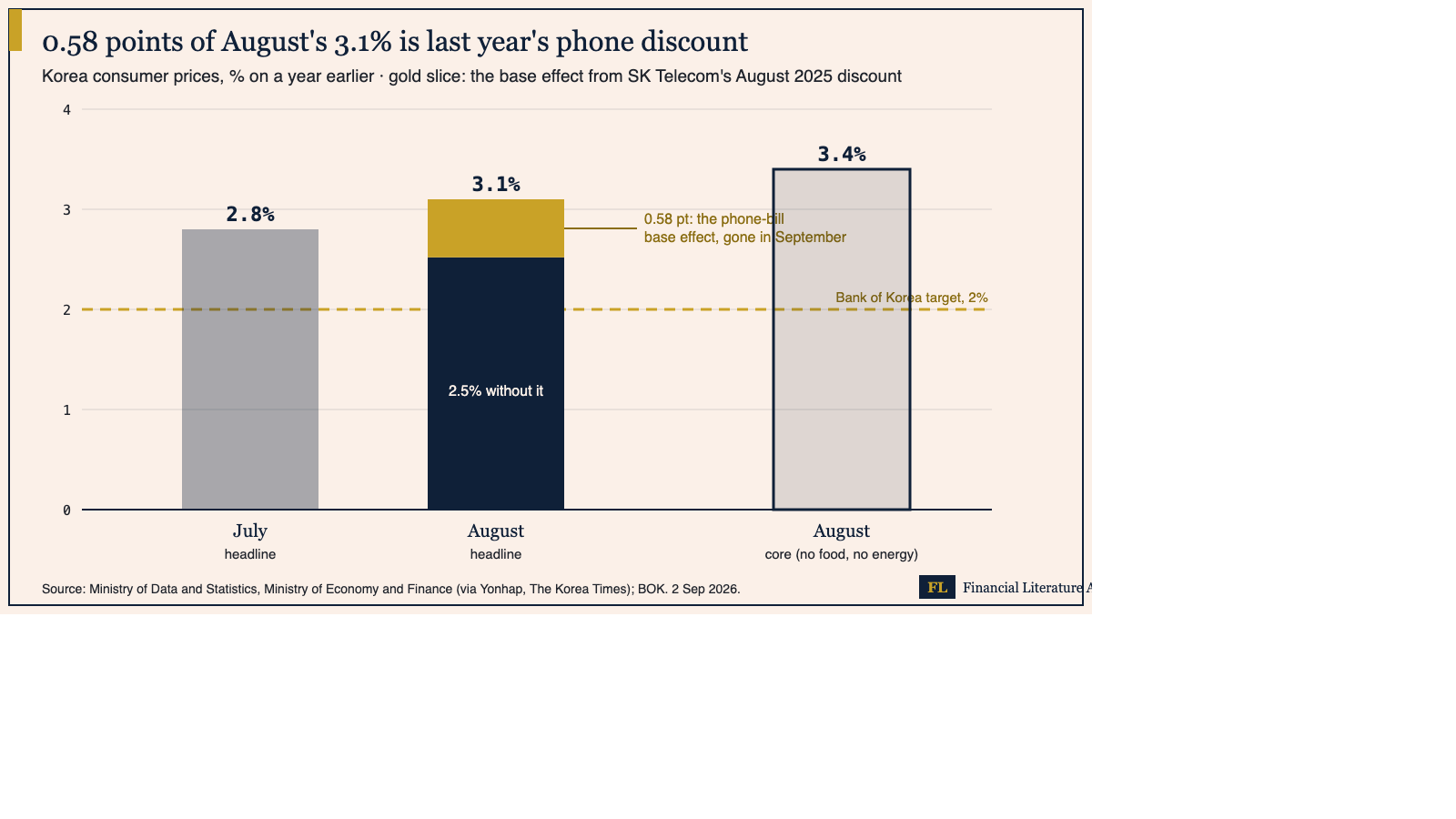
How to read this: a yearly rate has two ends, so before you read a jump as "prices are accelerating", check the far end. If the same month last year was unusually low, the rate rises even when this month's prices barely move, and falls back when the odd month drops out. The habit: find the "excluding" figure (here 2.5%), look at the month-on-month change (0.2%), and read core (3.4%) for the direction underneath. A base effect tells you about last year; core tells you about now.
📅 Tomorrow
Thursday, 10:45 am Seoul: China's RatingDog services PMI for August, after 50.4 in July, the other half of the economy after Monday's factory reading. Ho Chi Minh City reopens after the National Day break. Tonight, 9:15 pm Seoul: the US ADP private payrolls estimate, ahead of Friday night's official report.
One question. Today's chart showed August inflation at 3.1%, 0.58 points of it from last August's mobile discount dropping out of the comparison. Which reading is right? A: Phone bills jumped this month, so inflation is accelerating. B: This month's prices barely moved; the comparison month a year ago was unusually low, so the yearly rate rose, and that part fades when the odd month leaves the comparison. C: Without the phone effect inflation is 2.5%, so the core rate must be 2.5% too.
Financial Literature is for educational and informational purposes only. Nothing here is investment, financial, legal, or tax advice, or a recommendation to buy or sell any security. Content is impersonal and not tailored to any individual. Data may contain errors — verify before relying on it. We explain; we never advise. Sources: Korean statistics and finance ministries via The Korea Herald and The Korea Times, Reuters via Investing.com, Google Finance, Yahoo Finance, Money Today, Asia Economy Daily, Seoul Economic Daily, Indonesia Investments, Trading Economics.
Forwarded this by a friend? Subscribe here. Found it useful? Forward it to one person who'd want it.
— The Editorial Team