🌏 KOSPI −1.8% — a week's move, made in one day
Seoul fell 1.8% on Friday and sits 1.8% below last Friday: Monday to Thursday netted to nothing. Also: Tokyo's inflation preview and Thailand's reserves.

Numbers compiled Friday, 28 August 2026, at 4:45 pm in Seoul (UTC+9) — a 3-min read. Seoul and Tokyo closes are settled; Hong Kong and Bangkok were still trading and are labeled as snapshots, as are the currency and bond rows.
The KOSPI fell 1.79% on the day Nvidia rose 8.67%. Nvidia closed at $227.98 in New York on Thursday, and Seoul's chip stocks, which supply it, opened lower and stayed there. Three reasons were on the wires, none of them Nvidia: Politico's report that Washington is weighing steep tariffs on imported chips and on the servers and laptops that contain them, with tariff-free quotas tied to US factory commitments; Fed Chair Warsh's first Jackson Hole speech, due after Seoul closed; and Samsung Biologics' 3 trillion won share sale, which cut that stock 4.2%. Today's lesson is the calendar, not the chip: a week of ±3% days that ended exactly where Friday put it.
📊 The Dashboard — Friday, 28 August 2026
| Gauge | Level | Move | What this means |
|---|---|---|---|
| KOSPI (South Korea) | 6,788.88 | 🔴 ▼ −1.79% | Closed, settled — Google Finance and Investing.com's live page agree; a third aggregator printed 6,824.86 at compile time, which we treat as provisional. It opened down 0.95% at 6,846.54 and the low, 6,780.13, came in the last hour: a fall built through the day, not made at the bell. |
| KOSDAQ (South Korea, rotation row) | ≈838 | ⚪ ≈ flat | Closed — Investing.com's page shows +0.08%; one source, so we print the level as approximate. The smaller board did not follow the big one down: what sold today was the largest names. |
| Nikkei 225 (Japan) | 66,405.56 | 🟢 ▲ +0.41% | Closed, settled — Google Finance and Yahoo Finance's row agree. Tokyo took the same overnight news and finished green; the Spotlight explains the inflation print it absorbed at 8:30 am. |
| Hang Seng (Hong Kong) | ≈25,600 | 🟢 ▲ ≈ +0.1% | Still trading at compile — Investing.com (+0.13%) and Google Finance's 3:03 pm print (+0.19%); a snapshot. |
| USD/KRW | 1,372.5 | 🟢 ▼ won firmer | Seoul's 3:30 pm close, 1,372.5, matching Google Finance; Investing.com puts the 52-week low at 1,371.18. Stocks fell and the currency rose: whoever sold Korean shares today did not take the money out of Korea. |
| USD/JPY | ≈159.4 | ⚪ ≈ flat | Late-afternoon snapshot — 159.42. A hotter Tokyo print, a still yen: the market already expected the hike it points to. |
| JGB 10-year yield (Japan) | ≈2.93% | 🔴 ▲ +3 bp | Snapshot — 2.926%, from 2.892%. The bond market's reply to Tokyo's inflation: a little more, a little sooner. Bonds moved; the currency did not — read them together. |
🌏 The SEA watch — this week's number: Thailand's reserves
The rotation returns to Bangkok, where 1997 began. The SET was about 1,591 at 2:04 pm Bangkok time, down 0.6% and still trading, after Thursday's 1,600.70 close; the baht sat near 32.9 per dollar. The Bank of Thailand held its policy rate at 1.00% on Wednesday, unanimously, with second-quarter growth at 1.9%, down from 2.8% — a 1% rate against a US policy rate above 3.5%, which is why the baht has drifted weaker even as reserves stay deep.
The gauge to learn is foreign-exchange reserves: the central bank's stock of dollars (and gold, and other currencies) that it can sell to steady its own currency or pay the country's foreign bills. Bank of Thailand data put reserves at $280.9 billion in the week to 21 August; on Trading Economics' monthly series, July's $275.4 billion was the lowest since November 2025, down from a February peak of $293.9 billion — the two series are measured differently, so read each against itself. Why anyone watches it: in 1997 the baht was pegged at 25 to the dollar, the central bank "lacked the foreign reserves to support" the peg, the currency was floated on 2 July and reached 56 per dollar by January 1998. A reserve number is a fuel gauge: it tells you how long a country can defend a price it has chosen. A falling gauge on a floating currency, with hundreds of billions in the tank, is a very different reading from an emptying gauge under a peg. We describe, we don't call.
⭐ Spotlight: Tokyo's CPI — Japan's "core" is not everyone's core
Tokyo publishes its inflation three weeks before the national figure, so markets treat it as the preview. The August print: prices excluding fresh food rose 1.8% from a year earlier against a 1.7% forecast, and excluding both fresh food and energy, 2.0% (headline 1.9%, as expected). One concept: in Japan, "core" means ex fresh food, because vegetable and fish prices swing with the weather; the measure that strips out energy too is called "core-core". Elsewhere "core" already means ex food and energy. Same word, different cut — which is why a Japanese core number can look tame while the underlying one runs at target. A note on honesty: our sources print July's core figure differently (1.7% and 1.9%), so we quote August against its forecast only. Most market players expect the Bank of Japan to lift its rate to 1.25% at the 17–18 September meeting; the JGB row above is that expectation in a number.
📈 Chart of the Day — the week that was Friday
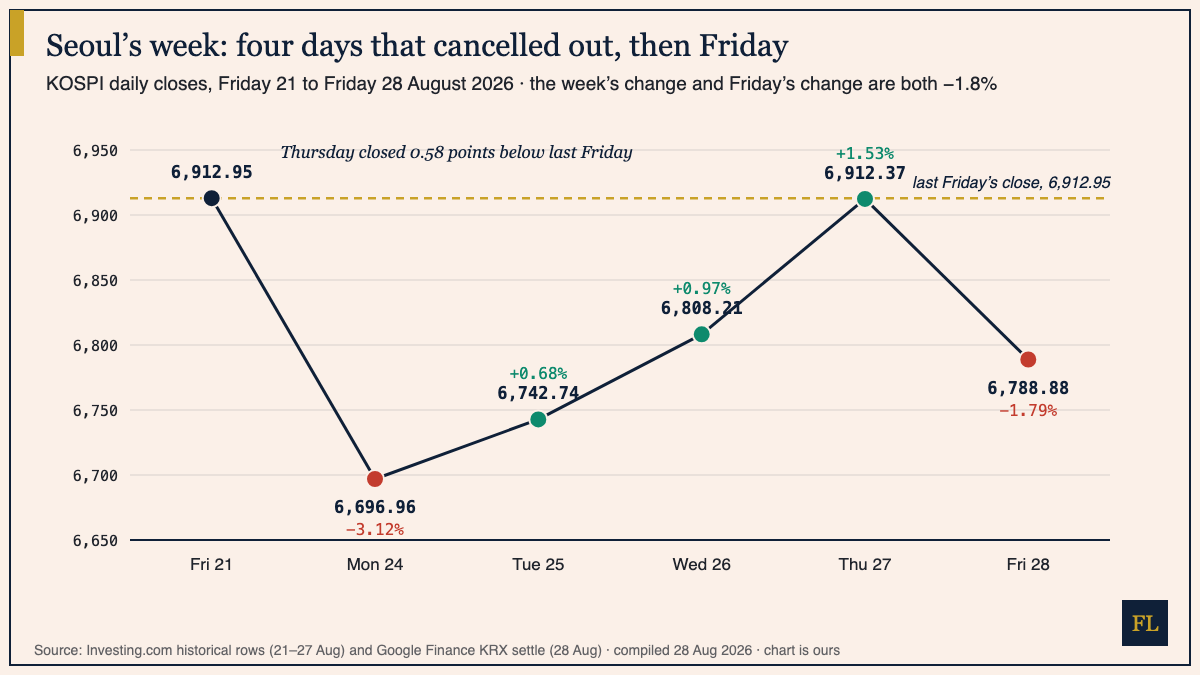
How to read this: a daily dashboard shows you six moves; a weekly one shows you one. Both are true. Monday's −3.12% and Thursday's +1.53% were real days for anyone who traded them, yet by Thursday's close the index sat 0.58 points from where it started, and the whole week's change is Friday's. When a reader says "the KOSPI fell 1.8% this week," ask which window they mean: the answer changes the story from "a bad Friday" to "a flat week", and the number stays the same. Sources: Investing.com's settled rows (Friday's own row had not refreshed at compile, so the last point is the Google Finance settle).
📅 Tonight and Monday
Tonight at 11 pm Seoul time, Fed Chair Warsh gives his first Jackson Hole keynote at 10:00 am Eastern — two calendars agree on the time. Watch Monday's USD/KRW row against today's 1,372.5, and Monday morning's chip stocks: Seoul sold ahead of the speech, so Monday shows whether the words matched the fear. Our stress board, for texture: VIX closed at 15.4 on 25 Aug 2026, lower than 65% of closes since 1990. Monday 10:30 am Seoul, China's official manufacturing PMI: consensus 49.7, July 49.2 — 50 is the line between shrinking and growing. Tuesday 9 am, Korea's full-month August exports, after the first 20 days ran 56% above a year earlier on chips.
Related reading from this edition: how to read a daily candle and the Bank of Korea's dot plot.
Financial Literature is for educational and informational purposes only. Nothing here is investment, financial, legal, or tax advice, or a recommendation to buy or sell any security. Content is impersonal and not tailored to any individual. Data may contain errors — verify before relying on it. We explain; we never advise. Sources: Google Finance, Investing.com, Yahoo Finance, Seoul Economic Daily, The Korea Times, The Korea Herald, Businesskorea, Reuters via AOL, investinglive, Stock Exchange of Thailand, Kaohoon International, Thai Examiner, Nation Thailand, FX.co, Trading Economics, Wikipedia, FXStreet, Newsquawk, Regards of Wall Street.
Forwarded this by a friend? Subscribe here. Found it useful? Forward it to one person who'd want it.
— The Editorial Team