What is a base effect, and why can inflation jump when prices barely moved?
Korea's inflation rate rose to 3.1% largely because of a phone discount in August 2025. How base effects work, and the three checks that expose one.

The short answer: a base effect is what happens to an annual inflation rate when the unusual month sits at the far end of the comparison, a year ago, rather than in the month just published. Korea's August rate rose to 3.1% from 2.8% mostly because August 2025 was artificially cheap, which means the rate moved without much new happening to prices this year.
What a base effect is
An annual inflation rate is a comparison between two months twelve months apart. Because it is a comparison, it has two ends, and either end can move it. If this month's prices jump, the rate rises. If the month it is measured against was unusually low, the rate rises too, even when this month is ordinary. The European Central Bank puts it in one line: "A base effect is the effect on the year-on-year rate of inflation when an unusually large month-on-month change 12 months earlier drops out of the index."
Korea's August print is a clean example of the second case. In August 2025, SK Telecom cut its subscribers' mobile bills by half after a data breach, and mobile phone charges fell 21% on the year. Those discounts are gone now, so this August's ordinary bills sit 26.7% above the discounted ones, and the mobile line in the basket does the arithmetic. The Ministry of Economy and Finance sized it: 0.58 percentage point of August's 3.1%, leaving about 2.5% without it.
Who tracks it, and why
Statistical offices and central banks track base effects because their job is to separate what the economy is doing from what the calendar is doing. A rate-setter reading 3.1% has to know how much of it is a phone discount that expired, because policy cannot act on last August. That is why the ministry published the 0.58 figure on the same morning as the headline, and why the Bank of Korea's deputy governor, Lee Ji-ho, could say that "in September, consumer price growth is expected to be lower than in August as the base effect fades, but the underlying upward trend is expected to continue, particularly in core items." Both halves of that sentence matter: the number will fall, and the pressure underneath will not.
The reference point for all of this is the Bank of Korea's 2% target, set on the year-on-year change in the consumer price index and unchanged since 2019. A base effect can push a print above or below that line for a month or two on its own.
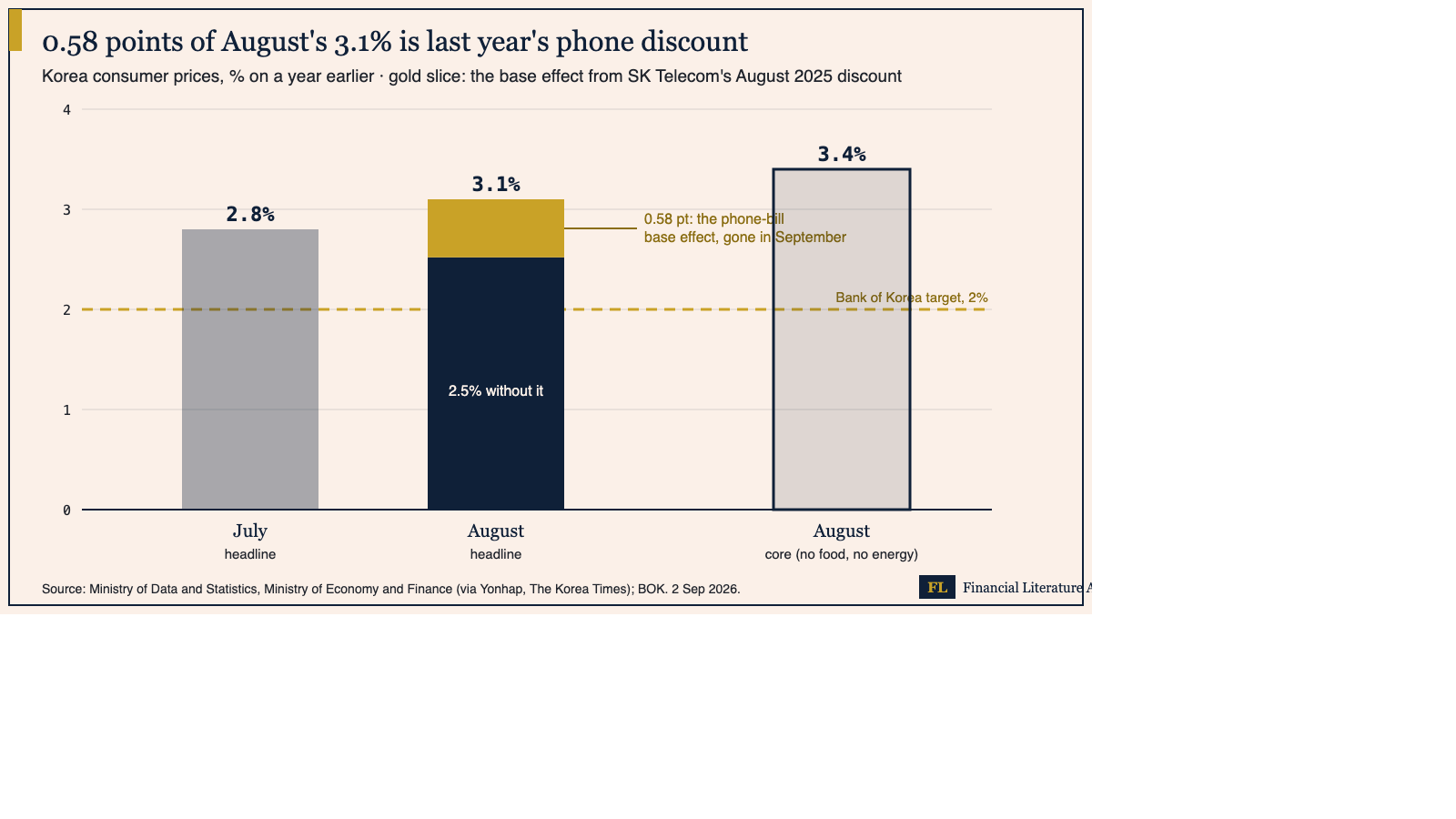
How to read this: the gold slice is the part of the bar that belongs to last year, not to this one. Read the "excluding" bar as the rate a reader would have seen if August 2025 had been a normal month, and read the gap between the two as the size of the calendar's contribution. Then check the month-on-month change, 0.2% in August, because that end of the comparison contains only this year.
How to read a move, in three steps
First, ask what happened in the same month last year. A discount, a subsidy, a tax change, a fuel cap or an oil crash a year ago will all show up as a jump or a drop today. Second, find the "excluding" figure. Statistical offices and finance ministries publish one whenever a known one-off is in the base, and it is the honest headline. Third, look at the month-on-month change and at core, the rate with energy and food stripped out, which was 3.4% in August. A base effect tells you about last year. The monthly change and core tell you about now.
The effect also expires on a known date, which makes it one of the few things in inflation data you can see coming. Korea's phone-bill base drops out of the comparison in September, so the annual rate should fall for that reason alone, and a reader who knows why will not mistake the fall for prices cooling.
What a base effect is not
It is not a mistake, and nothing is being adjusted or corrected: both numbers are accurate answers to different questions. It is not the same as core inflation, which removes volatile items from both ends of the comparison rather than explaining one end. It is not a forecast. And it is not always upward. When last year's month was unusually expensive, the base effect pulls this year's rate down and can make a genuine price rise look mild, which is the version that catches people out.
The habit
Whenever an annual rate surprises you, look twelve months back before you look at this month. We used that habit on Wednesday, when Korea's 3.1% landed, and the same instinct, read the second number before the headline, ran through Friday's Japanese spending figures, where the cash number and the inflation-adjusted number told different stories about one month. The archive keeps the daily series.
Financial Literature is for educational and informational purposes only. Nothing here is investment, financial, legal, or tax advice, or a recommendation to buy or sell any security. Content is impersonal and not tailored to any individual. Data may contain errors, so verify before relying on it. We explain; we never advise. Sources: European Central Bank, Bank of Korea, Ministry of Economy and Finance via The Korea Times, Ministry of Data and Statistics via The Korea Herald.
Forwarded this by a friend? Subscribe here. Found it useful? Forward it to one person who'd want it.
— The Editorial Team