🌍 −1.1% — Germany's factories made less in the month their order book grew
July production fell 1.1%, the steepest in nearly a year, three days after orders rose 2.5%. A car-plant shutdown did most of it.

Compiled Monday, 7 September 2026, at about 1:00 pm in Frankfurt (CEST, UTC+2), a 5-min read. Index rows are Friday's closes, final. The currency and bond rows are Monday snapshots, still trading, and say so. Wall Street is shut for Labor Day.
Yesterday's answer: B — because a single large contract can be worth a month of ordinary business, so the statisticians publish the order series twice, and the line excluding large orders plus the three-month window describe the ordinary order book better than the headline.
German industry produced 1.1% less in July than in June, against the 0.1% rise economists polled by Reuters had expected, three days after the same office reported that the order book grew 2.5%. One industry did nearly all of it, with its plants switched off. Today's lesson is the difference between what a factory is promised and what it makes.
📊 The Dashboard, Friday, 4 September 2026 (closes)
| Gauge | Level | Move | What this means |
|---|---|---|---|
| STOXX 600 (pan-Europe) | 649.88 | 🟢 ▲ +0.12% | Final: Investing.com. Monday midday it was 649.17, a shade lower, with energy shares up 1.2% as crude rose. |
| DAX (Germany) | ≈26,047 | ⚫ little changed | Final: Google Finance 26,046.40, Investing.com 26,048.38. Monday midday about 25,972, down 0.3%, still trading. Sunday's state election barely registered here. |
| FTSE 100 (UK) | 10,831.09 | ⚫ flat | Final: Google Finance, within a point of Thursday. Monday morning 10,847.57, up 0.15%, still trading. |
| SMI (Switzerland, rotation row) | 14,395.94 | 🔴 ▼ -0.8% Monday | Friday's close: Google Finance. Monday midday 14,277.51, still trading. Novartis fell 3.3% after its drug pelacarsen missed a goal in a late-stage trial: a single heavyweight can carry a small index. |
| EUR/USD | 1.1622 | ⚫ barely moved | Friday's ECB reference rate, from 1.1615. Monday, still trading: 1.1621, up 0.06%. The euro shrugged at the election result. |
| GBP/USD | ≈1.354 | 🟢 ▲ pound firmer | Monday snapshot, still trading: 1.3539, from 1.3516. |
| Bund 10Y yield | ≈3.36% | 🔴 ▲ +2 bp | Monday snapshot, still trading: 3.3559%, from 3.3383%, and 3.3538%, near a 15-year high. Red because a higher yield means a lower bond price. |
| Gilt 10Y yield (UK) | ≈5.14% | 🔴 ▲ +1 bp | Monday snapshot, still trading: 5.1444%, from 5.1366%, below last Wednesday's 5.28%. |
What happened, in plain words
Germany voted in one state on Sunday. The far-right AfD came first in Saxony-Anhalt with about 44% of the vote, a blow to Chancellor Friedrich Merz, whose CDU roughly halved its share after 24 years running the state, while every other party repeated its refusal to govern with the AfD. Markets treated it as news about Germany's politics rather than about its cash flows: the DAX moved less than a third of a percent, the euro did not move at all, and Bund yields rose about two basis points, in line with other European bond markets. A state parliament does not set the euro area's budget or its interest rate. That is the honest reading, and it is worth holding on to on days when a headline feels larger than the numbers under it.
Oil did more. Brent traded near $97 a barrel, close to a seven-week high, after strikes on tankers in the Gulf and an Iranian plan to declare a shipping exclusion zone outside the Strait of Hormuz. Dearer energy pushes up the prices Europe is trying to bring down, which is one reason the region's bond yields have climbed for four weeks. The European Central Bank decides on Thursday, in Berlin; money markets fully price a quarter-point rise to a 2.5% deposit rate.
⭐ Spotlight: the second estimate, and why 0.4% became 0.6%
Statistics arrive in drafts. Eurostat published its second estimate of second-quarter growth on Monday: euro-area GDP rose 0.6% on the quarter, revised up from the 0.4% first published, and 1.2% on the year, up from 1.0%. Employment rose 0.1%, with 176.4 million people employed in the euro area. Ireland grew fastest at 10.2% and Slovenia 1.8%; Austria was the only member state to shrink, by 0.1%. A flash estimate is built weeks after the quarter ends, from the countries and surveys that have reported. Later estimates add the ones that had not. That is why the number moves without anybody being wrong, and why the release says the figures may change again in a database update on 20 October. A third of a percentage point on a quarter is small in itself and large in a meeting room: it lands three days before a rate decision.
📈 Chart of the Day: what was promised, what was made
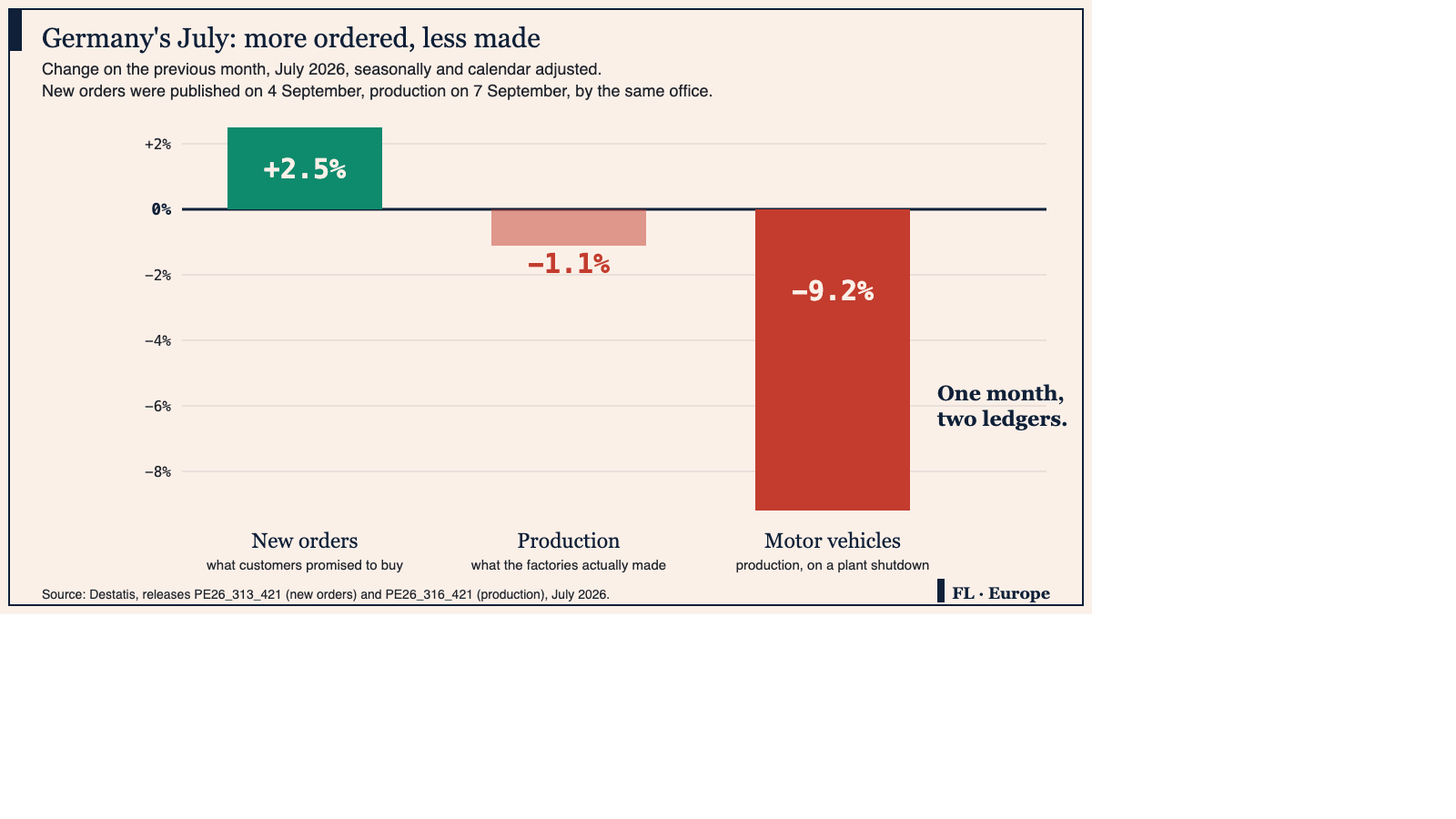
How to read this: orders and production measure different moments in the same business. An order is a promise recorded when it is signed, and it can be filled months later, or cancelled. Production counts goods actually made in the month. When the two point opposite ways, ask which one has a physical reason attached: here it is the car industry, down 9.2% on a multi-week plant shutdown, with production excluding energy and construction down 2.2% and energy output up 4.7% on wind and solar. A shutdown ends. Read the calmer three-month window before deciding whether a single month changed the story.
🔑 House indicators: the stress gauge
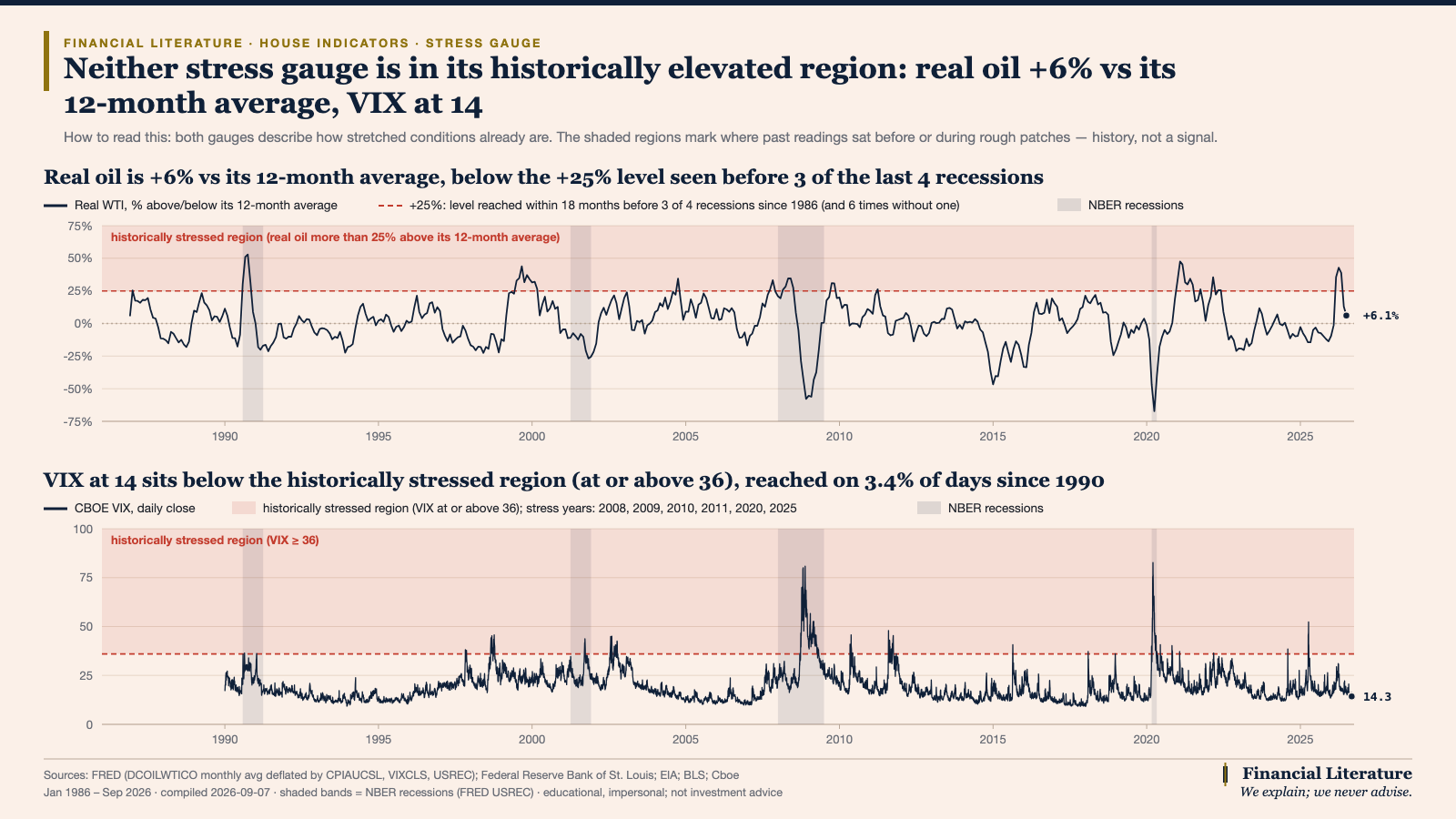
How to read this: both panels describe conditions that already exist rather than conditions to come, and the shaded bands mark where past readings sat before or during rough patches. Our monthly readings say real oil was 6.1% above its 12-month average in July, below the 25% level reached before three of the last four recessions since 1986 and six times without one, and the VIX closed at 14.3 on 3 September, lower than 73% of closes since 1990. Both are monthly and weekly snapshots, and this week's crude price is not in them yet.
📅 This week
Wednesday brings a speech by ECB President Christine Lagarde, and Thursday the decision itself, announced from Berlin with a press conference after it. Friday's letter read the order book that today's production figure was supposed to fill.
One question. Today's chart showed German new orders up 2.5% in July and German production down 1.1% in the same month. Which reading is right? A: One of the two releases must be wrong, because a factory cannot take more work and make less. B: Orders record work promised in the month and production records goods made in the month, so a plant shutdown can cut output while the order book fills. C: Netting them gives real activity of about plus 1.4%.
Financial Literature is for educational and informational purposes only. Nothing here is investment, financial, legal, or tax advice, or a recommendation to buy or sell any security. Content is impersonal and not tailored to any individual. Data may contain errors, verify before relying on it. We explain; we never advise. Sources: Destatis, Eurostat, European Central Bank, Google Finance, Investing.com, Trading Economics, Reuters via Investing.com, CBS News, FRED, Cboe.
Forwarded this by a friend? Subscribe here. Found it useful? Forward it to one person who'd want it.
— The Editorial Team