🌍 +2.5% — Germany's orders rose on ships and planes; without them, −1.4%
July factory orders beat forecasts by two points. Strip out the large contracts and the order book shrank, in the month and across the quarter.


Compiled Friday, 4 September 2026, at about 10:40 am in Frankfurt (CEST, UTC+2), a 5-min read. Index rows are final Thursday closes; the bond and currency rows are Friday-morning snapshots, still trading, and say so.
Yesterday's answer: B — because producer prices are read by stage of production, and energy at the top and intermediate goods in the middle were up while consumer goods at the end were not, so the pass-through is incomplete rather than finished; the core consumer rate for the same month is the reading of how much has reached households.
German factories took 2.5% more orders in July than in June, against the 0.3% economists expected. Strip out the large contracts and orders fell 1.4%. One line explains the distance: orders for ships, railway rolling stock and aircraft more than doubled on the month. Today's lesson is what a large order does to a national statistic, and where to look instead.
📊 The Dashboard, Thursday, 3 September 2026 (closes)
| Gauge | Level | Move | What this means |
|---|---|---|---|
| STOXX 600 (pan-Europe) | 649.10 | 🟢 ▲ +0.49% | Final (Investing.com, Google Finance). Off Tuesday's one-month low. Luxury fell 2% while Soitec rose 10.3% on a raised forecast and WPP 5.6% on winning the PepsiCo media account. |
| DAX (Germany) | 26,003.32 | 🟢 ▲ +0.63% | Final (Google Finance, Investing.com). Commerzbank rose 2.3% on a 1.2 billion euro buyback. A buyback shrinks the share count, so each remaining share owns more of the same company. |
| FTSE 100 (UK) | 10,831.52 | 🟢 ▲ +0.70% | Final (Google Finance, Investing.com). The best of the big three, helped by gilt yields easing back. |
| CAC 40 (France, rotation row) | 8,286.40 | ⚫ ▲ +0.07% | Final (Investing.com, Google Finance). Barely moved, and heading for a fourth weekly fall. France's construction survey fell to 37.3 in August from 41.5: on a survey where 50 is no change, that is a deep contraction. |
| EUR/USD | 1.1615 | 🟢 ▲ euro firmer | Thursday's ECB reference rate, from 1.1578. Friday, still trading: 1.1621 at 10:22 am. The dollar softened as bets on a Federal Reserve rise were pared. |
| GBP/USD | ≈1.354 | 🟢 ▲ pound firmer | Friday snapshot, still trading: 1.3538 at 10:21 am, from about 1.350. |
| Bund 10Y yield | ≈3.35% | ⚫ flat | Friday snapshot, still trading (Investing.com, Trading Economics), against Thursday's 3.3513%. Two quiet days after touching the highest since April 2011. |
| Gilt 10Y yield (UK) | ≈5.16% | 🟢 ▼ from the week's peak | Friday snapshot, still trading (Investing.com, Trading Economics), from the 5.28% of Wednesday's letter. Green because the bond price rose. |
What happened, in plain words
Thursday belonged to one American speech. Federal Reserve governor Christopher Waller said "three-month inflation has fallen steadily from 4.76% in February. That is a considerable improvement, and the speed of this downward trajectory is encouraging", and that he would "be inclined to support holding the target for the federal funds rate at its current setting" if it continued. The S&P 500 rose 1%, the ten-year Treasury yield eased to 4.74%, and the odds of a Fed rise this month fell to about 50% from 63%. The ISM services survey came in at 55.4 against 54.1 expected. Lower expected American rates pull global bond yields down with them, which is why European bonds had a second calm day.
Europe's own decision is next Thursday, 10 September, in Berlin. Money markets now fully price a quarter-point rise, to a 2.5% deposit rate; traders expect two more quarter-points by mid-2027. Brent is about $95.2, still heading for a strong week.
⭐ Spotlight: what a large order does to a national number
Germany counts new orders taken by its factories each month, in real terms, adjusted for the season and the number of working days. July's total rose 2.5% on June, which itself was revised up to 3.7%, and stood 13.1% above July 2025. Excluding large-scale orders, July fell 1.4%. Orders in transport equipment rose 126.4% on the month on ships, railway rolling stock and aircraft, while the motor industry took 12.5% fewer. Domestic orders rose 9.1% and foreign orders fell 2.1%, with the euro area up 12.1% and the rest of the world down 10.1%. A single shipyard contract can be worth a month of ordinary business, so the statisticians publish the series twice, with and without the big ones. Over the calmer three-month window, May to July was 2.9% above the previous three months, and minus 2.2% once large orders are removed. Factory turnover, which measures goods actually invoiced rather than ordered, fell 1.5% on the month.
📈 Chart of the Day: with and without the big contracts
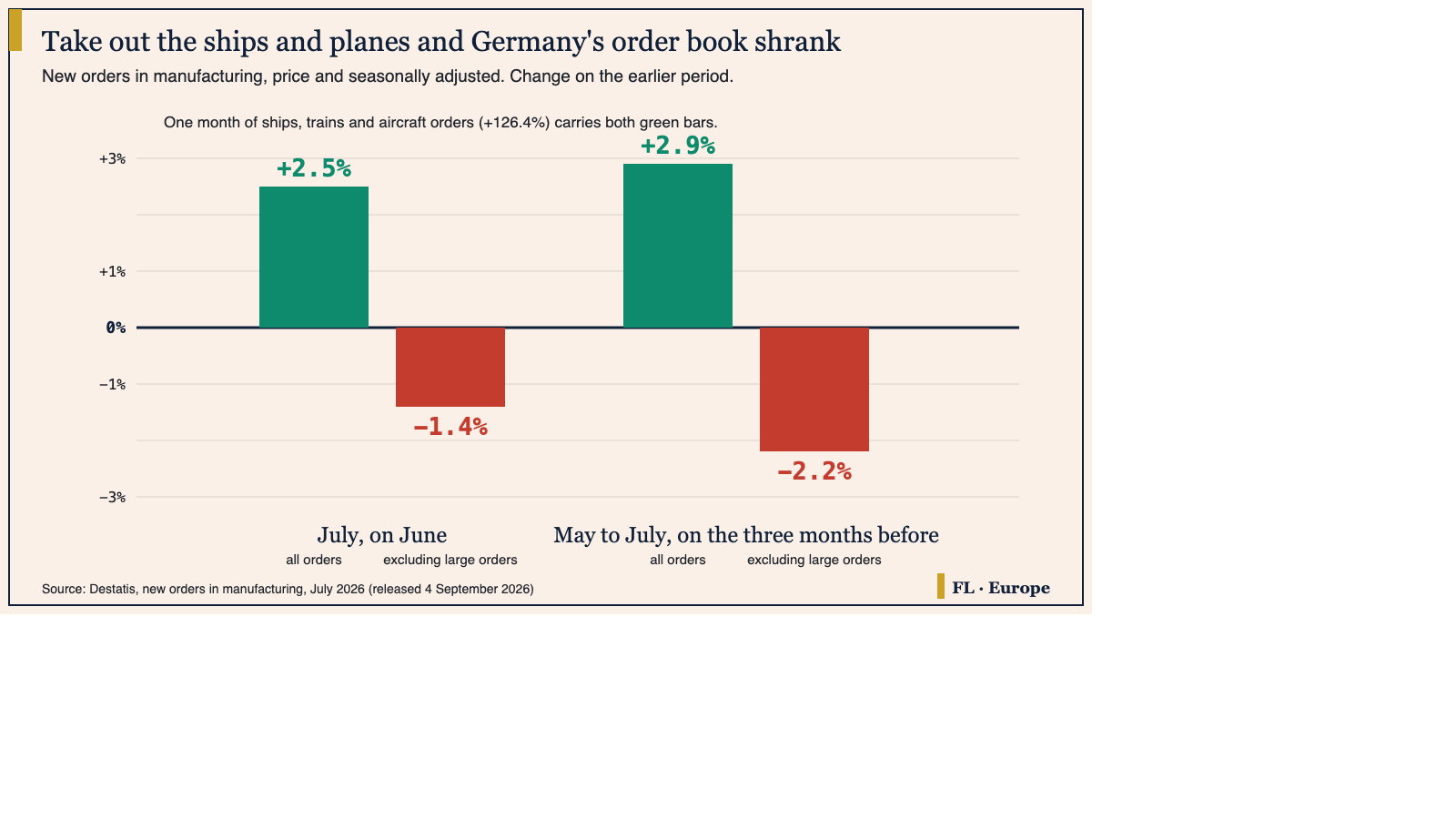
How to read this: for any lumpy monthly series, read three lines before you form a view. The headline tells you what happened. The series excluding one-off items tells you what usually happens. The three-month average tells you which of the two is lasting. When the headline and the adjusted line point opposite ways, the month was made by a handful of contracts, and the honest summary names both. The same habit works on company results, where one large sale can carry a quarter.
📅 Next week
This afternoon at 2:30 pm, American August employment. Collected forecasts centre on 56,000 jobs, in a range from minus 25,000 to plus 121,000, with unemployment at 4.1% after July's fall of 23,000. Then Thursday, the ECB in Berlin, and the Bank of England on 17 September. Yesterday's letter read the factory gate; Tuesday's read the till.
One question. Today's chart showed German orders up 2.5% in July and down 1.4% once large contracts are removed. Which reading is right? A: The 2.5% is the official figure, so the smaller line can be ignored. B: One month of ship, train and aircraft orders carried the total, so the line excluding large orders and the three-month average describe the ordinary order book better. C: The two figures cancel out, leaving orders up about 1.1%.
Financial Literature is for educational and informational purposes only. Nothing here is investment, financial, legal, or tax advice, or a recommendation to buy or sell any security. Content is impersonal and not tailored to any individual. Data may contain errors, verify before relying on it. We explain; we never advise. Sources: Destatis, European Central Bank, Investing.com, Google Finance, Trading Economics, Reuters via Investing.com, Yahoo Finance, investinglive, MoneyWeek.
Forwarded this by a friend? Subscribe here. Found it useful? Forward it to one person who'd want it.
— The Editorial Team