🌍 2.7% — France's inflation rose; Spain's rose more
France's harmonised inflation hit 2.7% in August (2.4% in July) and Spain's 4.5%, both on energy. Today: why every euro country has two inflation rates.


Compiled Friday, 28 August 2026, at about 10:30 am in Frankfurt (CEST, UTC+2) — a 5-min read. Index and bond rows are final Thursday closes, cross-checked against two sources; currency rows and the inflation prints are Friday-morning items, and say so.
France's inflation rose to 2.7% in August on the EU-harmonised measure, from 2.4%, and Spain's to 4.5%, from 3.9% — both published this morning, both driven by energy, and both arriving twelve days before the ECB decides whether to raise rates again.
📊 The Dashboard — Thursday, 27 August 2026 (closes)
| Gauge | Level | Move | What this means |
|---|---|---|---|
| STOXX 600 (pan-Europe) | 651.85 | 🔴 ▼ −0.69% | Final — Investing.com historical and Google Finance agree. Banks led the fall: BNP Paribas down nearly 5%, UniCredit 3.2%; a bad day, not a large one. |
| DAX (Germany) | 26,367.24 | 🟢 ▲ +0.31% | Final — Investing.com and Google Finance agree. The only big board in the green: SAP rose more than 5% and Infineon 4% after Nvidia’s results, reversing Wednesday's SAP drop. |
| FTSE 100 (UK) | 10,792.54 | 🔴 ▼ −0.79% | Final — Investing.com and Google Finance agree. Miners fell with metals prices; the index has little technology to catch the Nvidia lift. |
| CAC 40 (France) | 8,319.87 | 🔴 ▼ −1.68% | Rotation row, final — Investing.com and Google Finance agree on the level (wires printed −1.1% to −1.8% during the day; this is the settle). Société Générale −5.7%, BNP Paribas −4.8% at the close; Pernod Ricard −7.7% on a revenue miss. |
| EUR/USD | ≈1.165 | ⚪ ≈ flat | Friday snapshot, still trading — 1.1647 at 8:07 am UTC, where it was on Thursday morning; the inflation prints barely moved it. |
| GBP/USD | ≈1.359 | ⚪ ≈ flat | Friday snapshot, still trading — 1.3586 this morning, a third day near the week's low. |
| Bund 10Y yield | 3.25% | 🟢 ▲ +2.3 bp | Thursday close, final — Investing.com has 3.2493%, from 3.2267%; Trading Economics reads 3.26% this morning, the highest since March 2011. |
Friday, live: about 9:50 am the STOXX 600 is at 654.8, up 0.5%; the DAX up 0.5% at 26,507; the FTSE 100 up 0.2%; the CAC 40 up 1.0% as French banks recover 0.8–1%. Brent is near $88 after an $88.52 settle, up 1.8%. Snapshots, not closes.
What happened, in plain words
Thursday was France's day, for the wrong reasons. Bank shares fell after the first presidential-election debate was dominated by the state of France's public finances; one candidate proposed that the ECB "freeze" Covid-era state debts, and the prime minister asked who would still lend to France. The ten-year French yield reached 4.11%, about 88 basis points above Germany’s, the widest gap since late 2024, and France now borrows at a higher rate than Italy: 4.08% against 4.06% on Thursday. Banks hold government bonds and borrow at rates set off them, so a country's credit worry becomes its banks' share-price worry the same afternoon. Fitch’s scheduled review of France lands today, after the close.
Then this morning's prints. INSEE’s flash estimate has energy prices up 16.7% on a year earlier, services slowing to 2.0% — the rise is almost entirely fuel — and the national measure came in at 2.4% against a 2.2% forecast. INE’s flash for Spain has the national rate at 4.3% from 3.6%, core inflation slipping to 2.9%, against a 4.2% consensus. Both beat forecasts; both by energy. INSEE also reported that French GDP was flat in the second quarter and household purchasing power fell 0.5% — prices outran wages.
The ECB had already told us how it reads this. Thursday’s account of the July meeting records that "markets continued to expect further policy tightening, with a hike in September 2026 almost fully priced in", and Reuters’ reading of the account: another rate rise "would likely be necessary unless the inflation outlook improved significantly". The deposit rate is 2.25%; the decision is on 10 September. The outlook did not improve this morning.
⭐ Spotlight: one country, two inflation rates
Every euro-area country publishes two inflation numbers each month — today, 2.4% and 2.7% for France, 4.3% and 4.5% for Spain. The first is the national consumer price index, built on each country's own definitions and used at home for indexing pensions, rents and wages. The second is the Harmonised Index of Consumer Prices, compiled to the same method in every member state — and the ECB’s reference measure for inflation. The gaps come from scope: the HICP covers only what households pay out of their own pocket, so for health it uses prices net of social-security reimbursement, where the French CPI uses gross prices; and it leaves out the cost of living in a home you own. Which is "right"? Both — for different jobs. When a headline says "French inflation 2.7%" and another says "2.4%", nobody is wrong; check which gauge, and remember the ECB reads the harmonised one.
📈 Chart of the Day — both countries, both gauges, all higher
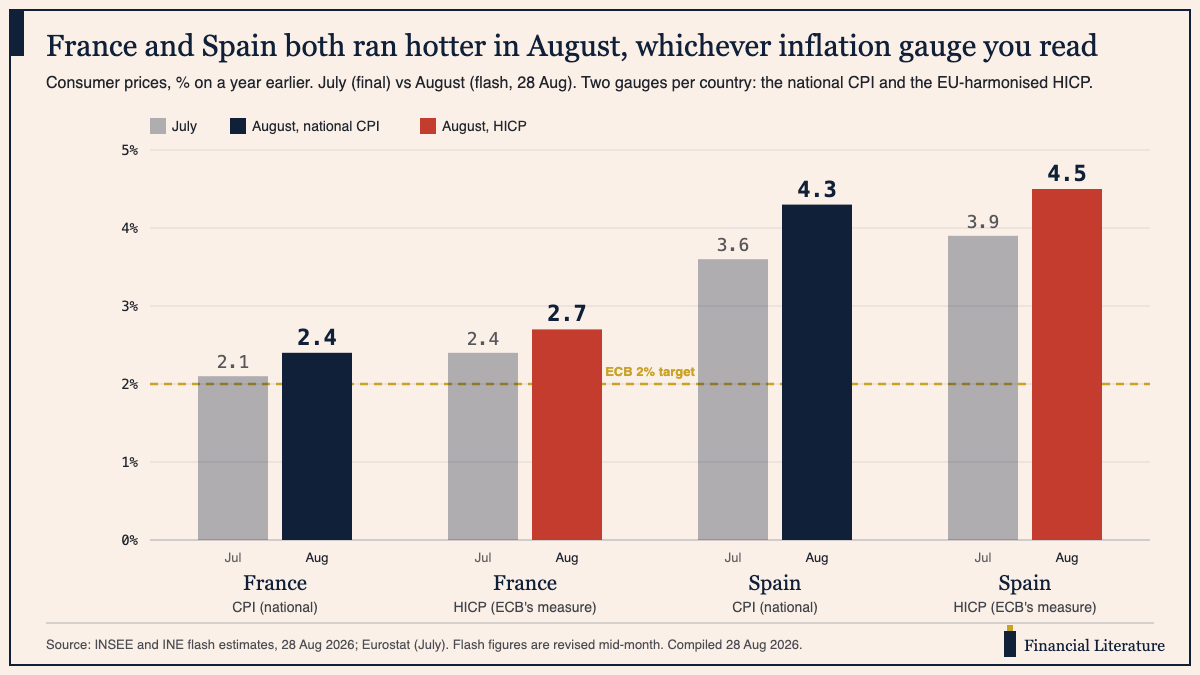
How to read this: the question a flash estimate answers is "up or down from last month, and by how much", so July-to-August is the move, and the gold line is the distance from target. Then compare the two gauges for one country: they move together (both French pairs rose 0.3 points) but sit at different heights, because they weigh different baskets. Finally, remember these are flash estimates: INSEE finalises August on 15 September, and revisions of a tenth are routine.
Earlier this week we read a survey against its forecast and an oil price into a bond yield; today's two prints are the same oil, reaching the shop shelf. The archive keeps the series.
📅 Tomorrow
Still today: Fed Chair Warsh’s first Jackson Hole keynote at 10:00 am Eastern, 4 pm in Frankfurt (Yahoo Finance agrees on the hour; about a third of bond traders expect a Fed hike in September), and Fitch on France after the close. Monday: London is shut for the summer bank holiday; Germany’s flash August inflation lands at 2 pm Frankfurt time. Tuesday, 11 am: Eurostat’s euro-area flash for August, after 2.9% in July — consensus 3.1%. Friday: the US jobs report.
Forwarded this by a friend? Subscribe here. Found it useful? Forward it to one person who'd want it.
We explain; we never advise. Nothing here is investment advice.
Financial Literature is for educational and informational purposes only. Nothing here is investment, financial, legal, or tax advice, or a recommendation to buy or sell any security. Content is impersonal and not tailored to any individual. Data may contain errors — verify before relying on it. Sources: Investing.com historical (STOXX 600, DAX, FTSE 100, CAC 40, Brent, Germany 10Y); Google Finance (STOXX 600, DAX, FTSE 100, CAC 40, EUR/USD, GBP/USD); Trading Economics (sessions, Bund, OAT, Brent, France CPI, Spain CPI, euro-area CPI, ECB rate); Newsquawk (Thursday wrap); INSEE (August flash, Q2 GDP, HICP note); Reuters via Investing.com (France CPI); INE (Spain flash); Eurostat (July HICP); ECB (HICP, July account); Reuters via Investing.com (account); Czech National Bank (CPI vs HICP); France Épargne, IBTimes (French banks, Fitch); Bundesbank, GOV.UK, LiteFinance, FedRateCalc (calendar); Regards of Wall Street, Yahoo Finance (Jackson Hole).
— The Editorial Team