🌍 3.20% — falling oil reached the Bund
Brent settled at $87 and the 10-year Bund yield closed at 3.20%, its lowest since mid-August. Today: how an oil price travels into a bond yield.


Compiled Wednesday, 26 August 2026, at about 10:30 am in Frankfurt (CEST, UTC+2) — a 5-min read. Index and bond rows are final Tuesday closes, cross-checked against two sources; currency rows are Wednesday-morning snapshots, still moving, and say so.
Oil fell for a second session on Tuesday, and Germany's ten-year borrowing cost fell with it — to 3.20%, its lowest close since 14 August. Brent crude settled at $87.27, down 3.6% on the day, after Iran and Oman said they had discussed a temporary joint navigation corridor through the Strait of Hormuz. Today's letter follows the oil price from the tanker lane into the bond table — a chain that, seen once, is recognisable every time after.
📊 The Dashboard — Tuesday, 25 August 2026 (closes)
| Gauge | Level | Move | What this means |
|---|---|---|---|
| STOXX 600 (pan-Europe) | 656.48 | 🟢 ▲ +0.35% | Final — Investing.com historical and Google Finance agree. Industrials and travel led; autos lagged. No red close since Thursday. |
| DAX (Germany) | 26,266.14 | 🟢 ▲ +0.61% | Final — Investing.com and Google Finance agree. Tuesday's strongest big board, the session the Ifo surprise we decoded yesterday landed in. |
| FTSE 100 (UK) | 10,886.16 | 🟢 ▲ +0.29% | Final — Investing.com and Google Finance agree. A sixth green day in a row. |
| CAC 40 (France) | 8,439.20 | 🔴 ▼ −0.16% | Rotation row, final — Investing.com and Google Finance agree. The only red big board: Paris carries the carmakers, and autos lagged. |
| EUR/USD | ≈1.168 | ⚪ ≈ flat | Wednesday snapshot, still trading — 1.1677 at 8:30 am UTC. The dollar index slipped from 99.11 to 98.90 on Tuesday's diplomacy headlines. |
| GBP/USD | ≈1.363 | ⚪ ≈ flat | Wednesday snapshot, still trading — 1.3634 this morning; Tuesday's best-performing major. |
| Bund 10Y yield | 3.20% | 🔴 ▼ −4.5 bp | Tuesday close, final — Investing.com has 3.2033%, from 3.2485% on Monday; Trading Economics reads 3.20%, near the lowest since 14 August. Wednesday morning: 3.19–3.20%, still trading. A lower yield is a higher bond price. |
Wednesday, live: mid-morning, the STOXX 600, DAX and FTSE 100 are within a tenth of a percent of flat; the CAC 40 is up about 0.4%. Underneath: basic resources up about 1%, energy down 1.1% as Brent fell for a third session, and technology a touch lower ahead of Nvidia's results tonight; Shell and BP each fell more than 1.5% while Rio Tinto and Anglo American rose with copper at a six-month high. Brent trades near $86. Overnight, Iran's deputy foreign minister called the Oman route seven miles wide and temporary, and said Iran would not consider the strait open. Snapshots, not closes.
What happened, in plain words
Start at the strait, which normally carries around one-fifth of the world's oil and LNG exports and has been mostly shut since the war began on 28 February. On Tuesday in Tehran, Iran and Oman described a framework with a temporary joint navigation corridor and a joint project to clear the strait of mines. Add Pakistan's mediation and a reading that Monday's US measures were less aggressive than feared, and Brent went from $92.67 on Friday to $90.54 on Monday to $87.27 on Tuesday — down 5.8% in two sessions.
Now the bond. A ten-year yield is, roughly, the market's average guess at ECB rates over the next decade, plus a cushion. Oil feeds expected inflation; expected inflation feeds the expected rate path; the rate path is the yield. When oil drops $5, that guess drops a little, and the Bund yield moves from 3.2485% to 3.2033%. The tell was in the timing: German bonds were initially pressured by the strong Ifo survey, then reversed as energy fell. A better survey argues for higher yields, and did, for a few hours. Cheaper oil won.
The ECB itself moved no part of this. A Reuters-sourced report on Tuesday said policymakers are ready to raise rates in September but have little appetite to signal further tightening, with the market 94% priced for a hike on 10 September. On Wednesday morning, board member Isabel Schnabel told Bloomberg: "At the current policy rate, inflation is unlikely to return to target over the medium term, and therefore further tightening will be necessary." The yield fell anyway, because September is already in the price; a ten-year yield trades on what comes after — and oil is the loudest voice about "after".
⭐ Spotlight: under 40 basis points — what "priced in" means
The ECB's deposit rate is 2.25%, set on 17 June 2026; the next decision is 9–10 September, in Berlin. Money markets trade contracts that settle on where the rate ends up, so their prices are a running vote: "94% priced" for September means the contract sits 94% of the way to a full quarter-point step, which would take the rate to 2.50%. Less than 40 basis points by year-end means one full hike and part of a second across three meetings. Yesterday we printed "more than 40"; today the same gauge reads "less than 40". Nobody at the ECB decided anything in between — the slippage is Tuesday's oil move in rate terms. "Priced in" is not a decision; it is a price, and it moves every day.
📈 Chart of the Day — oil fell back to mid-August, and the yield followed it there
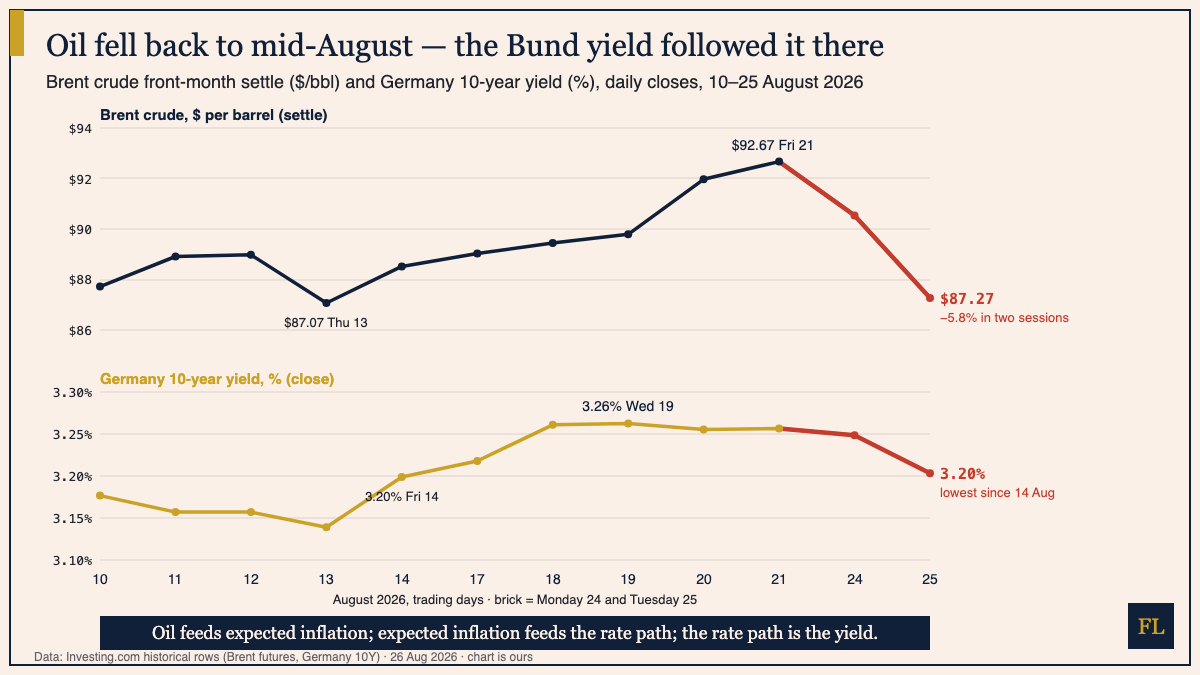
How to read this: two panels on one timeline are for comparing turning points, not levels. Find the day each line turned: oil peaked on Friday 21; the yield had stalled from Wednesday 19 — it hesitated first, then dropped hard on the day oil did. Then check the exceptions: on 18 August the yield jumped 4 basis points while oil barely moved — bond supply and US yields share the wheel. Two weeks make a habit to watch, not a law. The narrower question the chart answers: on the day that mattered, did the two lines agree? On Tuesday they did.
Two days ago we put Brent itself in the Spotlight; last week we read the gap between US and German ten-year yields. Today's chart is where the two meet.
📅 Tomorrow
Europe's afternoon belongs to the United States: July PCE inflation, the second estimate of second-quarter GDP, and Nvidia's results after the New York close — the verdict for ASML, Infineon and Siemens Energy lands here Thursday morning. Thursday also brings Germany's GfK consumer climate at 8:00 am CET, the ECB's account of its July meeting — and the opening of the Fed's Jackson Hole symposium, 27–29 August, where Chair Warsh speaks on Friday. Friday: French and Spanish flash inflation, German unemployment, Schnabel, and Fitch on France.
Forwarded this by a friend? Subscribe here. Found it useful? Forward it to one person who'd want it.
We explain; we never advise. Nothing here is investment advice.
Financial Literature is for educational and informational purposes only. Nothing here is investment, financial, legal, or tax advice, or a recommendation to buy or sell any security. Content is impersonal and not tailored to any individual. Data may contain errors — verify before relying on it. Sources: Investing.com historical (STOXX 600, DAX, FTSE 100, CAC 40, Brent, Germany 10Y); Google Finance (STOXX 600, DAX, FTSE 100, CAC 40, EUR/USD, GBP/USD); Trading Economics (Bund yield, Brent, session notes); Newsquawk (Tuesday wrap, weekly calendar); Al Jazeera (Iran–Oman talks, corridor details); Yahoo Finance UK (oil); Yahoo Finance (FTSE); investinglive (Reuters ECB sources); Bloomberg via Yahoo (Schnabel); ECB (key rates, meeting calendar, accounts); NIM (GfK schedule); researchcal (Jackson Hole).
— The Editorial Team