🌍 2.9% — Germany's states reported first; the national number lands at 2 pm
Six German states published August inflation this morning, all higher than July, three at 2.9%; the national flash follows at 2 pm. Today: the parts first.

Compiled Monday, 31 August 2026, at about 10:30 am in Frankfurt (CEST, UTC+2), a 5-min read. Index and bond rows are final Friday closes; currency rows and this morning's German state prints are Monday items, and say so. London is shut today.
First question below. The answer opens tomorrow's issue.
Six of Germany's sixteen states published their August inflation rates this morning, every one of them higher than in July, three of them at 2.9%. The national figure follows at 2 pm; today's letter is about reading the parts before the whole arrives.
📊 The Dashboard, Friday, 28 August 2026 (closes)
Monday, live: at about 10:10 am the STOXX 600 is at 654.7, down 0.1%; the DAX down 0.7% at 26,393; the CAC 40 up 0.1%; London shut. TotalEnergies and Eni are up 1.4 to 1.5% on the oil price; Siemens Energy is down nearly 4% and ASML 1%. Brent is above $90 after US forces struck Iranian rocket launchers on Larak Island on Sunday, the first such strike in a month; Friday’s settle was $88.10. Snapshots, not closes.
What happened, in plain words
Two events landed after Friday's close. Fed Chair Warsh, at Jackson Hole: "The Fed’s preferred measure of inflation, the 12-month change in the PCE price index, stands at 3.7 percent, while the six-month change is 4.1 percent", and "I would be hard pressed to describe broad financial conditions as restrictive". German yields, already at a 2011 high, read that as more tightening to come. Then Fitch: France stays A+, stable outlook; Fitch projects debt rising from 115.7% of GDP in 2025 to 122.7% by 2028 and growth of 0.8% this year. No downgrade, so French banks, hit on Thursday, recovered 0.7 to 1.5% on Friday.
The weekend added oil. Iranian forces were preparing to launch rockets carrying sea mines into the Strait of Hormuz, and US forces hit the launchers; Brent, which had eased to about $88 on Friday, is back above $90 this morning. For Europe it is last week's chain in reverse: oil up, yields up, energy shares up, industrials down.
⭐ Spotlight: the state prints, 2.9%
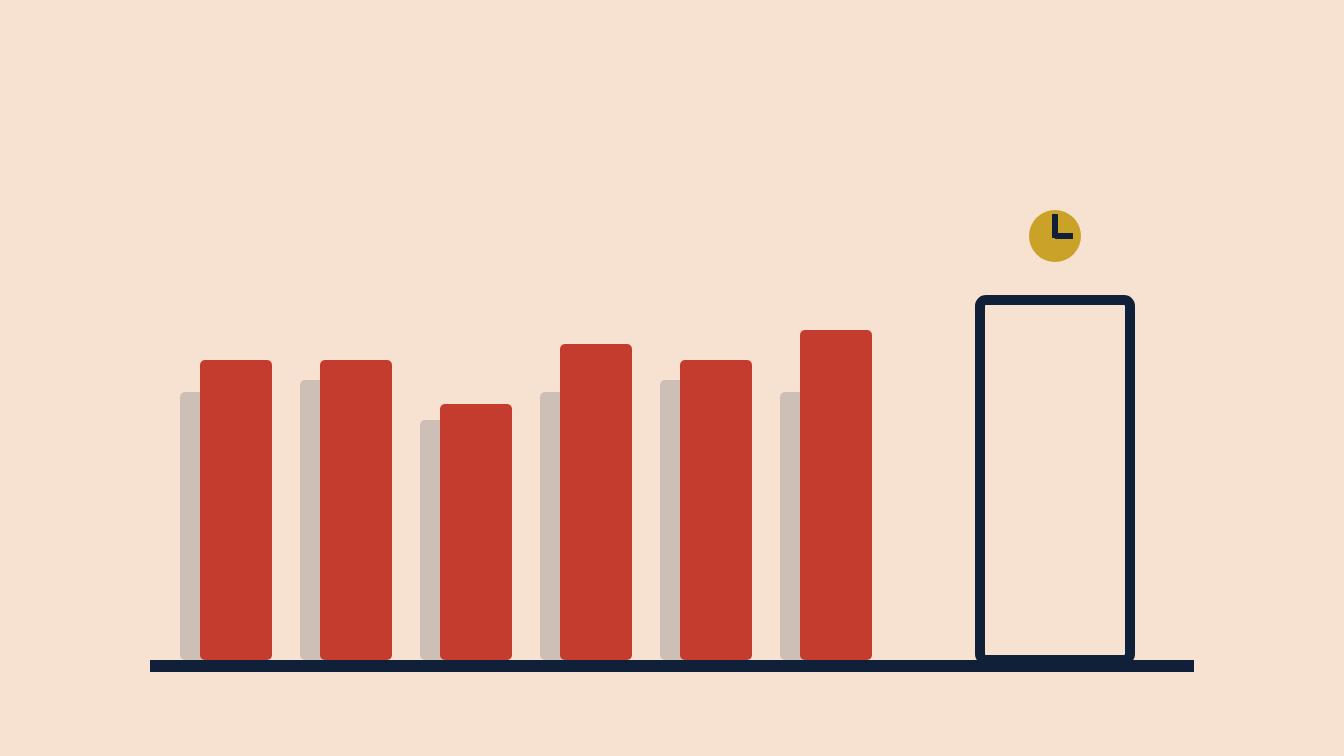
Germany's inflation rate arrives in two waves. From 8 am, six state statistical offices publish their own consumer price indices: North Rhine-Westphalia 2.9%, from 2.7% (prices up 0.2% on the month, after 0.9% in July), Bavaria 2.9%, from 2.8%, Baden-Württemberg 2.6%, from 2.5%, Hesse 3.0%, from 2.7%, Saxony 2.9%, from 2.8% and Brandenburg 3.1%, from 2.7%. At 2 pm Destatis publishes the national flash, a weighted blend of all sixteen states. People track the states for one reason: the national number is rarely a surprise once the big states are in. Today the six early states span 2.6% to 3.1%, all above Germany’s 2.8% in July, and forecasts for the 2 pm print sit at 3.0% (FXStreet’s calendar carries 2.9%), with the EU-harmonised rate expected at 3.1%. One arithmetic point: an annual rate can rise while the monthly step shrinks (North Rhine-Westphalia: 0.2% on the month, 2.9% on the year) because the month dropping out of the comparison, August 2025, was smaller still.
Why it matters this week: the ECB’s Governing Council meets on 9 and 10 September, hosted by the Bundesbank in Berlin, with the deposit rate at 2.25%; its own July account records that "markets continued to expect further policy tightening, with a hike in September 2026 almost fully priced in". Germany is the largest weight in the euro-area rate Eurostat publishes tomorrow. Friday’s letter read France and Spain; Saturday’s explainer covered why each country has two inflation rates; today is the third piece.
📈 Chart of the Day: six states, one direction
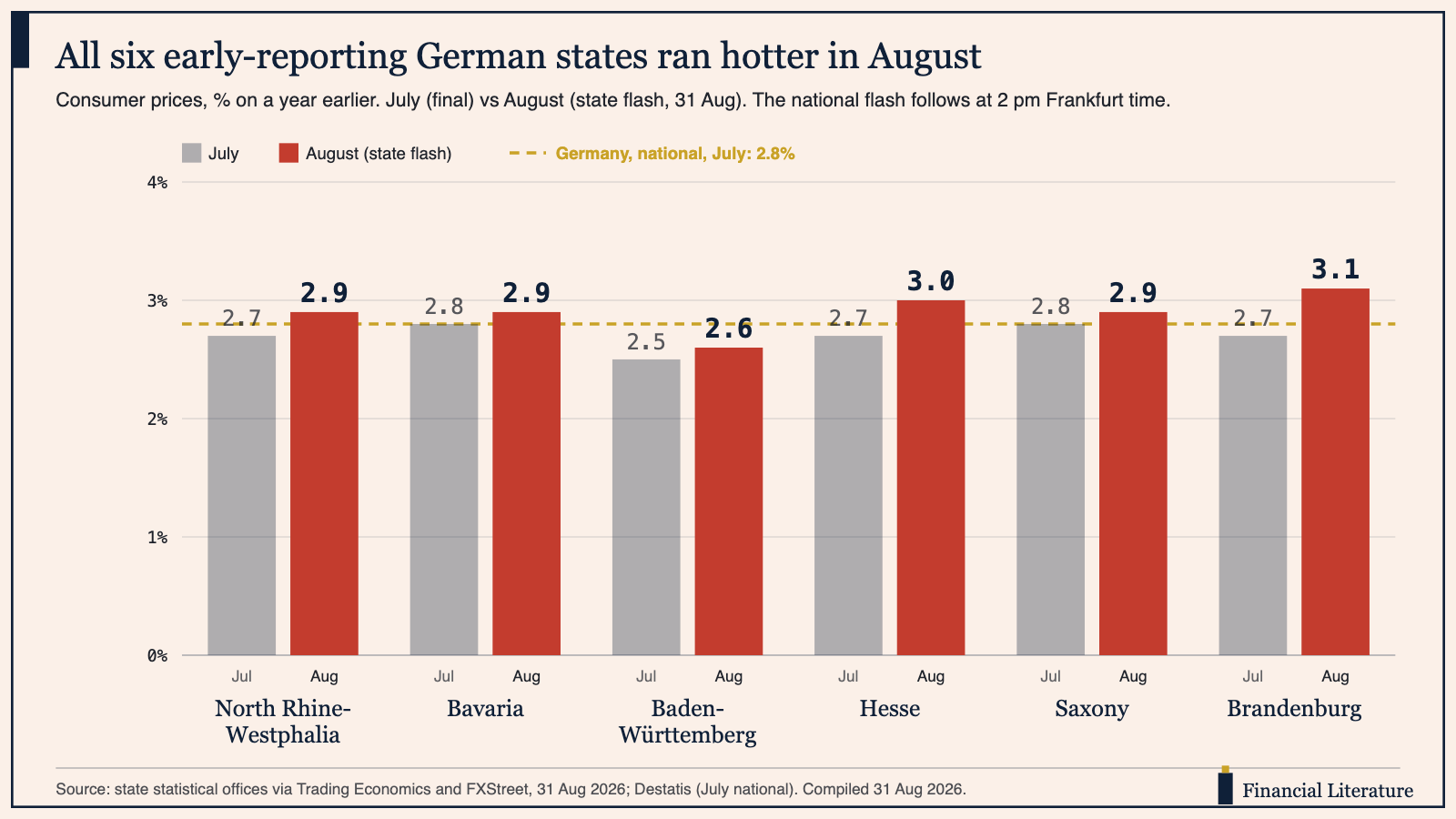
How to read this: direction first, then range, then any single state. Six rises out of six means the national rate will be above July's; the range, 2.6% to 3.1%, is the box the flash lands in, nearer the populous states (North Rhine-Westphalia, Bavaria, Baden-Württemberg) than the small ones, because the national index weights each state by its share of spending, not one state one vote. What the chart cannot show is the harmonised rate the ECB reads, which uses a different basket and usually sits a few tenths away.
📅 Tomorrow
Still today, 2 pm Frankfurt: Germany’s national August flash. Tuesday, 11 am: Eurostat’s euro-area flash for August, after 2.9% in July, when energy prices were 10.3% higher than a year earlier; consensus 3.2%. Friday, 2:30 pm: the US jobs report for August. Thursday week, 10 September: the ECB in Berlin.
One question. Today's chart showed six German states' August inflation rates, 2.6% to 3.1%, every one above its July reading. Which reading is right? A: the national rate is a weighted blend of all sixteen states, so it lands inside the states' range and nearer the populous ones; the direction, up, is already known. B: the national rate is the simple average of the six states, 2.9%, so the 2 pm print adds nothing. C: the highest state, Brandenburg at 3.1%, sets the national rate, because inflation is measured at its peak.
Forwarded this by a friend? Subscribe here. Found it useful? Forward it to one person who'd want it.
We explain; we never advise. Nothing here is investment advice.
Financial Literature is for educational and informational purposes only. Nothing here is investment, financial, legal, or tax advice, or a recommendation to buy or sell any security. Content is impersonal and not tailored to any individual. Data may contain errors — verify before relying on it. Sources: Investing.com (STOXX 600, DAX, FTSE 100, CAC 40, Brent, Germany 10Y); Google Finance (STOXX 600, DAX, FTSE 100, CAC 40, EUR/USD, GBP/USD); Trading Economics (markets, Bund, Brent, Germany CPI and state rows, euro-area CPI, ECB rate); FXStreet (state CPI releases, calendar); investingLive; Destatis; Newsquawk (Friday wrap); Federal Reserve (Warsh keynote); Edge Consultancy, Dmarketforces (Fitch); CNN, NBC News (Hormuz); ECB (meeting calendar, July account); Eurostat (July HICP); GOV.UK, LiteFinance, FedRateCalc (calendar).
— The Editorial Team