🌍 49.6% — German heating oil got dearer, household energy got cheaper
German inflation was confirmed at 2.9% for August. Heating oil rose 49.6% in a year, and the group of prices it belongs to still got cheaper.


Compiled Thursday, 10 September 2026, at about 11 in the morning in Frankfurt (CEST, UTC+2), a 5-min read. Index rows are Wednesday's closes, final. The currency and bond rows are Thursday snapshots, still trading, and say so.
Yesterday's answer: B — because the raw index counts the kilometres actually driven, and German motorway freight drops every August when plants and hauliers take their holidays. Adjustment strips out the pattern that repeats every year, which is what lets two months sit side by side.
Germany confirmed its August inflation rate at 2.9% this morning, hours before the European Central Bank decides interest rates in Berlin.
Inside that 2.9% sits today's lesson. Heating oil cost 49.6% more than in August last year. Motor fuels cost 27.7% more, after 23.0% in July. Energy products as a group were 10.5% dearer, the steepest energy reading in over three years. And household energy, the group heating oil belongs to, was 0.7% cheaper than a year ago. All four of those sentences are true at once, and the reason is weight.
📊 The Dashboard, Wednesday, 9 September 2026 (closes)
| Gauge | Level | Move | What this means |
|---|---|---|---|
| STOXX 600 (pan-Europe) | 640.41 | 🔴 ▼ -1.4% | Final: Investing.com, from 649.60 on Tuesday. Europe's biggest one-day fall in two months. Thursday morning about 641, a shade higher, still trading. |
| DAX (Germany) | 25,576.45 | 🔴 ▼ -1.66% | Final: Google Finance and Investing.com. Thursday morning 25,555.43, still trading. |
| FTSE 100 (UK) | 10,670.06 | 🔴 ▼ -1.31% | Final: Google Finance and Investing.com. Thursday morning 10,655.84, still trading. |
| IBEX 35 (Spain, rotation row) | 19,695.30 | 🔴 ▼ -1.51% | Madrid's 35 largest listings, heavy in banks, so it leans on euro-area rate expectations. Inditex fell 3.61%. Final: Investing.com and Bolsamania. |
| EUR/USD | 1.1652 | 🟢 ▲ euro firmer | Wednesday's ECB reference rate, from 1.1614 on Tuesday. Thursday, still trading: 1.1637. |
| GBP/USD | ≈1.3554 | 🟢 ▲ +0.07% | Thursday snapshot, still trading: 1.3554, from 1.3545. |
| Bund 10Y yield | ≈3.43% | ⚫ barely moved | Thursday snapshot, still trading: 3.4340%, from 3.4381% at Wednesday's close, itself about 7 bp above where it traded on Wednesday morning. |
| Gilt 10Y yield (UK) | ≈5.26% | ⚫ barely moved | Thursday snapshot, still trading: 5.2607%, from 5.2678% at Wednesday's close, back near the 5.28% we wrote about last week. Red would mean a higher yield and a lower bond price. |
What happened, in plain words
Wednesday was Europe's worst session since July. The STOXX 600 fell 1.4%, Frankfurt 1.66%, Madrid 1.51%, Paris 1.94% and London 1.31%. One story did most of it. Brent crude passed 100 dollars a barrel for the first time since July and closed near 101, after the heaviest wave of attacks on shipping in the six-month conflict between Iran and the United States. Dearer oil means dearer inflation, and dearer inflation means borrowing costs that stay high for longer, which is why a story that lifts an oil producer's shares can still take a percent off the index those shares sit in.
The Governing Council publishes its decision at 14:15 Berlin time this afternoon and the president takes questions half an hour later, in Berlin rather than Frankfurt because the Bundesbank is hosting. The deposit rate has been 2.25% since July, and a quarter-point rise to 2.50% is what nearly every forecaster has written down. A number that is that widely expected carries little information. Two other things do. September is one of the four meetings a year that arrives with fresh staff projections for growth and inflation, which is the closest the bank comes to publishing a view of where prices are going. And the answers on oil will matter more than usual, because energy is the line a central bank can do least about and it is the line doing the pushing.
Two more numbers from this morning. Core inflation, which leaves out food and energy, sat at 2.4%, services slowed to 2.8% and food was flat at 0.1%. The harmonised rate, built to the same recipe in every member state, also came in at 2.9%; that is the series feeding the euro-area figure we read at the start of the month, published for every country by Eurostat on the Data Catalog. Take energy out of August and very little is left.
⭐ Spotlight: the euro short-term rate, 2.189%
Everyone will write down 2.50% this afternoon if the Governing Council moves. The rate at which money actually changed hands is a different number. The euro short-term rate, written €STR, is the average rate at which euro-area banks borrowed euros overnight without collateral on the previous business day, and it is built from real trades rather than from quotes: Wednesday's reading of 2.189% came from 921 transactions worth 67.0 billion euros across 47 reporting banks.
It is worth tracking because it shows where policy lands, not where it is announced. Wednesday's 2.189% sat six hundredths of a percentage point below the deposit rate of 2.25%, and that small gap is the logic of the whole system: banks hold far more cash than they need, so nobody lends at more than the rate the central bank itself pays, and the money market prices just underneath it. Of the ECB's three official rates, 2.25% on the deposit facility, 2.40% on the main refinancing operations and 2.65% on the marginal lending facility, only the first is doing any steering.
📈 Chart of the Day: one group, two directions
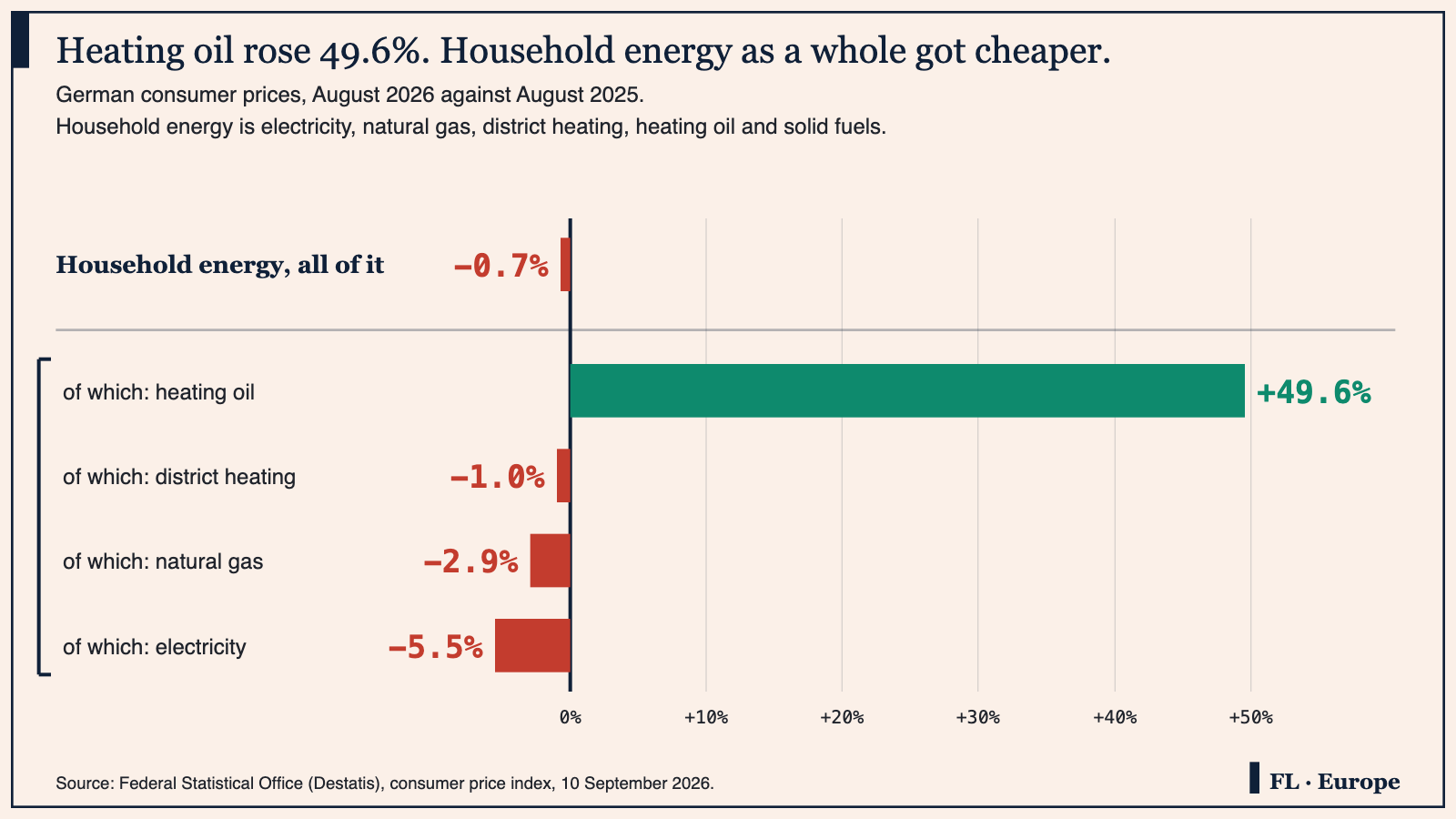
How to read this. A group's price change is not the average of its parts. It is the average weighted by how much households actually spend on each part. For household energy to fall 0.7% while heating oil rose 49.6%, heating oil has to be a small slice of that spending, and electricity and natural gas, both cheaper, have to be large ones. So when a component's percentage looks dramatic, ask what share of the basket it is before you decide what it did to the total. The same arithmetic runs the other way in the headline: energy products including motor fuels rose 10.5%, because filling a car is a far bigger line in the German household budget than filling an oil tank.
📅 Tomorrow
Two releases, one on each side of the Atlantic. At 07:00 London time the Office for National Statistics publishes Britain's monthly GDP for July, the estimate that turns a quarter into a story about which month did the work. At 14:30 Berlin time American consumer prices for August arrive, and European bond desks will read that number as closely as their own. Tomorrow's issue opens with what the Governing Council actually did this afternoon.
One question. Today's chart showed German household energy 0.7% cheaper than a year ago, while heating oil, one of its parts, was 49.6% dearer. Which reading is right? A: One of the two figures must be a mistake, because a group cannot fall while a part of it rises. B: The group is an average weighted by household spending, so a part with a small share can rise steeply without lifting the total. C: The group excludes heating oil, which is why the two point different ways.
Financial Literature is for educational and informational purposes only. Nothing here is investment, financial, legal, or tax advice, or a recommendation to buy or sell any security. Content is impersonal and not tailored to any individual. Data may contain errors, verify before relying on it. We explain; we never advise. Sources: Destatis, European Central Bank, Eurostat, Google Finance, Investing.com, Trading Economics, FX.co, Bolsamania, Armenpress, ONS.
Forwarded this by a friend? Subscribe here. Found it useful? Forward it to one person who'd want it.
— The Editorial Team