Why does Germany report factory orders twice, with and without large orders?
One contract for ships or aircraft can carry a national statistic. Why Destatis publishes two order figures, and which one answers which question.

The short answer: Germany's statistical office publishes new factory orders twice each month, once as a total and once with exceptionally large contracts stripped out, because a single order for ships or aircraft can be worth more than a month of ordinary business. In July the two versions pointed in opposite directions: all orders rose 2.5% on June, and orders excluding large-scale contracts fell 1.4%.
What the series measures
Each month German manufacturers report the orders they have taken, and the Federal Statistical Office turns them into an index that is adjusted for prices, for the season and for the number of working days. The office is explicit about the limits of the exercise: "Information on new orders is only collected in selected branches of manufacturing. The rates of change are based on the price adjusted indices of new orders and of turnover in manufacturing."
The key word is orders. An order is counted when the contract is signed, not when the thing is built, shipped or paid for. That is what makes the series useful, because it looks further ahead than production does, and it is also what makes it jump, because one signature can arrive in one month and be built over five years.
Why there are two numbers
German industry builds things that come in very large single units. When a shipping line or an airline signs, the order lands in one month in one branch and carries the national figure with it. In July 2026 that is precisely what happened: the office attributed the rise to "an exceptionally high volume of large-scale orders particularly in the manufacture of ships, railway rolling stock and aircraft", a branch whose orders more than doubled on the month.
It is not a one-off quirk. In December 2023 the headline rose 8.9% while orders excluding large-scale contracts fell 2.2%, and the office's explanation was almost the same sentence: "In particular, an exceptionally large number of aircraft were ordered." Publishing both series is how a statistical office reports a true total without letting it be mistaken for the ordinary trend. Data compilers say the same thing more bluntly: German factory orders "can be very volatile and misleading because they are heavily affected by geopolitical events, temporary shocks in demand and business deals which may only happen once."
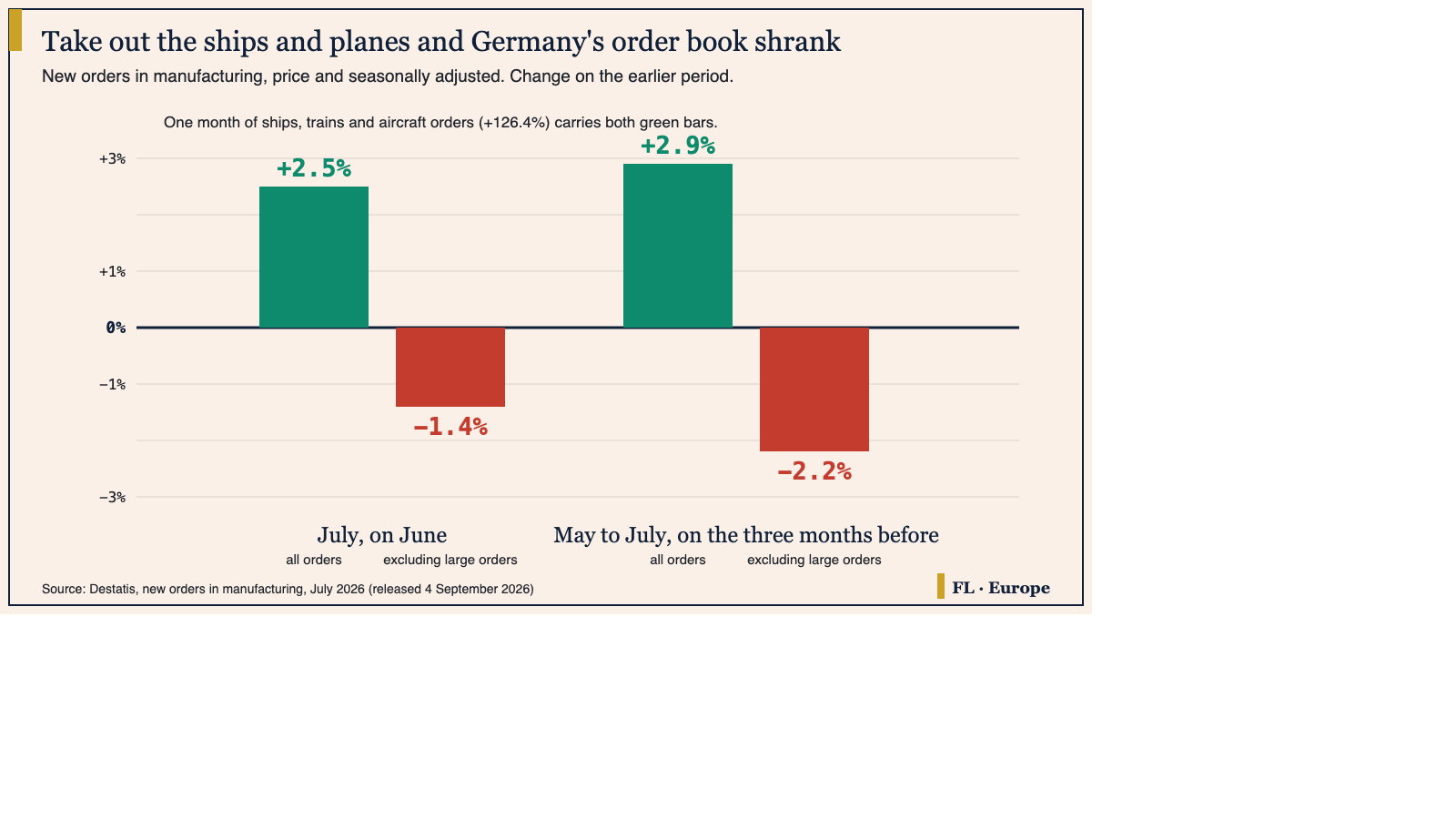
How to read this: the green bars and the red bars are the same factories in the same months, counted with and without the largest contracts, so the gap between each pair is the size of the lumpy part. Read the left pair for the month and the right pair for the trend, because the three-month comparison is the office's own way of smoothing single signatures out. When a pair straddles zero, as both do here, the honest summary names both numbers.
How to read a move, in three lines
Read the headline first: it tells you what the total order book did, and the total is what factories will eventually build. Read the excluding line second: it tells you what the rest of industry did, which is the better guide to demand next quarter. Read the three-month comparison third: May to July was 2.9% above the previous three months in total, and 2.2% below them without the large orders, so even at three-month range the two views disagree.
Two extra checks are cheap. The split between home and abroad separates a domestic story from an export one, and in July it was stark: domestic orders rose 9.1% while foreign orders fell 2.1%. And turnover, what factories actually invoiced in the same month, fell 1.5%, a reminder that an order book and a production line are not the same thing.
What the second series is not
The excluding line is not "the real number" and the headline is not a trick. Both are accurate answers to different questions, one about the whole order book, one about the typical firm. Nor is the excluded part meaningless: ships and aircraft are real work, they employ real people, and they will show up as production for years. And neither line is a forecast. They tell you what was signed in July, not what will be signed in September.
The habit
Ask what a headline is made of before you decide what it means. That was Friday's issue, where one branch made the month, and it was Wednesday's, where energy accounted for the whole of a jump in factory-gate prices. Same question, different data. The archive keeps the daily series.
Financial Literature is for educational and informational purposes only. Nothing here is investment, financial, legal, or tax advice, or a recommendation to buy or sell any security. Content is impersonal and not tailored to any individual. Data may contain errors, so verify before relying on it. We explain; we never advise. Sources: Federal Statistical Office of Germany (Destatis), press releases of 4 September 2026 and 6 February 2024; Trading Economics.
Forwarded this by a friend? Subscribe here. Found it useful? Forward it to one person who'd want it.
— The Editorial Team