🌎 162,000 — the jobs number tripled the forecast; two industries made most of it
US payrolls rose 162,000 in August against about 53,000 expected, with June and July revised up 55,000. New York and Toronto are shut for Labor Day.


Compiled Monday, 7 September 2026, about 7:45 a.m. in New York (Eastern Time). A 4-min read. The New York and Toronto exchanges are closed for Labor Day, and so is the US bond market, so every row below is Friday's close. There is no Monday session to report.
Yesterday's answer: B — because the services headline is the plain average of four equally weighted parts, so it says nothing about any one of them; employment at 47.8 meant more firms cut staff than added, never how many people that was.
The American exchanges are shut today, so the week opens with a number instead of a session: employers added 162,000 jobs in August, roughly triple what forecasters expected, and the last inflation reading before the Federal Reserve decides lands on Friday.
📊 The Dashboard, Friday, 4 September 2026 (closes)
| Gauge | Level | Move | What this means |
|---|---|---|---|
| S&P 500 (500 big US firms) | 7,718.60 | 🔴 ▼ −0.38% | Final. Down 29.11 points. The next close is Tuesday's. |
| Nasdaq Composite (tech-heavy) | 26,506.99 | 🔴 ▼ −0.29% | Final. Down about 77 points. |
| Dow (30 blue-chip firms) | 53,414.25 | 🔴 ▼ −0.51% | Final. Down 271.86 points, the weakest of the four. |
| Russell 2000 (2,000 smaller firms) | 2,975.65 | 🟢 ▲ +0.25% | Rotation row. Up 7.38 points, the only board higher. Smaller firms borrow more at short rates, and they still rose. |
| US 10-year Treasury yield | 4.78% | ⚪ ▲ +1 bp | Friday's close. The bond market is shut today, so the Treasury publishes no reading for Monday. |
| US 2-year Treasury yield | 4.37% | ⚪ ▲ +3 bp | Friday's close, from 4.34%. The two-year moved three times as far as the ten-year, which is where a change in rate expectations shows up first. |
| Dollar index (DXY) | 99.18 | ⚪ ▲ dollar firmer | Friday's close, from 99.00 on Thursday. |
| USD/CAD | 1.3837 | ⚪ ▲ loonie weaker | Friday's close, from 1.3794. Canada lost 42,000 jobs the same morning America added 162,000. |
| USD/MXN | 16.8802 | ⚪ ▼ peso firmer | Friday's close. Mexico keeps its own calendar and 7 September is not a holiday there. |
What happened, in plain words
Friday brought the largest labour-market surprise of the year. Economists polled by Dow Jones looked for about 53,000 new jobs; the count came in at 162,000, and the two previous months were revised up by a combined 55,000, turning July's reported loss of 23,000 into a gain of 21,000. The unemployment rate did not move, holding at 4.1%, because the number of people looking for work grew alongside the number working. Investors read a stronger jobs market as a reason the Fed might raise rates this month rather than hold: all three big boards closed lower, the two-year yield rose, and Investing.com's rate monitor went from 50.4% odds of a rise on 16 September on Friday morning to 58.1% by Monday morning. No Fed official can answer for that. The Committee's blackout on public comment began at midnight on Saturday, ten days before the meeting opens, and runs until the day after the decision.
⭐ Spotlight: the August payroll report, read by its parts
The payroll headline is not a measurement of its own. It is the sum of what employers reported industry by industry, so it can be large for reasons that have little to do with each other. August's 162,000 was well above the average monthly gain of 31,000 over the prior twelve months, and where it came from was unusually narrow. Food services and drinking places added 59,000, against an average of 12,000 a month over that same year. Local government education added 42,000, largely undoing a fall the month before. Those two lines together are 101,000 of the 162,000. Construction added 22,000 and manufacturing 16,000, which extends a run that has recovered 58,000 factory jobs since a low in December 2025. Health care, normally the dependable engine, added only 13,000 against a twelve-month average of 32,000. Information lost 23,000, spread across computing infrastructure and data processing, publishing and broadcasting. The unemployment rate comes from a separate survey of households, which is why it can sit still at 4.1% while the payroll count jumps: participation edged up to 61.6%, and the broadest measure of underemployment, U-6, fell to 7.7%.
📈 Chart of the Day: what the 162,000 was made of
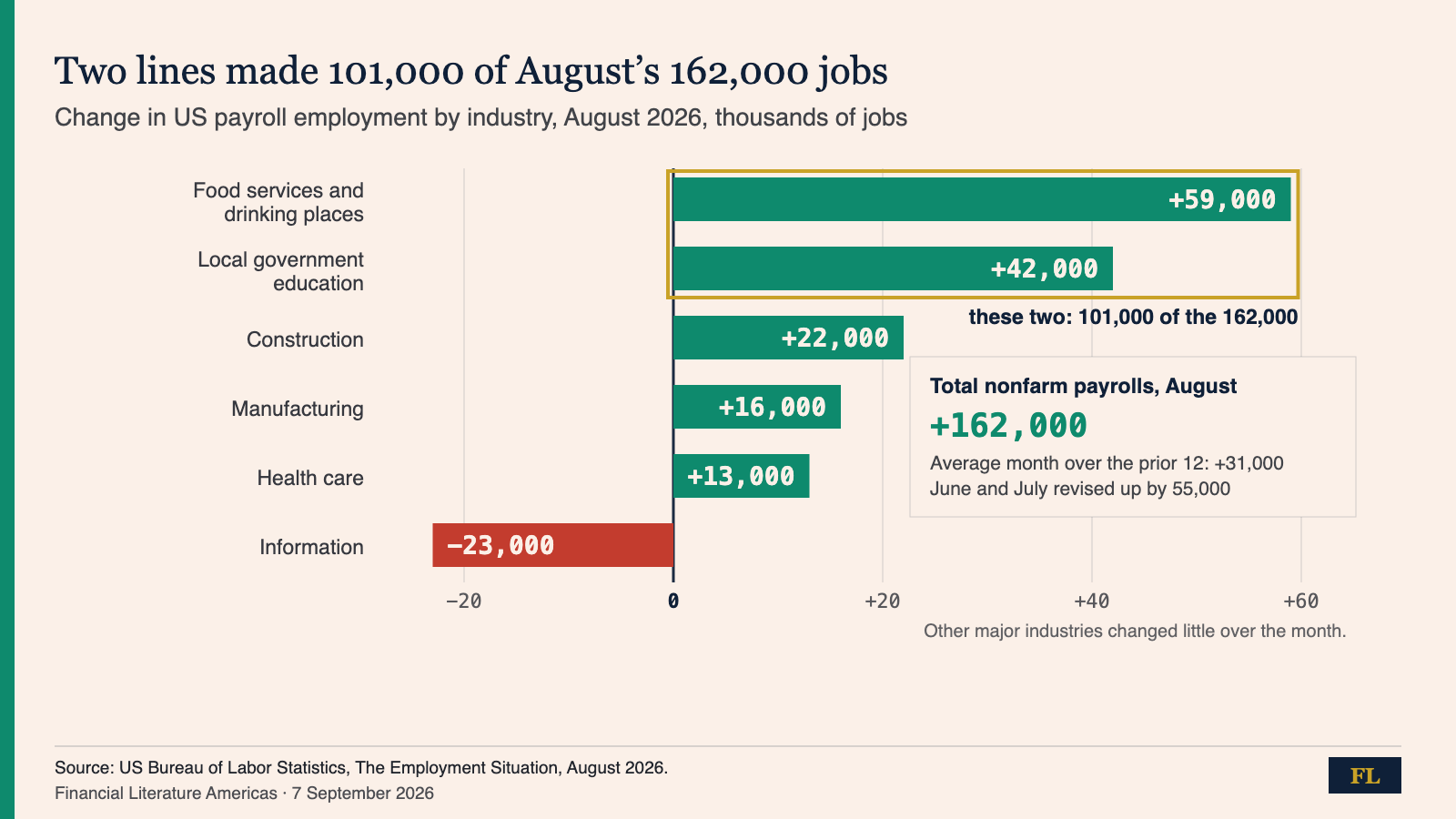
How to read this: a payroll headline is a net total of industry lines, so the first question is which lines made it, and the second is whether each line is behaving normally. Compare a component with its own twelve-month average rather than with zero: food services at 59,000 against an average of 12,000 is the unusual part of this report, while health care at 13,000 against 32,000 is a slowdown sitting inside a strong number. The same habit shows you that a big headline can coexist with whole industries shrinking, which is what information losing 23,000 means.
📅 Tomorrow
Trading resumes Tuesday and the week runs four days. Thursday brings August producer prices at 8:30 a.m. ET, the same morning the European Central Bank decides in Berlin. Friday brings the August consumer price index at 8:30 a.m. ET, per the release schedule, and it is the last inflation reading before the Fed's 15 and 16 September meeting, which also publishes each policymaker's own rate projections. Watch the distance between the headline rate and the core rate that leaves out food and energy: with crude oil finishing Friday near $91, those two can point different ways, and which one the market chooses to trade is the week's real question.
One question. Today's chart showed August payrolls of 162,000, with food services and drinking places adding 59,000 against a twelve-month average of 12,000, and health care adding 13,000 against an average of 32,000. Which reading is right? A: health care shed jobs in August. B: the headline is a net total of industry lines, so the useful test is each line against its own twelve-month average, and by that test food services was unusually strong while health care was unusually weak. C: a headline three times the forecast means every large industry hired more than usual.
We explain; we never advise. Nothing here is investment advice.
Financial Literature is for educational and informational purposes only. Nothing here is investment, financial, legal, or tax advice, or a recommendation to buy or sell any security. Content is impersonal and not tailored to any individual. Data may contain errors, so verify before relying on it. Sources: BLS Employment Situation; Statistics Canada Labour Force Survey; US Treasury yield curve; AP closing table; Investing.com; NYSE holiday calendar; SIFMA; FOMC calendar; BLS release schedule.
This follows Friday's issue, services grew faster while the jobs part of the same gauge shrank, and Saturday's explainer, what a reading of 50 actually means.
Forwarded this by a friend? Subscribe here. Found it useful? Forward it to one person who'd want it.
— The Editorial Team