🌎 2.25% — the Bank of Canada held, changed one sentence, and the loonie rose
Canada held at 2.25% a seventh time but dropped ‘remains appropriate’; the loonie rose. S&P 500 +0.5% as yields paused and ADP hiring slowed to 38,000.

Compiled Thursday, 3 September 2026, about 7:20 a.m. in New York (Eastern Time), before the opening bell. A 4-min read. Stock index rows are final Wednesday closes; yields and currencies trade around the clock, so those rows are Thursday-morning snapshots and labeled as such.
Yesterday's answer: B — because a diffusion index shows which side of 50 most firms sit on, not a growth rate; 54.6 is a smaller majority reporting growth than 55.6, and only a reading below 50 would mean contraction.
The Bank of Canada held its overnight rate at 2.25% for a seventh straight decision but no longer called that level appropriate, the Canadian dollar firmed to its best close since 21 August, and in New York the boards bounced, the S&P 500 up 0.5%, as the 10-year yield paused near 4.79% and New York Fed president John Williams said there is no clear science yet that a September rate rise is needed.
📊 The Dashboard, Wednesday, 2 September 2026 (closes)
| Gauge | Level | Move | What this means |
|---|---|---|---|
| S&P 500 (500 big US firms) | 7,666.60 | 🟢 ▲ +0.46% | Final. Up 35.13 points (Investing.com); +12% for the year. |
| Nasdaq Composite (tech-heavy) | 26,217.83 | 🟢 ▲ +0.45% | Final. Up 118.05 points (Investing.com); Nvidia rose 3%. +12.8% for the year. |
| Dow (30 blue-chip firms) | 53,061.95 | 🟢 ▲ +0.56% | Final. Up 295.07 points (Investing.com); +10.4% for the year. |
| Russell 2000 (2,000 smaller firms) | 2,953.17 | 🟢 ▲ +1.13% | Rotation row. Up 33.04 points (AP has 33.03), the day’s leader, at +19%. |
| US 10-year Treasury yield | ≈4.77% | ⚪ ≈ paused | Thursday snapshot (Investing.com). Wednesday it closed near 4.79%, little changed after Tuesday’s highest since January 2025; the 2-year is 4.37% and the 30-year 5.25%. |
| Dollar index (DXY) | ≈99.1 | 🔴 ▼ −0.4% | Thursday snapshot, from 99.55 at Wednesday’s close; most of the fall is a sharp yen rally overnight. |
| USD/CAD | ≈1.381 | 🟢 ▼ loonie firmer | Thursday snapshot. Wednesday ran from a high of 1.3941 before the decision to a close of 1.3846; this morning’s 1.381 is firmer than any close since 21 August. Fewer Canadian dollars per US dollar means a stronger loonie. |
| USD/MXN | ≈17.02 | 🔴 ▲ peso softer | Thursday snapshot, from 16.96. |
What happened, in plain words
Three things let stocks breathe. Oil’s climb slowed, Brent settling at $95.63, up 1% after Tuesday’s 4.6% jump. The 10-year yield stopped rising. And Williams, on CNBC, said the Fed is seeing “well-anchored inflation expectations and pretty contained compensation growth” and would wait and see before adding to rates; traders still price roughly a two-thirds chance of a quarter-point rise on 16 September, 66.2% on CME’s FedWatch tool. The morning’s hiring gauge was soft: ADP counted 38,000 private jobs added in August, the slowest since January, against 47,000 expected, with manufacturing down 17,000 and education and health up 45,000; July was revised up to 46,000. July factory orders rose 0.9% against 0.6% expected. At 2 p.m. the Fed’s Beige Book said activity “increased modestly since early July”, with ten of twelve districts growing, employment up “very slightly”, prices up moderately in eight districts, and data-centre projects a named source of construction and factory orders.
⭐ Spotlight: the Bank of Canada’s overnight rate, 2.25%
The overnight rate is the Bank of Canada’s target for what banks charge each other for one-night loans, and it is the floor under every other Canadian borrowing cost. The Bank sets it on eight fixed dates a year, fencing it with a Bank Rate of 2.50% and a deposit rate of 2.20%, and it has stood at 2.25% since 29 October 2025. Watchers read the number and the sentence around it. The number was easy: the economy and inflation were “evolving broadly as forecast”, with second-quarter GDP up 3.3%, unemployment down to 6.4% in July, headline inflation near 3% because of gasoline but 2.2% without it, and core measures close to 2%. The sentence changed. July’s statement said the rate “remains appropriate”; Wednesday’s dropped that line and said instead that “the upside risks to inflation have increased, while new tariffs make growth prospects more uncertain”, and that the Council “is prepared to adjust monetary policy as needed”. The loonie row is where that lands: Canadian money earns 2.25% overnight against 3.50–3.75% in the United States, a gap of 1.25 to 1.50 points. The next decision is on 28 October.
📈 Chart of the Day, two rates and a gap
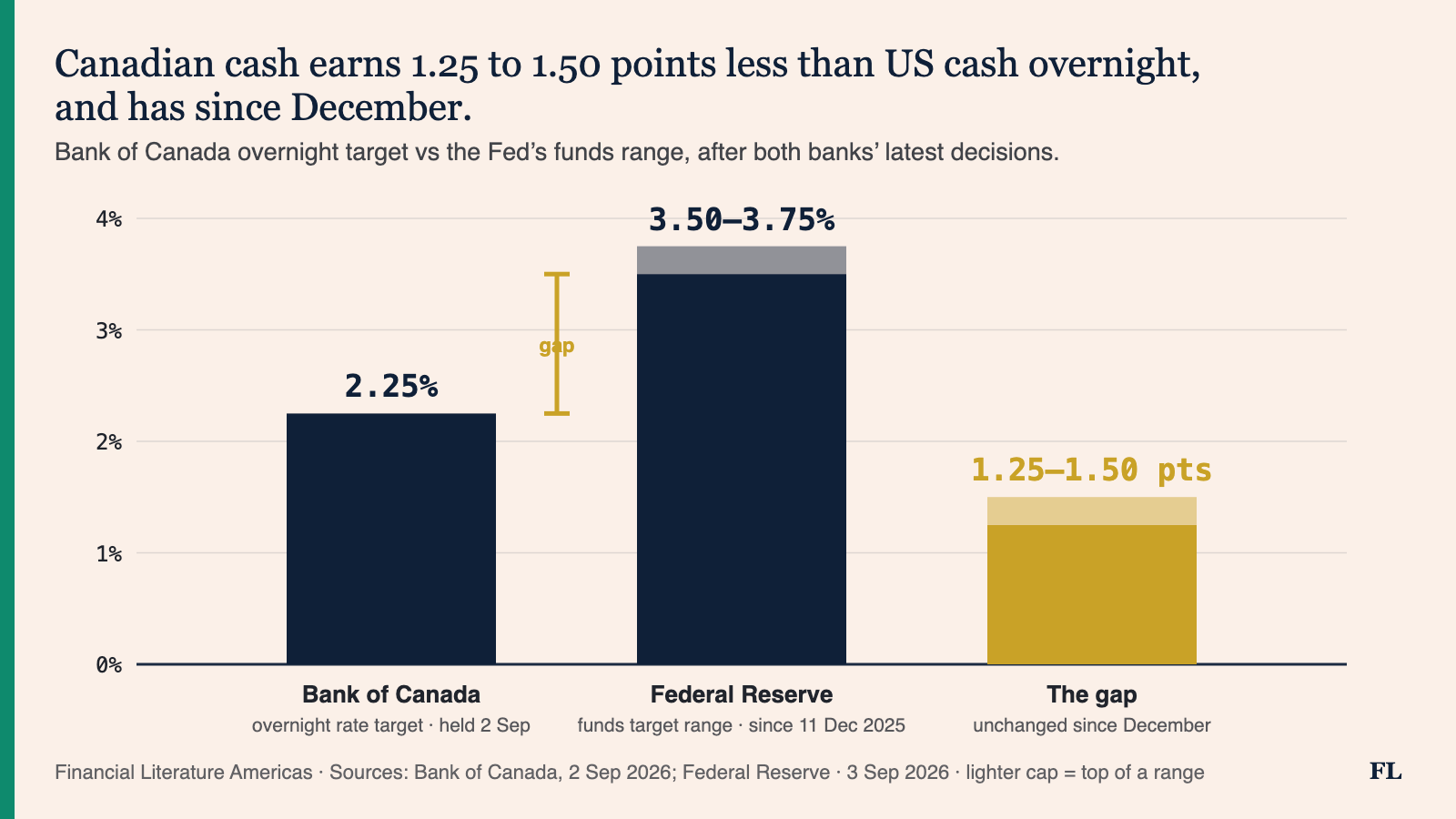
How to read this: read a currency pair through two rates, never one. The level that matters is the gap, because money parked in the higher-paying currency earns the difference every night, so a wide gap is a standing weight on the lower-paying one. Then read what could move the gap: a quarter-point Fed rise on 16 September would widen it by a quarter-point, arithmetic rather than forecast, while a Bank of Canada that stops calling its rate appropriate changes the expected path on the other side. On Wednesday neither rate moved and the loonie rose anyway, which tells you prices trade the expected gap, not the printed one. Gap first, level second.
📅 Tomorrow
Today: the July trade balance at 8:30 a.m. ET and jobless claims, expected near 205,000; ISM services for August at 10 a.m., expected 54.2 after 54.1. Friday, 4 September: the August employment reports for the US and Canada at 8:30 a.m. ET; US payrolls are expected near +55,000 after July’s −23,000, with unemployment 4.1%. US markets close Monday, 7 September, for Labor Day; the Fed meets on 15–16 September. Tomorrow’s issue decodes the services gauge, the larger cousin of Tuesday’s factory one.
One question. Today’s chart showed Canada’s overnight rate at 2.25% and the Fed’s range at 3.50–3.75%. Which reading is right? A: A lower Canadian rate means the loonie always falls against the US dollar, whatever else happens. B: The gap of 1.25 to 1.50 points is the number to read; it did not change on Wednesday, so the loonie’s rise came from what traders now expect the gap to do, not from its level. C: Because the Bank of Canada held while the Fed did nothing, the gap narrowed.
We explain; we never advise. Nothing here is investment advice.
Financial Literature is for educational and informational purposes only. Nothing here is investment, financial, legal, or tax advice, or a recommendation to buy or sell any security. Content is impersonal and not tailored to any individual. Data may contain errors — verify before relying on it. Sources: AP via WTOP; S&P 500; Nasdaq; Dow; Russell 2000; Bank of Canada; Bank of Canada (July); Bank of Canada rate history; opening statement; Fed rate history; American Banker; Yahoo Finance; Investrade; ADP National Employment Report; Yahoo (ADP); Beige Book; Trading Economics (yields); 10-year; DXY; dollar (TE); USD/CAD history; USD/CAD; USD/MXN; Investing.com preview; payrolls consensus; unemployment consensus; Scotiabank release calendar; NYSE calendar; FOMC calendar.
This builds on yesterday’s issue, fewer factories grew in August, and Monday’s, the Fed chair who put prices first.
Forwarded this by a friend? Subscribe here. Found it useful? Forward it to one person who’d want it.
— The Editorial Team