🌎 57% — the Fed chair put prices first; a September hike became the favourite
Warsh said the Fed's focus 'should be on prices'; September hike odds went from 35% to 57%, the 2-year jumped, stocks slipped. Oil above $91 on Iran.

Compiled Monday, 31 August 2026, about 7:00 a.m. in New York (Eastern Time), before the opening bell. A 4-min read. Stock index rows are final Friday closes; bond yields, currencies and oil trade around the clock, so those rows are Monday-morning snapshots and labeled as such.
First question below, the answer opens tomorrow’s issue.
The Fed chair told Jackson Hole on Friday that “the Fed’s predominant focus right now should be on prices,” and within the hour the market-implied odds of a September rate rise went from 35% to 57%; today’s issue is about what that number is, and what it is not.
📊 The Dashboard, Friday, 28 August 2026 (closes)
| Gauge | Level | Move | What this means |
|---|---|---|---|
| S&P 500 (500 big US firms) | 7,711.76 | 🔴 ▼ −0.25% | Final. Down 19.23 points (Investing.com prints the same close). Still +0.5% for the week and +12.7% for the year. A slip, not a fall. |
| Nasdaq Composite (tech-heavy) | 26,402.42 | 🔴 ▼ −0.52% | Final. Down 138.93 points (−0.52% on Investing.com), the day’s weakest big board; +0.8% on the week. |
| Dow (30 blue-chip firms) | 53,559.99 | ⚪ ▼ −0.02% | Final. Down 9.45 points (Investing.com agrees); +0.5% on the week, its first winning week in three. |
| Russell 2000 (2,000 smaller firms) | 2,972.37 | 🔴 ▼ −1.39% | Rotation row. Down 41.97 points (−1.4% on AP’s count), −1.5% on the week. Smaller firms feel a hike scare first. |
| US 10-year Treasury yield | ≈4.73% | 🔴 ▲ +4 bp Fri. | Monday snapshot. Friday it rose 4 basis points to 4.72% while the 2-year jumped about 8 to 4.35% from 4.22%; this morning the 10-year reads 4.73%, the 2-year 4.33%, the 30-year 5.22%. |
| Dollar index (DXY) | ≈99.5 | 🟢 ▲ +0.6% Fri. | Monday snapshot. Friday’s 0.59% rise to 99.69 was the biggest daily gain since 17 June; it has given back a little to about 99.5 this morning. |
| USD/CAD | ≈1.389 | 🔴 ▲ loonie weaker | Monday snapshot, about 1.389 from roughly 1.385 on Friday morning, even after Canada’s 3.3% annualized second-quarter growth. A rising pair means a weaker Canadian dollar. |
| USD/MXN | ≈17.01 | 🔴 ▲ peso weaker | Monday snapshot, about 17.01 from near 16.96. Mexico’s 6.50% rate still beats the Fed’s 3.50–3.75%; a US hike would narrow that gap. |
What happened, in plain words
Kevin Warsh gave his first Jackson Hole speech as Fed chair at 10 a.m. Friday. He said “inflation is running above our 2 percent target”, that the Fed’s preferred gauge “stands at 3.7 percent” (the July PCE print we decoded on Thursday), and that he would be “hard pressed to describe broad financial conditions as restrictive”. He announced nothing. Traders heard a chair who will raise rates if inflation does not turn: futures pricing of a quarter-point rise at the 16 September meeting jumped from 35% to 57%, the 2-year yield went from 4.22% to 4.35%, and the dollar had its best day since June. Stocks slipped rather than sold off, because the same speech called the labour market “consistent with full employment” and said he was “impressed by the overall performance of the economy”.
Two other Friday items. Canada grew 3.3% annualized in the second quarter, its fastest since early 2023, with the first quarter revised up to +0.3%, and markets still put the odds of a Bank of Canada hold on Wednesday near 99%. PayPal fell 12.7% to $53.66 after Stripe and Advent dropped their roughly $50 billion takeover pursuit. Then, over the weekend, US forces struck Iranian rocket launchers on Larak Island near the Strait of Hormuz and Iran fired at US bases in Jordan; Brent is above $91 this morning, up more than 3%, and S&P 500 futures were down 0.2% before the open.
⭐ Spotlight: the September hike probability, 57%
Fed funds futures are contracts that settle on the average overnight rate the Fed actually delivers in a given month, so their price is a running bet on where policy will be. The CME FedWatch tool compares that price with today’s 3.50–3.75% range and expresses the gap as the odds of a quarter-point step: on Friday morning the September contract implied a 35% chance of a rise, and by the close 57%. Watchers follow it because it is the fastest readable record of what the market heard the Fed say; it is a price, it moves with every data print, and it forecasts nothing by itself.
📈 Chart of the Day, a coin flip that tipped
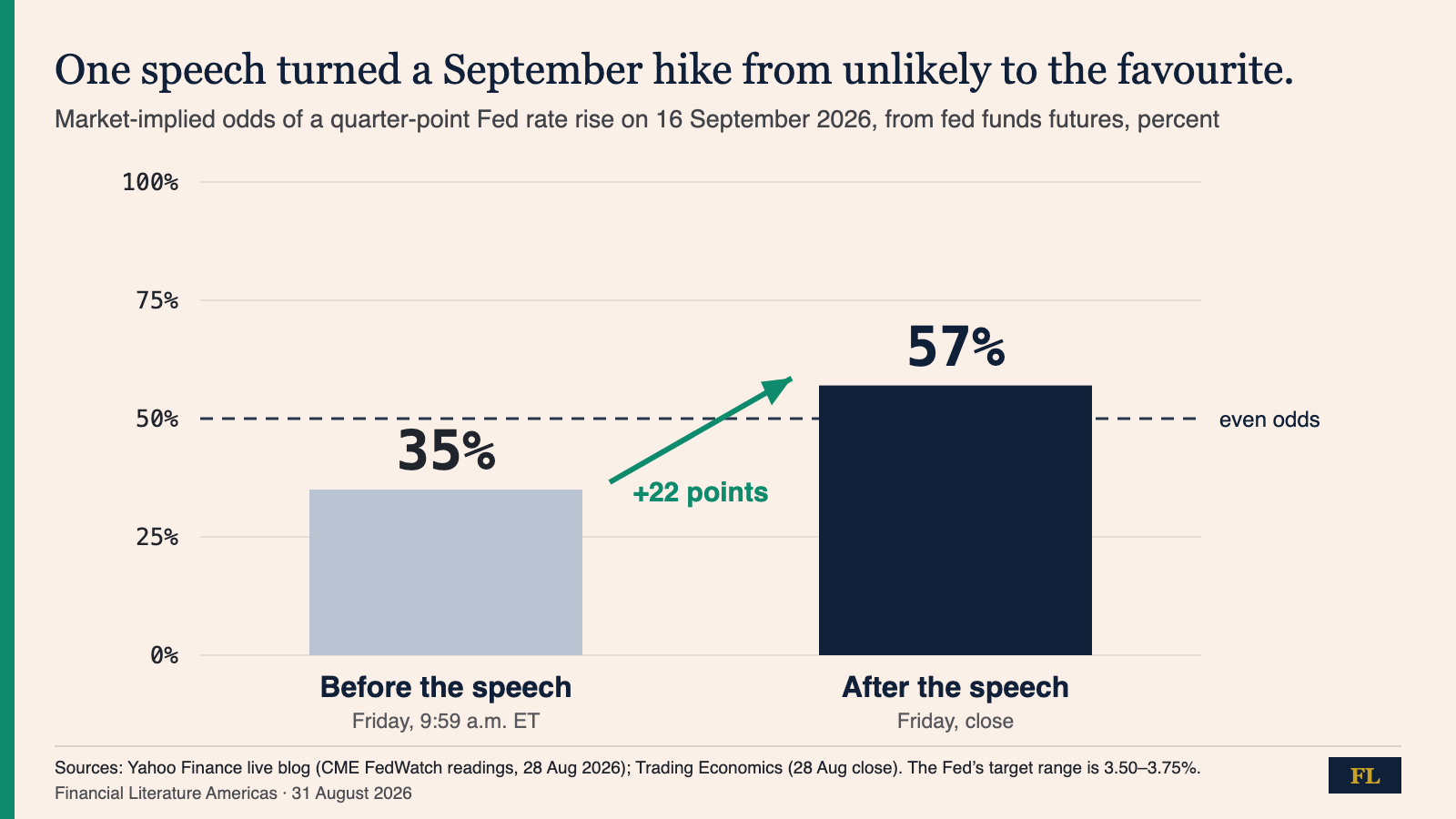
How to read this: read the dashed 50% line first; a bar below it means the market leans to no change, a bar above it means it leans to a move, and a bar near it means the market is split. Then read the size of the jump, not the level: 22 points in one session measures how much the speech surprised, and a reading that moves that far can move back as far on Friday’s jobs report. A probability is never a decision; only the Fed’s statement on 16 September is.
📅 Tomorrow
Monday has no major US data. Tuesday brings ISM manufacturing and July job openings at 10 a.m. ET. Wednesday the Bank of Canada decides at 9:45 a.m. ET, expected to hold at 2.25%, then the Fed’s Beige Book; Thursday ISM services and jobless claims; Friday, 4 September, the August jobs report at 8:30 a.m. ET, after July’s 23,000 fall, with forecasts collected by Trading Economics and Investing.com running from about 40,000 to 80,000. US markets close Monday, 7 September, for Labor Day; the Fed meets on 15–16 September. Canada’s matching tariffs start 8 September; the 50% auto and steel tariff is dated 1 January 2027 (our 24 August issue).
One question. Today’s chart showed the market-implied odds of a September rate rise moving from 35% to 57% during one speech. Which reading is right? A: The Fed has decided to raise rates on 16 September. B: Traders now price a rise as slightly more likely than not, and the number will keep moving with each data release until the meeting. C: The Fed raised its rate by 0.22 percentage points on Friday.
We explain; we never advise. Nothing here is investment advice.
Financial Literature is for educational and informational purposes only. Nothing here is investment, financial, legal, or tax advice, or a recommendation to buy or sell any security. Content is impersonal and not tailored to any individual. Data may contain errors — verify before relying on it. Sources: AP (Friday closes, via Yahoo Finance); S&P 500; Nasdaq; Dow; Russell 2000; Yahoo Finance live blog (FedWatch, yields); Federal Reserve (Chair Warsh, “In Our Time”); Reuters via Yahoo Finance (dollar); 10-year; DXY; USD/CAD; USD/MXN; Brent; payrolls; Michigan sentiment; CP24 (Canadian Press, Canada GDP); Bank of Canada; AP via BNN Bloomberg (Monday futures, oil, 2-year); The National (oil, Iran); Motley Fool (PayPal); Al Jazeera (Canada tariffs); Schaeffer’s week ahead; Investing.com week ahead; NYSE calendar.
Friday’s issue, one stock lifted the board while the average stock fell, is the habit this one builds on.
Forwarded this by a friend? Subscribe here. Found it useful? Forward it to one person who’d want it.
— The Editorial Team