🌎 3.7% — inflation ran a tenth hot; Nvidia guided a year ahead
PCE 3.7% beat by a tenth, core 3.3% in line, the boards closed flat. After the bell Nvidia guided $108bn and 70% growth next year. Warsh speaks Friday.

Compiled Thursday, 27 August 2026, about 7:30 a.m. in New York (Eastern Time), before the opening bell. A 3-min read. Stock index rows are final Wednesday closes, cross-checked against two settled sources; bond yields, currencies and oil trade around the clock, so those rows are Thursday-morning snapshots and labeled as such.
The Fed's preferred inflation gauge came in at 3.7%, a tenth hotter than forecast; the boards closed where they started, and the day's real number arrived after the bell, when Nvidia guided a year further ahead than it ever has.
📊 The Dashboard — Wednesday, 26 August 2026 (closes)
| Gauge | Level | Move | What this means |
|---|---|---|---|
| S&P 500 (500 big US firms) | 7,675.70 | ⚪ ▼ −0.0% | Final. Down 1.58 points, less than 0.1%; Investing.com's settled quote agrees to the cent (−0.02%). A waiting day; +12.1% for the year. |
| Nasdaq Composite (tech-heavy) | 26,130.20 | ⚪ ▼ −0.1% | Final. Down 21.10 points (−0.08% settled). Nvidia fell 1.6% in the regular session ahead of its results. |
| Dow (30 blue-chip firms) | 53,463.88 | 🔴 ▼ −0.2% | Final. Down 113.52 points (−0.21% settled), ending a three-day run of gains. Still +0.4% on the week, alone among the four. |
| Russell 2000 (2,000 smaller firms) | 3,005.90 | ⚪ ▼ −0.1% | Rotation row, final. Down 4.12 points (−0.14% settled), just above 3,000 and still +21.1% for the year, the best of the four. |
| US 10-year Treasury yield | ≈4.67% | 🔴 ▲ edging up | Thursday snapshot. About 4.67%, up roughly 2 basis points after the hotter headline inflation number; the 2-year sits near 4.24%, the 30-year near 5.19%. |
| Dollar index (DXY) | ≈99.2 | ⚪ ▲ ≈+0.1% | Thursday snapshot. Just above 99 for a fourth morning, firmer after Wednesday's data: hotter inflation nudges rate expectations up, and higher expected rates tend to lift a currency. |
| USD/CAD | ≈1.388 | ⚪ ≈ flat | Thursday snapshot. About 1.388, the Canadian dollar still off last Thursday's three-month high of 1.376 as the tariff exchange weighs on growth. A rising pair means a weaker Canadian dollar. |
| USD/MXN | ≈16.99 | ⚪ ▲ ≈+0.2% | Thursday snapshot. About 16.99, the peso giving back a little of the two-year high we noted yesterday; Mexico's 6.50% policy rate is unchanged, so a pause, not a turn. |
What happened, in plain words
Three reports landed at 8:30 a.m.; the one that mattered was a tenth of a point. The PCE price index — the inflation measure the Fed actually targets — rose 0.2% in July and 3.7% from a year earlier against a 3.6% forecast. The core index, which strips out food and energy, rose 0.2% on the month and 3.3% on the year, exactly as forecast. Beneath the prices, households earned more than they spent: personal income rose 0.4%, disposable income 0.5%, spending 0.2% — services up $86.2 billion, goods down $49.9 billion. Adjusted for inflation, spending grew less than 0.1%: real consumption stood still.
The other two reports were firmer. Second-quarter GDP stayed at 1.5% annualized in its second estimate, down from 2.1% in the first quarter, but the revision underneath was upward: final sales to private domestic purchasers — growth with trade, inventories and government stripped out — rose 4.2%, three tenths better than first thought. July durable-goods orders jumped 1.1% against a 0.5% forecast. Read together: prices a touch hot, income solid, real spending flat, factories busy. Futures priced the September meeting at nearly 62% for a hold in the 3.50–3.75% range, little changed from Tuesday — the print moved the odds at the edge, which is why the 10-year moved 2 basis points and the S&P 500 moved 1.58 points.
Then, after the close, the number the market had waited for since Monday. Nvidia reported revenue of $96.2 billion, up 106% from a year ago, with $89.0 billion of it from data centers and a forecast of $108.0 billion, plus or minus 2% for the current quarter — with no data-center compute revenue from China assumed. The shares fell as much as 3% after hours, then reversed to trade up as much as 5% — the turn came when finance chief Colette Kress said revenue should grow by around 70% in fiscal 2028, against the roughly 44% analysts had modelled — on Fortune's arithmetic, $690–700 billion against about $570 billion in the models. Chief executive Jensen Huang said "our supply allows us to confidently deliver 70%" even though demand is higher; Kress met the critics of the loans and stakes Nvidia extends to its own customers head on: "we know some will call this circular financing. We see it differently." Abercrombie & Fitch soared 36% and Salesforce surged 13% after hours taught the same lesson in smaller print: the price moves on the gap between the number and the expectation, not on the number.
⭐ Spotlight: the personal saving rate — 3.0%
Each month the BEA subtracts what households spent from their after-tax income and expresses the remainder as a share of that income. In July the saving rate was 3.0%: of every $100 of disposable income, $3 went unspent. Watchers track it because it is the cushion under consumption: when income growth slows, a thick cushion keeps spending going and a thin one cannot. July's income up 0.5% against spending up 0.2% thickened it slightly, from a thin base. We could not verify a long-run average from a primary source this morning, so we describe the level, not its rank; the habit is to watch which way it moves.
📈 Chart of the Day — two rulers
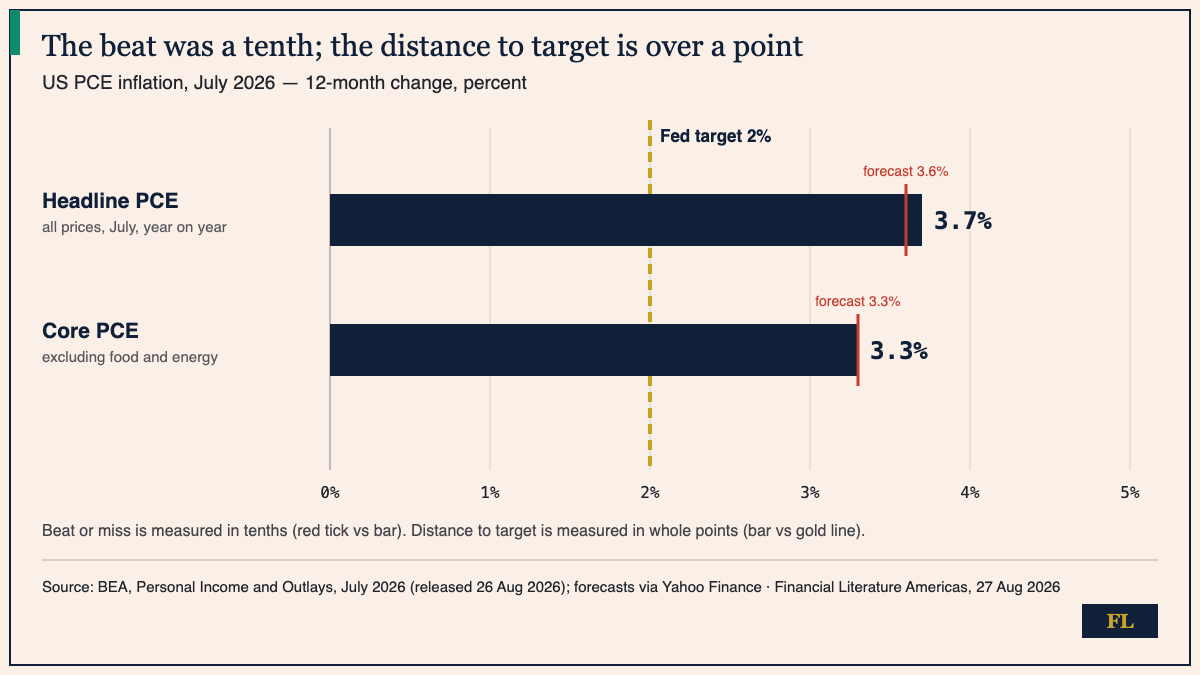
How to read this: an inflation headline carries two measurements at once. The red tick against the bar is the ruler markets trade on for a day — was it above or below the forecast, and by how much — and it is marked in tenths. The gold line is the ruler the Fed is judged on, and the bars sit 1.3 to 1.7 points away from it. When a report is called "hot" or "in line," ask which ruler the writer is holding; Wednesday's 1.58-point index move says the market was reading the first.
📅 Tomorrow
Thursday at 8:30 a.m. ET brings weekly jobless claims — about 210,000 expected, after 206,000 last week — and the July goods-trade balance, as Jackson Hole opens. The main event is Friday: Fed Chair Warsh's first keynote there, at 10 a.m. ET — MNI and Newsquawk, both dated 20 August, agree on the time. Watch whether he separates the inflation reading from the growth one, as the bond market did on Wednesday. Brent sits near $88 after three days of losses — the input that decides whether the headline-versus-core gap widens or closes next month.
We explain; we never advise. Nothing here is investment advice.
Financial Literature is for educational and informational purposes only. Nothing here is investment, financial, legal, or tax advice, or a recommendation to buy or sell any security. Content is impersonal and not tailored to any individual. Data may contain errors — verify before relying on it. Sources: AP (Wednesday closes, via The Epoch Times); Investing.com settled quotes (S&P 500, Nasdaq, Dow, Russell 2000); BEA Personal Income and Outlays, July 2026; BEA GDP second estimate, Q2 2026; Yahoo Finance (forecasts); RTTNews; NVIDIA; Fortune; investingLive; Yahoo Finance live blog; Motley Fool (FedWatch); Trading Economics (10-year, DXY, USD/CAD, USD/MXN, Brent); FXStreet; Investing.com calendar; MNI, Newsquawk.
Forwarded this by a friend? Subscribe here. Found it useful? Forward it to one person who'd want it.
— The Editorial Team