🌎 4.474% — what America paid for three-year money, and who actually lent it
The Dow fell 628 points on Tuesday and Brent went above $100 this morning. In between, the Treasury sold $58bn of three-year notes at 4.474%.

Compiled Wednesday, 9 September 2026, about 7:20 a.m. in New York (Eastern Time), before the opening bell. A 4-min read. The four index rows are Tuesday's closes. Yields, currencies and oil trade around the clock, so those rows are Wednesday-morning snapshots and were still moving as this was written.
Yesterday's answer: B — because each index is built for a different question. The CPI prices a fixed urban household basket, the PCE index prices everything consumed on households' behalf, and the PPI prices what producers receive. The spread between them is normal, and the Fed's 2% goal is written on the PCE index alone.
Brent crude traded above $100 a barrel this morning, its first time there since July. Behind that noisy number sits a quiet one from Tuesday afternoon. The United States government sold $58bn of three-year notes, and to place them it had to promise buyers 4.474% a year, the most it has paid at a three-year sale since June 2024. The same machinery runs again at 1 p.m. Eastern today, for $39bn of ten-year debt.
📊 The Dashboard
| Gauge | Level | Move | What this means |
|---|---|---|---|
| S&P 500 (500 big US firms) | 7,673.52 | 🔴 ▼ −0.58% | Tuesday's close, a second fall in a row. |
| Nasdaq Composite (tech-heavy) | 26,421.41 | 🔴 ▼ −0.32% | Tuesday's close. Chipmakers held up: Qualcomm rose 3.2% while the board fell. |
| Dow (30 blue-chip firms) | 52,786.07 | 🔴 ▼ −1.18% | Tuesday's close, 628 points lower. One member, Amgen, fell about 10%. |
| Russell 2000 (2,000 smaller firms) | ≈2,961 | 🔴 ▼ about −0.5% | Tuesday's close. Smaller firms sell mostly at home, and fell by less than the Dow. |
| US 10-year Treasury yield | 4.81% | ⚪ ▲ +1 bp | Wednesday morning, a basis point above Tuesday's 4.80% close, and in the highest band of the past year. |
| US 2-year Treasury yield | 4.39% | ⚪ ▲ +2 bp | Tuesday's close on the same table, from 4.37% on Friday. The two-year tracks what traders expect the Fed to do. |
| Dollar index (DXY) | 98.75 | ⚪ ▼ barely moved | Wednesday morning, a shade below Tuesday's 98.78. A dearer barrel has not lifted the dollar this week. |
| USD/CAD | 1.3777 | ⚪ ▼ loonie firmer | Wednesday morning. Canada exports oil, so a rising crude price usually supports its currency. |
| USD/MXN | 16.91 | ⚪ ▼ peso firmer | Wednesday morning, near the strong end of the peso's range for the past year. |
| Brent crude | $100.69 | ⚪ ▲ +2.8% | Still trading, and moving fast. Above $100 for the first time since July, from a $97.92 close on Tuesday. |
What happened, in plain words
Iran-aligned Houthi forces attacked Saudi energy installations, and Saudi Arabia's energy ministry said operations at several oil facilities had been suspended. Oil rose on Tuesday and has kept rising this morning. American shares fell, but unevenly: the Dow lost 628 points while the Nasdaq lost 0.32%, and most of that gap came from health care. Amgen dropped about 10% and Novartis's US-listed shares fell 13.9% after a late-stage trial of the heart drug pelacarsen disappointed, while Boston Scientific fell 5.9% on a summer cybersecurity incident it said would cost it its guidance. The Dow weights its 30 members by share price, so one expensive stock having a very bad day moves it more than it moves the wider boards.
All of this lands a week before the Federal Reserve decides. Interest-rate futures put the chance of a quarter-point rise on 16 September at 60.4%, against 39.6% for no change, on one monitor at 6:55 a.m. Eastern. That is firmer than the 58.7% the same tool showed yesterday morning, and it is what a bond auction has to price around.
⭐ Spotlight: the three-year note auction, 4.474%
The government does not set the rate it pays. It runs an auction. On Tuesday the Treasury offered $58bn of notes maturing in September 2029, carrying a fixed coupon of 4.375%. Bidders submitted the yield each would accept, the Treasury filled the lowest yields first until the $58bn was placed, and the yield of the last bid it needed became the price everyone pays: 4.474%. Because that sits above the coupon, the notes went out slightly below face value, at $99.72 per $100.
Bids totalled $157.9bn, or 2.72 times the amount on offer. That cover ratio has barely shifted all summer: 2.60 in July, 2.71 in August, 2.72 now. The yield has not sat still at all, climbing from 4.179% in July to 4.291% in August to 4.474% on Tuesday. Same borrower, same size, nearly 30 basis points dearer in two months.
📈 Chart of the Day
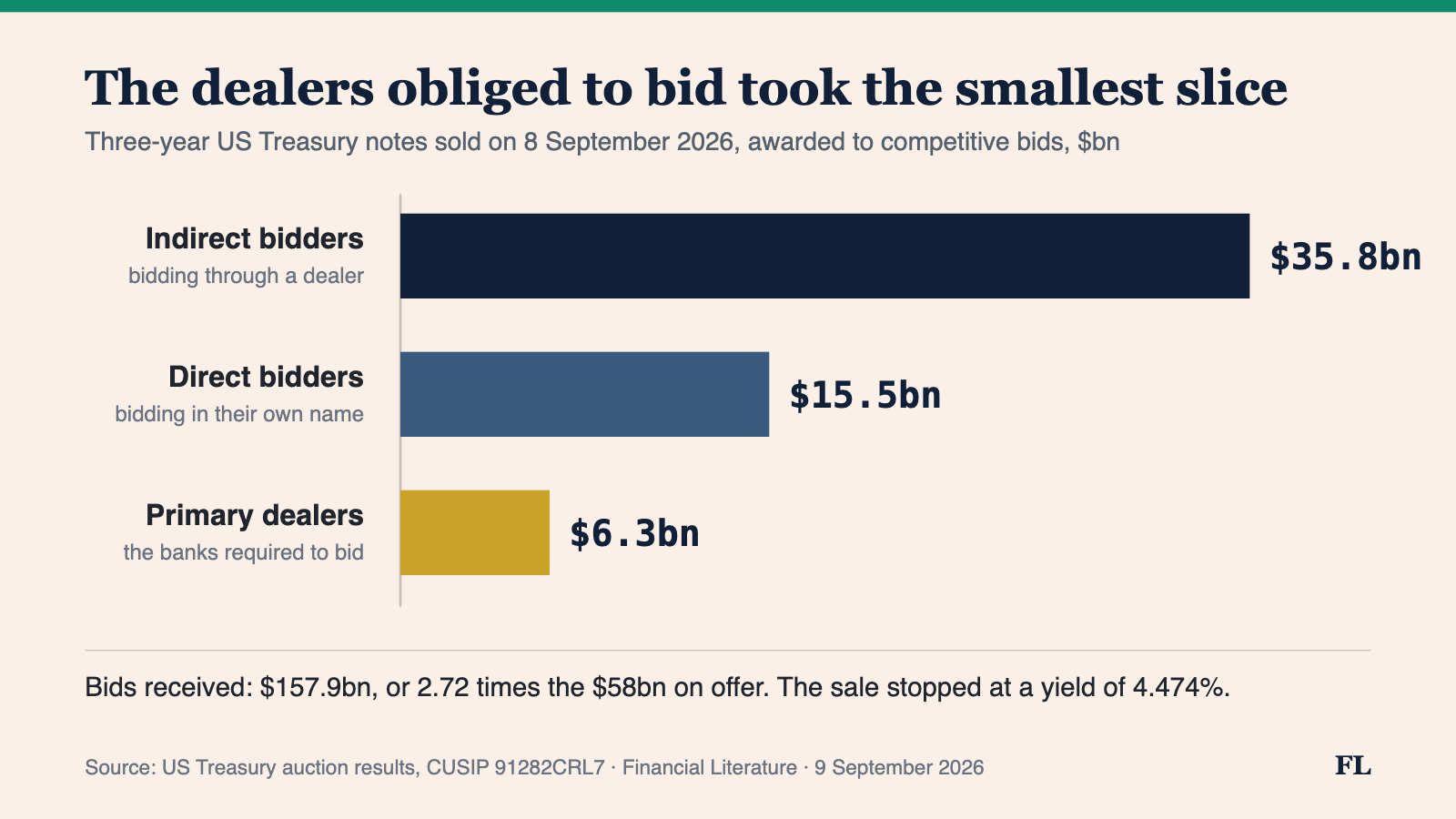
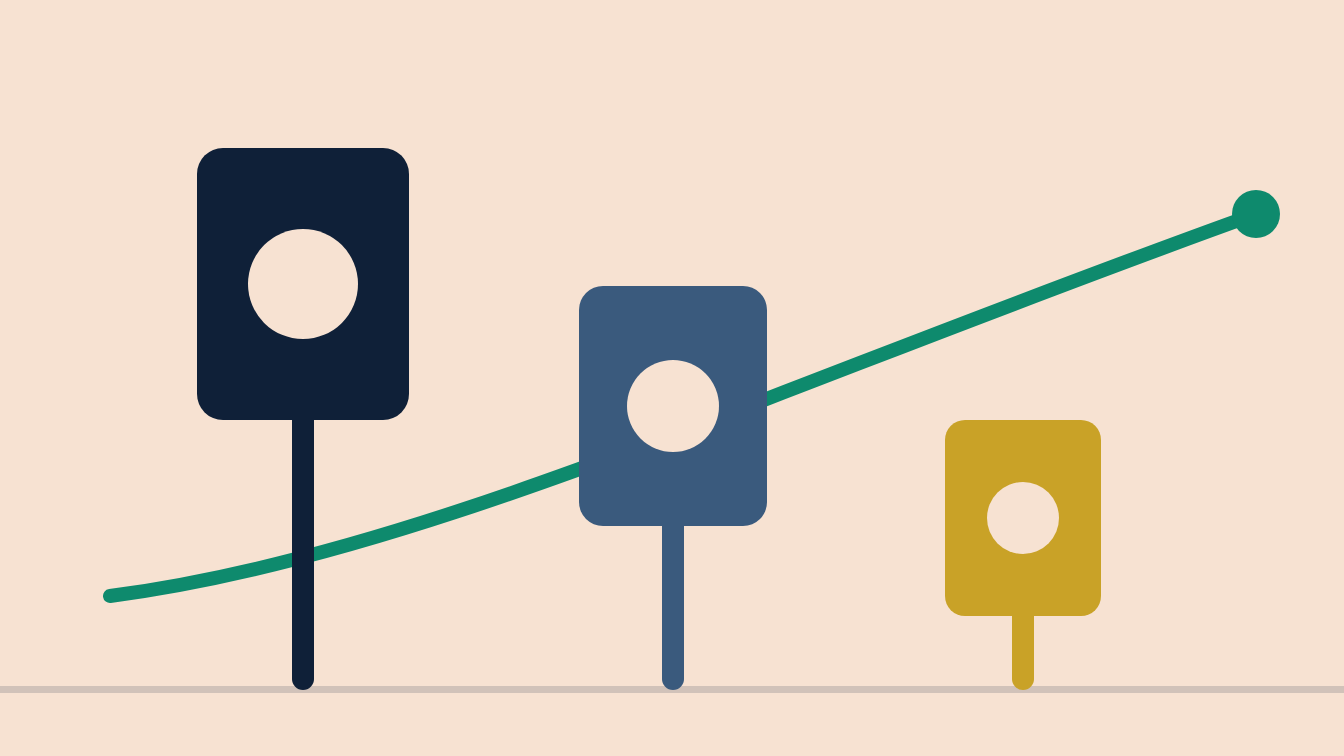
How to read this. Read the cover ratio first, and read it as a headcount of dollars rather than a price. A sale covered 2.72 times tells you how much money turned up; what that money charged is the stop yield, and the two can move in opposite directions. Then read the allotment, which is the part the headlines skip. Primary dealers are the two dozen firms obliged to bid at every auction, which makes them the buyer of last resort: left holding a small share, as with Tuesday's $6.3bn, the rest of the sale went to other bidders, and when their share swells the sale leaned on them. Finally, treat the indirect line as a rough proxy for overseas demand rather than a measurement of it. It counts bids routed through a dealer on a customer's behalf, and that customer may be a foreign central bank or a pension fund three miles from the Treasury. All of it is published free, auction by auction, with the recipes for pulling it on our US Treasury on the Data Catalog page.
📅 Tomorrow
Producer prices for August land at 8:30 a.m. Eastern on Thursday, per the BLS schedule, and the Treasury reopens the 30-year bond at 1 p.m. Consumer prices follow on Friday. The line to watch on Thursday is producer energy, which ran 18.2% above a year earlier in July: August is the month the barrel went past $90, so much of that move should turn up in what producers were charged.
One question. Today's chart showed a $58bn three-year note sale that drew $157.9bn of bids, with primary dealers awarded $6.3bn of it. Which reading is right? A: a cover ratio of 2.72 means buyers paid 2.72 times face value for the notes. B: the cover ratio counts dollars bid against dollars offered, and the small dealer share means other bidders absorbed most of the paper. C: dealers taking the smallest share means the sale failed.
Forwarded this by a friend? Subscribe here. Found it useful? Forward it to one person who'd want it.
We explain; we never advise. Nothing here is investment advice.
Financial Literature is for educational and informational purposes only. Nothing here is investment, financial, legal, or tax advice, or a recommendation to buy or sell any security. Content is impersonal and not tailored to any individual. Data may contain errors, so verify before relying on it. Sources: TreasuryDirect auction results; US Treasury daily par yields; BLS release schedule; InvestingLive; Associated Press via WTOP; Investing.com; Trading Economics.
— The Editorial Team