🌍 €21.3bn — Germany's surplus widened because imports fell 5.7%
July's trade surplus was the widest since August 2024. Exports fell 0.8%, imports fell 5.7%. A balance can widen for two very different reasons.

Compiled Tuesday, 8 September 2026, at about noon in Frankfurt (CEST, UTC+2), a 5-min read. Index rows are Monday's closes, final. The currency and bond rows are Tuesday snapshots, still trading, and say so.
Yesterday's answer: B — because an order is recorded in the month it is signed and may be filled months later, while production counts only what was actually made, so a plant shutdown can cut output in the same month the order book fills.
Germany sold a little less abroad in July and bought a great deal less. Exports fell 0.8% on the month to 138.2 billion euros and imports fell 5.7% to 116.9 billion, leaving a trade surplus of 21.3 billion euros against 15.4 billion in June. That is the widest monthly surplus since August 2024, and forecasters had looked for about 16 billion. Today's lesson is what a balance can tell you, and what it cannot.
📊 The Dashboard, Monday, 7 September 2026 (closes)
| Gauge | Level | Move | What this means |
|---|---|---|---|
| STOXX 600 (pan-Europe) | 649.90 | ⚫ unchanged | Final: Investing.com and MarketScreener, from 649.88 on Friday. Tuesday morning about 648, a third of a percent lower, still trading. |
| DAX (Germany) | 26,006.53 | 🔴 ▼ -0.15% | Final: Google Finance and Investing.com. Tuesday morning 25,844.90, down 0.6%, still trading. |
| FTSE 100 (UK) | 10,822.13 | 🔴 ▼ -0.08% | Final: Google Finance and Investing.com. Tuesday morning 10,783.78, still trading. Britain's shoppers slowed in August, below. |
| AEX (Netherlands, rotation row) | 1,115.42 | 🟢 ▲ +0.17% | Amsterdam's 25 largest listings, heavy in chip equipment and energy. Final: Google Finance and Investing.com. A small index moves with a few very large names. |
| EUR/USD | 1.1622 | ⚫ unchanged | Monday's ECB reference rate, the same figure as Friday's. Tuesday, still trading: 1.1613. The euro is sitting still into Thursday. |
| GBP/USD | ≈1.353 | 🔴 ▼ pound a touch softer | Tuesday snapshot, still trading: 1.3530, from 1.3539. |
| Bund 10Y yield | ≈3.39% | 🔴 ▲ +1 bp | Tuesday snapshot, still trading: 3.3929%, from 3.3835%, near a 15-year high. Red because a higher yield means a lower bond price. |
| Gilt 10Y yield (UK) | ≈5.20% | 🔴 ▲ +2 bp | Tuesday snapshot, still trading: 5.2008%, from 5.1802%, below last Wednesday's 5.28%. |
What happened, in plain words
The fall in imports was broad rather than one bad line. Goods bought from other EU countries dropped 6.1% to 59.6 billion euros and goods bought from outside the EU dropped 5.3% to 57.4 billion, with imports from China down 7.5% to 15.2 billion. On the selling side the destinations pulled in different directions: exports to the United States rose 19.1%, while exports to China fell 9.5% and exports to the United Kingdom fell 7.2%. Over the first seven months of the year the surplus came to 125.8 billion euros, against 122.8 billion in the same stretch of 2025, so the year is running a little wider than last year rather than dramatically so.
In Britain, shoppers pulled back. Total retail sales in the four weeks to 29 August were 0.7% higher than a year earlier, down from 1.3% in July and below the 1.6% average of the past year; food sales rose 2.6% and non-food sales fell 0.8%. The trade body put it down to household bills leaving less room for anything discretionary.
Energy did the rest of the morning's work. Brent crude traded close to 99 dollars a barrel, up about 2%, on reported attacks on Saudi energy facilities and renewed disruption fears around the Strait of Hormuz. Dearer oil feeds the prices the European Central Bank is trying to bring down, and euro-area bond yields pushed higher again on Tuesday, with the two-year Schatz near 2.98%. The Governing Council meets on Wednesday and Thursday in Berlin, hosted by the Bundesbank; all 65 economists in a Reuters poll expect the deposit rate to rise a quarter point to 2.50%, and roughly nine in ten expect it to stop there.
⭐ Spotlight: exports to the United States, 14.4 billion euros
A bilateral export line counts the goods one country sent to one other country in a month. The United States was again the largest single destination for German goods in July, at 14.4 billion euros, 19.1% more than in June and 28.3% more than in July 2025. Trade economists and finance ministries watch these lines because they are the closest thing to a monthly reading on how one trade relationship is changing, and this one has been changing: the same office reported in May that Germany's first-quarter surplus with the United States had fallen 30.5% from a year earlier, to 12.4 billion euros, with exports down 12.1% after Washington imposed high tariffs on many imports in 2025, motor vehicles among them. One strong month does not undo a quarter like that, and a monthly bilateral figure is small enough that a few large shipments can turn it. Watch the run of months, not the month.
📈 Chart of the Day: the surplus was made on the import side
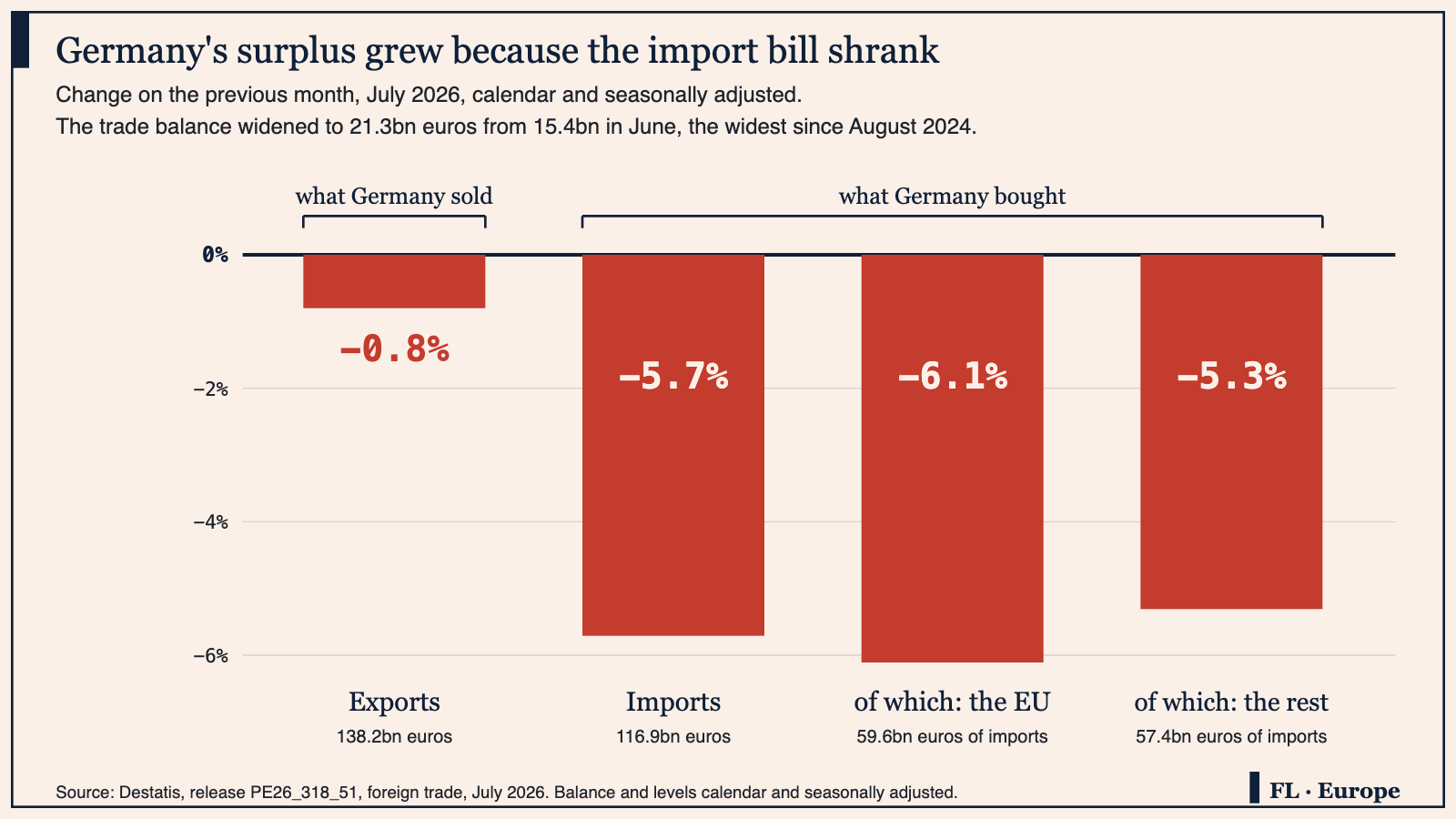
How to read this: a trade balance is a subtraction, exports minus imports, so it can widen for two opposite reasons. Selling more abroad widens it. Buying less from abroad widens it too, and that is what happened here: the import bill fell about seven times as fast as the export line, and the last two bars show the fall was broad, inside the EU and outside it. When a surplus grows, look at which of the two numbers moved, because a country that buys less is telling you something about its own demand, not about foreign appetite for its goods. Yesterday's letter read the same month from the factory floor.
📅 Tomorrow
ECB President Christine Lagarde speaks on Wednesday afternoon, and the rate decision itself lands on Thursday at 12:15 in Berlin, with the press conference at 12:45. With a quarter-point rise widely expected, the sentence to read is the one about what comes next, not the number. Last Thursday's letter showed the energy costs feeding into it.
One question. Today's chart showed German exports down 0.8% in July, imports down 5.7%, and the trade surplus widening to 21.3 billion euros. Which reading is right? A: The surplus widened because Germany sold more abroad. B: The surplus widened because the import bill fell far faster than exports, so the gap between two shrinking numbers grew. C: A wider surplus always means a stronger economy.
Financial Literature is for educational and informational purposes only. Nothing here is investment, financial, legal, or tax advice, or a recommendation to buy or sell any security. Content is impersonal and not tailored to any individual. Data may contain errors, verify before relying on it. We explain; we never advise. Sources: Destatis, European Central Bank, Google Finance, Investing.com, MarketScreener, Trading Economics, FX.co, InvestingLive, Retail Gazette, RTE.
Forwarded this by a friend? Subscribe here. Found it useful? Forward it to one person who'd want it.
— The Editorial Team